Breaking News
COVID-19: The Latest

Jefferson County’s potential reopening process discussed

By ANDREW GRIMM 7 min read
SAFE DISTANCE — The Jefferson County Board of Health met on Tuesday inside the Towers Building with members wearing masks and keeping distance from one another. -- Andrew Grimm

STEUBENVILLE -- What does a potential reopening look like locally? The Jefferson County Board of Health began discussing that question at its monthly meeting Tuesday morning.

According to county Health Commissioner Nicole Balakos, the state's plan is to begin the reopening process on May 1 when Gov. Mike DeWine's current stay-at-home order is set to end.

"As it looks in the conversations we have had with the governor's office, the Ohio Department of Health and the health commissioners, it looks like there is going to be a great deal of latitude to the local counties as we make decisions about businesses and communities in the event of opening up," Balakos said.

Members of the board pondered a lot of questions about how that process will work locally and across the state.

"If a restaurant wants to open, who approves their plans?" Dr. Patrick Macedonia asked.

"We need a plan, we can't do one thing for this business and something different for another," he said. "We have to be consistent."

Balakos said the approaches will vary county to county across the state and be adjusted depending on the number of cases, hospitalizations and ICU admissions in a particular county, and will be based on guidelines from DeWine's office.

"What we're expecting is every three weeks we're going to have a reset based on our case numbers," she said. "As we see, OK we did this for a couple weeks, what was the impact on the community?"

The guidelines from the state are not yet available to the county and will likely continue to change before May 1, according to Balakos.

"What they are telling us is that local health departments are going to be the enforcement officers," Balakos said. "There is going to be quite a lot of latitude at the local level on how decisions are made, and it is going to be on a county-by-county basis, and it will vary as your case load changes."

"It is going to be very fluid," she added. "There are going to be changes coming out every day."

Everything from restaurants to graduations and outdoor events and where certain things fall in the different phases of the federal government's guidelines were discussed.

"When you think of the things that are coming right up, people want answers," Balakos said.

The difference county-to-county in the local area was a topic of discussion.

"Our (county plan) will be very different from Harrison and very different from Columbiana," Balakos said. "Because we are a border county, our plan will be different from an interior county. There are a lot of variables that have to come into play."

"If you drive up to have dinner in East Liverpool, the rules are going to be different than here in Steubenville, and different in St. Clairsville and in West Virginia," Dr. George Van Weelden said.

Balakos noted the decisions have to focus on consumer safety.

"We have to help provide the guidance so that the customer feels safe," she said. "If the customer doesn't feel safe, they are not going to go out. A lot of that is communication with the businesses about what are the best practices and what are other places doing that are successful."

The board will hold a special meeting at 7 p.m. on April 29 to form plans based on the anticipated guidelines from the governor.

Macedonia asked for local officials and law enforcement to be informed of the plans to keep the county officials "on the same page."

"We have to have a game plan, (the board) has to be OK with it, and then present it to everybody," Clark Crago said.

An update from the board of health said there are 32 confirmed cases in the county as of Tuesday afternoon, with five probable cases, 15 recoveries and one death.

It was said during the meeting there have been nine patients that have been hospitalized.

"It can change very quickly," Balakos said.

In her monthly report, Balakos praised the local media -- including the Herald-Star -- for helping get information to the public during the ongoing pandemic.

"With the quickly evolving information and overload of data, having that local voice is critical to our citizens," she said. "The blessing of local media is critical to our messaging."

She called the last two months "a whirlwind" for the department.

"We have adapted our behaviors in ways our society hasn't seen since 9/11," Balakos said, before detailing the ways the county department has reacted to the pandemic.

"Our community has rallied around us in our time of need, and the employees are working tirelessly," she said.

She noted the county department has received messages of praise for its "transparency and communication" and social media following continues to grow.

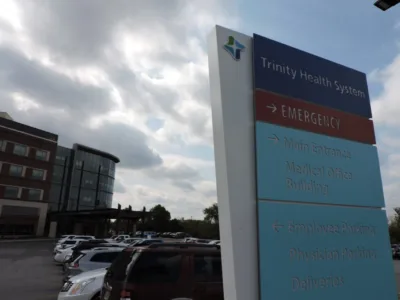
In his monthly report, county Medical Director Dr. Mark Kissinger discussed the collaboration between Trinity Health System and the Franciscan University of Steubenville to form quick, in-house testing at the hospital.

"They increased their capacity and the turn around time is a lot better," he said.

The board revoked its previous resolution declaring a state of emergency in the county. That resolution was part of a consent agenda passed at an emergency meeting on March 31.

The item was moved from a consent agenda to the old business portion of the agenda for discussion by Macedonia.

The reason for revoking it was because the board of health did not have the authority to make the declaration under the Ohio Revised Code section it cited, rather such a move would have needed to be made by the Jefferson County Commission.

The commissioners discussed the resolution with EMA Director John Parker at their April 2 meeting and determined there is not a need for the county to declare a state of emergency because DeWine has already done so for the entire state.

Crago raised the question of possibly testing first responders who might have come in contact with a positive case.

The process for keeping track of who came in contact and how the decision to test those individuals was detailed to him. Balakos noted the guidelines for testing asymptotic individuals is changing rapidly.

"What existed yesterday may change by the end of the day," she said.

Kissinger noted that it could take up to five to seven days after exposure to test positive.

In providing clarification on the process for distribution of personal protective equipment by the county Emergency Management Agency, Balakos said the health department's partnership with the EMA is growing.

Non-COVID-19 topics of discussion included odor complaints from residents near the APEX Landfill. There have been 33 complaints so far in April.

Macedonia raised those concerns, stating the health departments needs to do more.

"We owe these people more than what they are getting," he said. "They have health reasons, personal reasons and financial reasons why they're concerned. We cannot take this any further lightly."

"There are a lot of landfills in this state that do the job correctly," he added. "I'm not against landfills, I'm against the way APEX is being run."

"My opinion has always been, and I have said this many times, APEX sends money to the EPA annually, along with every other landfill," Terry Bell said. "APEX sends probably $4 to $4.5 million a year to the EPA based on tonnage and a tipping fee.

"The old adage, that is like hiring a fox to watch your chicken coop."

Macedonia was asked by Van Weelden to look into further actions the board can take.

Prior to the regular meeting, the board held its annual reorganization meeting. Bell was elected president of the board, and Macedonia was elected vice president.

Committee chairs will be appointed by Bell at a later date.

Dr. Frank Petrola was absent from the meeting and did not participate by phone.

The next regular meeting will be at 8:15 a.m. May 19.

Starting at /week.