
Sharing surgical technique
Weirton orthopedic surgeon explains innovative ACL procedure
Trending
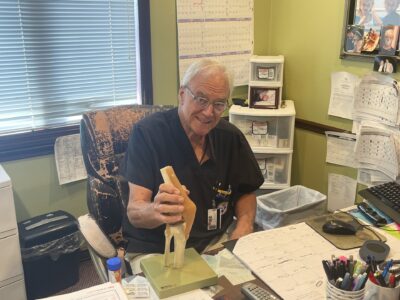
WEIRTON -- A local doctor had the chance to discuss a surgical technique he uses during a recent medical conference.
Dr. Charles Capito, whose practice is based in Weirton, explained that a procedure he has been using can make a repair to an ACL injury stronger.
He said the technique involves getting more tissue to help while reconstructing a damaged knee.
The conference, Capito said, was an annual event held by the Allegheny Health Network that attracts professionals from Pittsburgh and the immediate area. Most of the speakers, he said, came from Allegheny General Hospital. He added that he has a lot of interaction with doctors from the hospital.
"I told them that I have this technique where you can get twice as much tissue," Capito explained.
He added that when he was doing an allographic surgery -- using tissue from a deceased donor -- he would get a whole patella tendon and tubercle, which connects the kneecap to the shin. It's about 30 millimeters wide, and you would take about 10 millimeters out.
"So, I thought that, maybe, maybe you could get more tissue," he said.
Capito said the technique does not reduce the recovery time for an ACL tear, which can occur when you bend or twist your knee beyond its natural limit. It does, however, make the repair a little stronger.
"Instead of 10 millimeters, you get 22 millimeters or 24 millimeters. I think it's just stronger," Capito said.
A Weirton native, Capito graduated from West Virginia University. His training included a residency at Johns Hopkins in Baltimore and fellowships at the University of Virginia and the North Sydney Sports Medicine Institute, where he had the chance to work with a doctor who treated the top rugby players in Australia.
Capito said the recovery time from an ACL injury remains about a year.
"When you put it in, it's stronger than it is two weeks later," he said. "The tissue dies, and then it revascularizes and gets a blood supply to it. It takes eight months to a year for it to be strong. That's why all of the athletes are out for a year."
He added that who that type of procedure is for has changed through the years, explaining that the current recommendation is that young people should have an ACL repair done using material from their own body.
"That knocked out a lot of high school and college kids," Capito added. "But I think it would be good for the older sports guy."
Capito added that while he has not seen a recent increase in ACL injuries, he has noticed another trend.
"In the last 20 years, with girls doing more active sports, we have seen that injury more with girls," he said.
Capito said he thought his discussion had been well received by his colleagues.
"I would like to have a university start using it, because they have more patients," he said.