
Baseball pioneer honored
Fleetwood-Walker mural dedicated
Trending
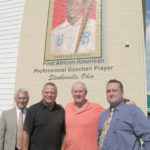
STEUBENVILLE -- The life of Moses Fleetwood Walker, the first African-American to play professional baseball, was remembered Sunday as the community gathered to dedicate a mural in his honor.
The mural, in the 100 block of North Third Street, is beside a mural featuring President Abraham Lincoln. City Mayor Jerry Barilla said Lincoln freed slaves through the Emancipation Proclamation in 1863 and Walker was the first African-American to play professional baseball 21 years later.
Barilla noted Walker is in the Baseball Hall of Fame. Walker was born in Mount Pleasant in 1856 but grew up in Steubenville, attending Steubenville High School and playing baseball on the North End ball field.
Walker faced racial discrimination when he went to the big leagues.
He played baseball while at Oberlin College, then at the University of Michigan and ultimately for the American Association's Toledo Blue Stockings (1883-1884). The team received threats due to Walker's appearance as catcher and he soon had to leave the team. After Walker played his last game for Toledo, no other African-American would play in Major League Baseball until Jackie Robinson broke the color barrier in 1947.
Craig Brown of Salem, a Kent State University, Salem Branch, professor, was instrumental in researching Walker and getting the state Legislature to name Oct. 7 in Walker's honor.
Brown said Moses' brother, Welday, also played for the Blue Stockings, but not at the same time.
The brothers are buried at Union Cemetery. Moses got a tombstone in 1990, with the help of the Oberlin Heisman Club. Welday received a tombstone in 2016, with the help of the Society for American Baseball Research.
Brown said a Moses Fleetwood Walker nutcracker will be added to this year's display at Historic Fort Steuben,
State Rep. David Leland, D-Columbus, who was a co-sponsor of the bill to have Oct. 7 named statewide in honor of Walker, said it was fitting the first observance of the day be held in Steubenville. Brown's students were instrumental in getting the state proclamation for Walker approved after several tries in the Legislature.
Brown said Walker faced bigotry, hatred and discrimination in the 1880s. He said it took 60 years for another African-American to play in the Major Leagues.
"It is a cautionary tale to all of us," Brown said of Walker's attempt to play professional baseball. "It is especially important in the environment we are living in today. But he had it right in 1884. Anyone could play baseball based on their ability. And, then we lost that for more than 60 years. It is a reminder to fight for justice, equality and fair play. We will never be finished. Civil rights is still so important. As long as we keep talking, it lives on."
Brown said Walker is one of the greatest success stories in civil rights for African-Americans.
Mark Palmer of Steubenville is a descendant of Walker. Walker was his great-great uncle. He thanked those at the dedication for the mural and for the recognition Walker has received in Toledo.
State Rep. Jack Cera, D-Bellaire, said this part of Ohio is rich in its history.
"It is great to learn more about the history of the African-American population. It not always gets told. If we don't share that knowledge, it tends to get lost. I don't want that to happen," Cera said.
City native Rich Donnelly, who spent 50 years in professional baseball, including 30 years as a Major League coach, said it is hard to get the Major Leagues for any player.
"I can't imagine how (Walker) got there under the conditions. When you are the first in the world to do something, you are really special. He had enough courage and guts to survive being beat down and yelled at to get to his dream of playing Major League baseball," Donnelly said.
He noted that today minorities make up 39 percent of the rosters of big league teams.
"When (Walker) started, that percentage was lower and it stayed that way for a long time," he said.
Donnelly said he likes to tell kids, especially African-Americans, that Walker walked the streets of Steubenville, went to high school here and played on the ball fields in the city.
"Kids should know the history and what came before them, so they can pass it on," he said.
Donnelly said he grew up with diversity in Steubenville and then went to play ball down south and saw the two separate bathrooms for whites and nonwhites.
Ruston Baker, the artist behind the mural, said he told young kids, walking by as he was painting, to go home and do research on Walker.
Barilla said the next mural project will recognize three city African-American men who were part of the famous Tuskegee Airmen during World War II.