
Holt tells Rotary prevention efforts are saving lives
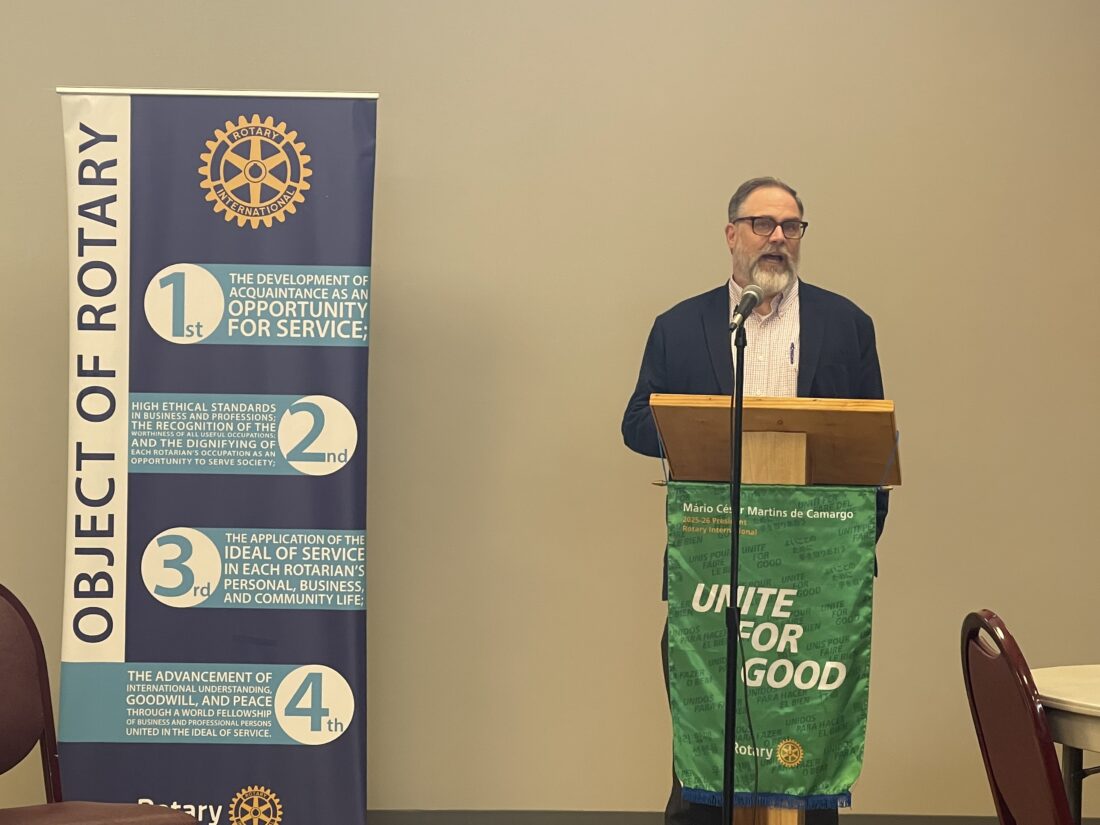
Ross Gallabrese DETAILS WORK — Bill Holt, executive director of the Jefferson County Prevention and Recovery Board, discussed its work with members of the Steubenville Rotary Club.
STEUBENVILLE — When your job involves building and marinating a safety net for behavior health services, members of the community might not always notice the work you are doing.
It’s something Bill Holt understands.
“If we are doing our job well, you don’t know that we exist,” Holt told members of the Steubenville Rotary Club while speaking during Wednesday’s luncheon meeting. “The folks that we serve, you don’t know that we exist, because they are taking their medications, they’re housed, they’re receiving the supports that they need and they are living in the community, being productive members of society.”
Holt has been the executive director of the Jefferson County Prevention and Recovery Board for about six years, he explained. Its purpose is to fund, plan and coordinate mental health services, substance and abuse disorder services and prevention services across the county.
“One of the things I am particularly proud of is that since I have been executive director, we have brought in almost $4 million in grants for the community,” he told Rotarians and their guests who had gathered inside the JeffCo Event Center. “I feel those opportunities are a part of my job to make the system better.”
The board, he added, worked on a statewide initiative with Ohio State University to reduce overdose deaths, and those numbers in our region have generally fallen.
Naloxone, he said, was making a difference in the number of deaths.
Delivered through a nose spray, the opioid overdose reversal drug is available to everyone because it is incredibly safe to administer.
“If someone is not having an overdose, it is not going to hurt them,” Holt said. “It does save lives — it saves lives all of the time.”
By working with members of the community and working with first responders, Holt added, it was learned that one of the worst areas for overdoses in the county was the rest area at the northern intersection of state Routes 7 and 213.
“There were frequent overdoses there,” Holt said.
He added that the board talked with TEMS Executive Director Clark Crago, who confirmed there had been a lot overdose deaths there.
“We had the idea to put naloxone in the rest area,” Holt said. “The state said, ‘No, you can’t do –absolutely not.’ And we said, ‘Why not?’ and they said, ‘I don’t know.’ So, we pushed the state on that and said that there was no reason why this couldn’t just be in the rest area. “Eventually, the state relented, and we stocked naloxone in that rest area,” Holt continued. “That was about four years ago. Now, if you go to any rest area in the state of Ohio, you will find naloxone in those restrooms. We were the first ones in the state to do that.
“We’re really proud of that — we’re really excited that that’s out there for everyone across the state. It really does save lives,” he added.
Working to head off problems is an important part of the board’s work.
“When you think about the problems we are facing as a community, the three main areas that we operate in are mental health, substance abuse disorder and prevention,” said Holt, who worked in behavioral health in the Pittsburgh area before coming the Jefferson County. “I often say that an ounce of prevention is worth a pound of cure. So, if you are able to reach kids before they have serious substance abuse issues or mental health disorders, that makes a huge difference. How do you quantify that — how do you judge success, because you are preventing something from happening?
“There actually is a lot of evidence and of lot of research that supports some of these programs and the reduction in the number of kids using drugs and improved outcomes for kids who face difficulties at home and a lot of other challenges, so we continue to invest heavily in prevention services. They are, to one extent or another, in all of the school districts around the county, some of them more than others,” he added.
Housing, he said, is the biggest investment that can be made in mental health.
“I’m sure all of us have heard recently about the fires in the community, because homeless individuals sneak into abandoned homes and try to stay warm and start fires,” Holt said. “It’s horribly dangerous for that community.”
That’s why housing is a key component.
“If you are able to find stable housing for an individual with a mental illness, you will often prevent some of these tragedies from happening, so a big part of what we invest in is keeping individuals housed and off of the streets,” Holt said. “Then we build support around these individuals.”
Those support services include court-appointed guardians, who help individuals take care of themselves, and court-appointed payees, who manage funds for individuals so they can live in the community and be safe and productive, he added.
He added that while the board has no control over or direct involvement with privately owned substance abuse recovery facilities, such as Milton Jefferson Recovery, which recently opened on Sinclair Avenue, they do try to coordinate with everyone in the community and have talked with them extensively.
“It’s a great opportunity for individuals in our community to have access to treatment,” Holt said.
Holt said the centers also help with economic development.
“Behavioral health care is health care,” Holt said. “This facility employs dozens of people. It’s a huge economic engine for our community. Assuming they continue to do the right thing for the right reasons, it’s going to be a powerful economic engine.”
He added that anyone who has a question, a concern or complaint about the work being done by the board is welcome to stop by the office on Madison Avenue.
“We are here to serve the community,” he said.
Local News
Brooke County grand jury indicts 24
WELLSBURG — Two dozen area residents had initial hearings in Brooke County Circuit Court this week after being ...
Fitness Court installation to begin later this summer

Steubenville community ‘sharing culture and history’ on Juneteenth
History in Conversation: Telling the Mountain State’s story as America turns 250
Residents share memories of fatherly advice
A father serves many roles in the life of a child, often providing valuable lessons and advice through the ...