Jefferson County Historical Association holds annual banquet
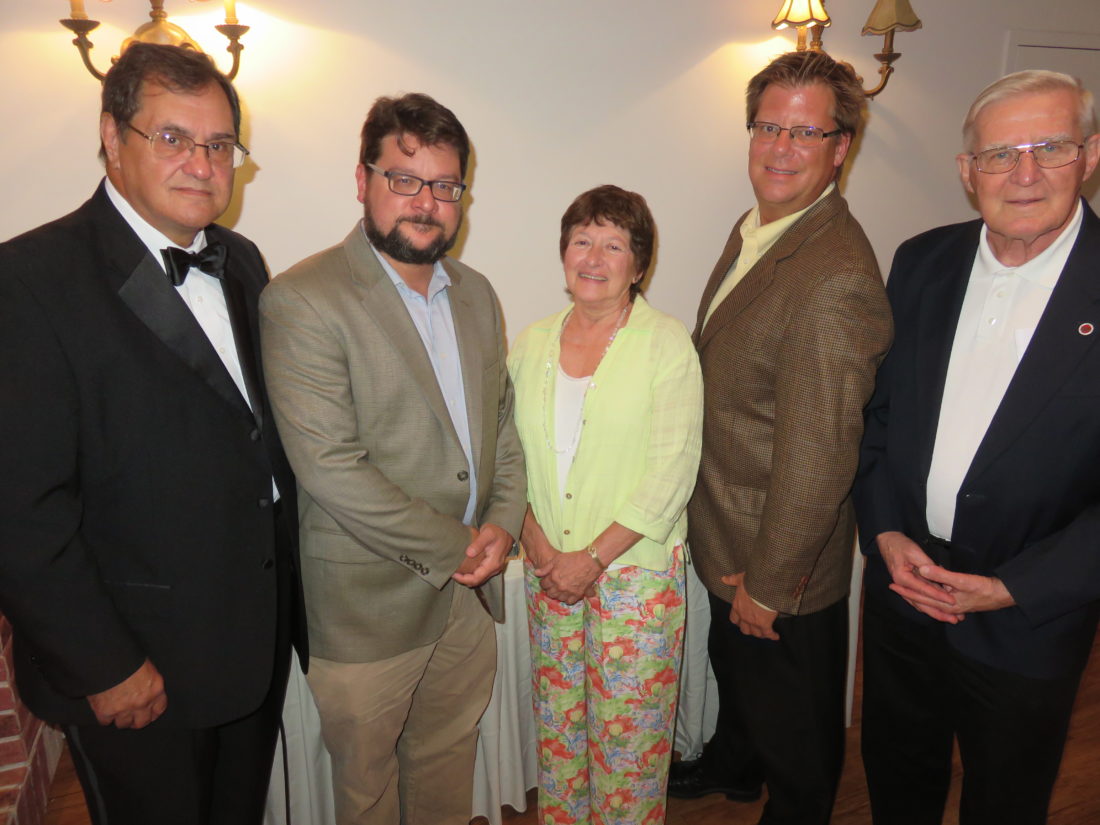
BANQUET HELD — The Jefferson County Historical Association held its annual meeting and banquet Thursday at St. Florian Hall in Wintersville, and among those on hand were, from left, Barry Bardone, master of ceremonies; guest speaker Louis Martin, author of “Smokestacks in the Hills: Rural-Industrial Workers in West Virginia;” Judy Brancazio, association president; Thom Way, secretary and board member; and Charlie Green, second vice president. - Janice Kiaski
WINTERSVILLE — “When we enter our membership drive in the late fall, remember how the Jefferson County Historical Association depends on you,” its president told an audience of about 50 Thursday evening during the group’s annual meeting and banquet held at St. Florian Hall.
While the meeting traditionally brings a review of programs, events and changes at the museum on Franklin Avenue, President Judy Brancazio opted instead to share “facts and figures” to shed insight into finances.
Membership stands at 220 individuals, down from 237 two years ago. “Of this number, 138 reside in Jefferson County or within a very short distance,” Brancazio said. “We have a few members from Hancock County. There are 40 members who live in other counties of Ohio, and 41 members live out of state,” she said, noting that more than half the members are life members.
“Yearly dues are not a primary source of income,” Brancazio said, adding the museum, for example, operates on donations from members and visitors. “Upgrades usually depend on grants or restricted donations.”
Brancazio gave a rundown of expenses, noting building costs average about $2,000 and are “fairly constant.” She said major repairs and upgrades were higher than normal in 2015.
The association needs a minimum of $9,000 “to avoid dipping into the reserve emergency fund,” she said.
“At this point we have received about $7,000, which is a bit above normal. Our members, both life and regular, have always donated generously,” she said.
Brancazio also introduced officers and board members, including Eleanor Naylor, first vice president and past president who remains “a staunch supporter both with her presence and financially.” Charlie Green, second vice president, is the museum director and editor of the quarterly newsletter. Mike Giles has served as recording secretary for the past two years, and Thom Way, the newest board member, is secretary and assistant treasurer.
The association will be losing Susan Probert and Lois Rekowski as board members at the end of the fiscal year, Brancazio said.
“Board members who served this year are Joan Anliker, Barry Bardone, Dr. Howard Brettell, Malvin Lilly, Robert Martin, Betty Masters, Bob Phillipson and Linda Wells,” Brancazio said.
The guest speaker was area native Lou Martin, associate professor of history at Chatham University and chair of the department of history, political science and international studies. The steel industry of the Ohio Valley was the topic for the guest lecturer of 19th century industrialization who resides in Pittsburgh with his wife.
Martin graduated from Oak Glen High School and earned his bachelor’s degree and doctorate from West Virginia University. He has published articles in “Pennsylvania History” and “LABOR: Studies in Working-Class History of the Americas.” His book, “Smokestacks in the Hills: Rural-Industrial Workers in West Virginia,” is published by the University of Illinois Press as part of its Working Class in American History series.
Martin’s book started out as his dissertation when he was working toward his doctorate at WVU.
“It’s about the steel and pottery workers of Hancock County primarily in the ’50s and ’60s, but it looks at how they had a distinctive rural industrial culture,” Martin said. “They combined rural traditions with life in the factory towns. It also explores the origins of the steel and pottery industry in the county and the changes in technology that allowed companies to recruit rural people who had no prior experience working in factories,” he said.
The book, which ends with the decline of the industries after the 1960s, represents years of work and research, according to Martin.
“The first person I interviewed was in 2002. I got my PhD in 2008, and I spent years revising my dissertation to make it more readable, and I eventually got the book published in 2015,” he said of the book that is available on Amazon.com.
Asked to single out something he found most fascinating from his research, Martin said, “I have grown up in the area thinking of the 1950s and 1960s as the golden age, an age of full employment and certainly the region’s economy was booming, but when I talk to people who lived through those times, especially if they were younger workers and didn’t have seniority, they remember that as sometimes a lean time when they faced layoffs and when they worried about unemployment running out, so they talked a lot about making ends meet.”
(Kiaski can be contacted at jkiaski@hrealdstaronline.com.)
Local News
Steel Valley Showroom expands Cedar One’s reach beyond real estate
Local officials alarmed by increase in fatal drug overdoses
STEUBENVILLE — Jefferson County officials are sounding the alarm about an uptick in fatal drug overdoses. Health ...
Bridging the gap: Rails to Trails group sees opportunity in Market Street Bridge
Brain Power
Contributed photos The Steubenville Kiwanis Club held its 14th-annual trivia team competition April 11 in the ...
Holt tells Rotary prevention efforts are saving lives