
Program returning local vaccination insights, addressing gaps
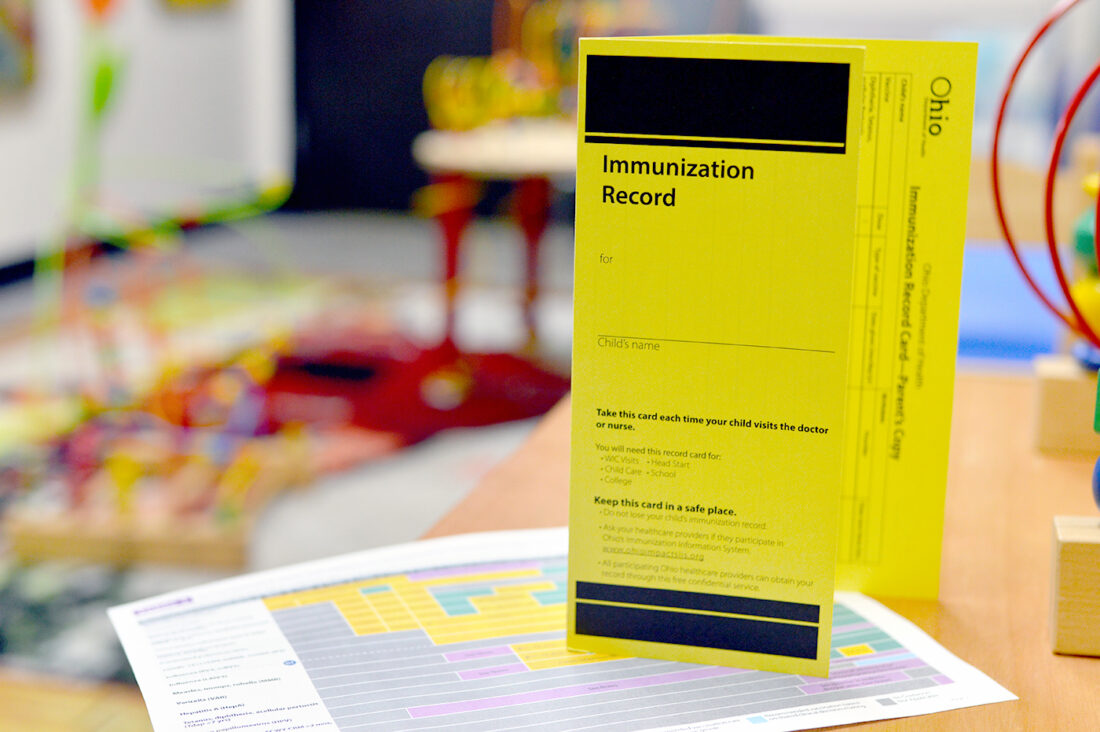
UP-TO-DATE — An Ohio immunization record card and recommended child and adolescent immunization schedule sat on a waiting room table in the Jefferson County General Health District’s Steubenville office. -- Christopher Dacanay
STEUBENVILLE — Data from the Ohio Department of Health shows a continual decline in child vaccine rates in the state.
As reported by The Columbus Dispatch, 86.2 percent of Ohio kindergarteners met all vaccine requirements in the 2023-2024 school year, the ODH found.
That’s down from the 2022-2023 school year’s 86.5 percent and even lower compared to the 2019-2020 school year’s 89.9 percent. Numbers began their descent in the 2020-2021 school year and hit their lowest at 85.6 percent a year later.
That dip and persistent low point has some health officials concerned, particularly as it relates to herd immunity among children in Ohio schools.
Herd immunity occurs when, due to a previous infection or vaccination, a high proportion of individuals in a population is resistant to a disease. That large-scale immunity makes a disease’s spread unlikely within the population, protecting individuals who cannot be vaccinated for reasons such as a weakened immune system.
Ensuring the state’s schoolchildren are up-to-date on their required vaccines and maintaining herd immunity have been priorities of the ODH, which administers Get Vaccinated Ohio.
The cyclical GV program aims to “improve and sustain vaccination coverage among children, adolescents and to reduce vaccination disparities in Ohio,” according to a memorandum for the 2025 GV program. That goal will reportedly be accomplished by “achieving and maintaining 90 percent vaccination coverage levels for universally recommended vaccines among children less than 24 months of age, school aged children and for adolescents.”
After a few years’ pause — during which COVID-19 pandemic funds provided financial support for its vaccine programs — the Jefferson County General Health District resumed operating the GV program locally in 2024.
The grant period began July 1 and is set to conclude June 30. Throughout that period, JCGHD staff will have engaged local schools and pediatric clinics, tracking vaccination rates and initiating steps to improve them.
“Access for everyone is our main function, as we have vaccine programs for children and adults,” said Health Commissioner Andrew Henry. “However, the state of Ohio has seen a decline in child vaccination rates, so it’s important for local health departments to take the lead on vaccine-preventable illnesses. Our local pediatricians and school-based clinics are great and have strong vaccination rates. The Get Vaccinated program really aims for children who might fall through the cracks and not see a medical provider regularly.”
Registered nurse Danielle Czuchran has been leading the local health distric’s GV program — just one of her roles within the health department, where she’s worked for the past two-and-a-half-years.
“There are diseases that can be prevented from these vaccines, and when kids don’t have them or are missing doses, those diseases can reappear,” she said. “There are some kids who can’t get vaccines, so this helps protect them, when kids who are able have them.”
The health department has different ways it can approach improving vaccine coverage in the county, Czuchran said, namely reminder recalls, pediatrician office training and education and school-based vaccine verification.
By using Ohio’s vaccination database, Impact Statewide Immunization Information System, health district staff can access reports that detail whether local children are up-to-date on their immunizations.
If a child appears to be approaching or past due for a vaccine, staff can contact their parents via a call or letter, Czuchran said. If the parents confirm a missing vaccine, staff can get them scheduled for an appointment at the health department or advise them to make an appointment with the child’s pediatrician.
ImpactSIIS does not track pediatricians from outside Ohio, Czuchran said, so reports may simply need updating. Parents are typically contacted every few months.
Additionally, staff members have three different educations they can provide to local pediatrician offices to improve their knowledge of vaccine scheduling, ensuring patients know what they need and when to return.
Those training sessions include Immunization Quality Improvement for Providers for children and adolescents, Maximizing Office Based Immunization for infants and Teen Immunization Education Sessions for teenagers. Czuchran said there are eight pediatrician offices in Jefferson County, including eight school-based health clinics, and she’s working to schedule each of them for sessions.
As part of the GV program, the ODH selected six schools for Czuchran to perform vaccine validation at specific grade levels. There, she’d ensure all students have the vaccines they need, or verify they have exemptions on file.
Czuchran’s work targets grade levels kindergarten, seventh and 12th across Buckeye Local Senior and Junior High Schools, Buckeye Local West Elementary, Bishop John King Mussio Central Elementary School, Indian Creek Middle School and Steubenville High School.
Czuchran also provided education for the school nurses, helping them understand what vaccines are required by Ohio Revised Code and why — specifically vaccines for polio; diphtheria, tetanus and acellular pertussis; measles, mumps and rubella; chickenpox; meningitis, tetanus, diphtheria and pertussis and hepatitis B.
Beginning in January, Czuchran completed her school visit far ahead of the April 11 deadline.
The GV program is a deliverable grant, Czuchran said, meaning the JCGHD will be reimbursed by the ODH for its activities once they’re accomplished.
Apart from the GV program, the health district performs immunization outreach and will later be visiting nine schools to deliver sixth and 11th graders the vaccines they need for the next school year, Nursing Directro Kylie Smgonovich said.
Local News

An anniversary at the Tiltonsville Library
Picturing the past
Cloak & Dagger mid-season finale features “American Nightmares”
Sharing surgical technique
Brooke County health officials warn of rabies cases
WELLSBURG – A pair of positive rabies cases in the area is causing concern for Brooke County health ...
City gives mall owner more time to address violations
STEUBENVILLE — The Fort Steuben Mall’s owner is planning to bring the main corridor up to code and ...