
Choice Neighborhoods team fleshes out improvement strategies
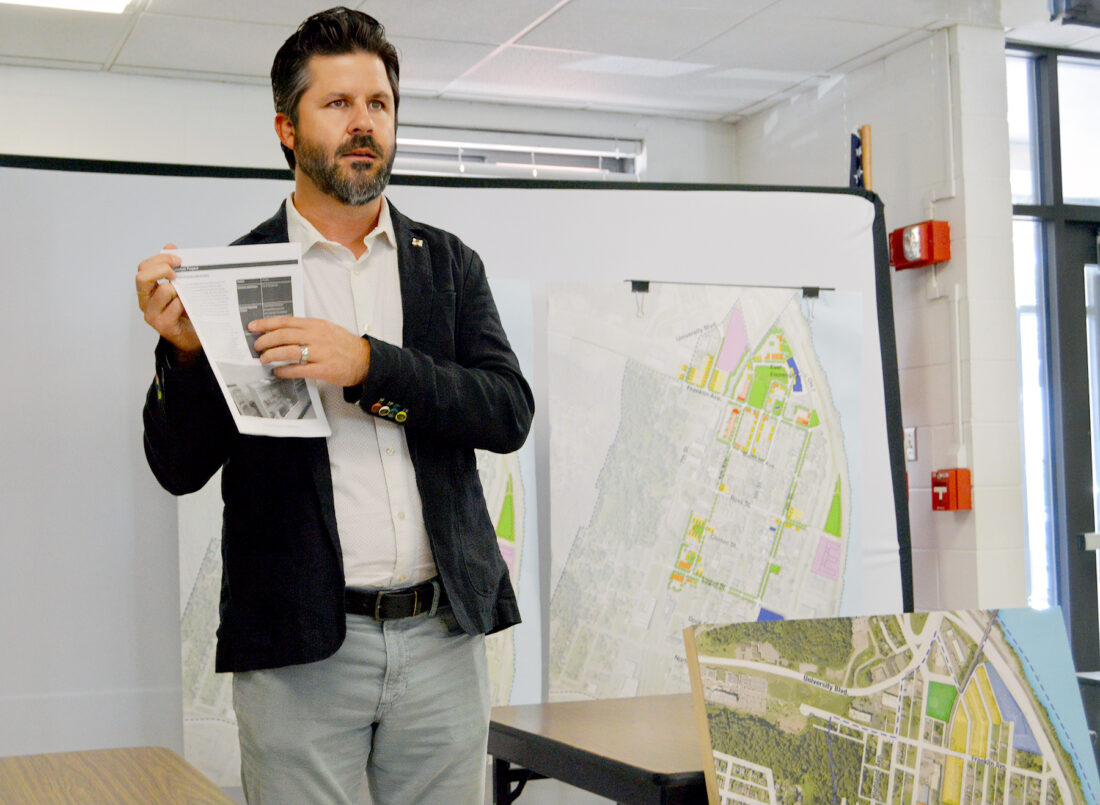
PLANNING — Adam Rosa, principal and founder at COLLABO, challenged the Steubenville North Choice Neighborhood coordinating committee to flesh out the plan’s community improvement strategies during a meeting in the John F. Kennedy Apartments community room Tuesday. -- Christopher Dacanay
STEUBENVILLE — During a meeting in the John F. Kennedy Apartments community room Tuesday, coordinating committee members fleshed out more than a dozen community improvement strategies that will be included in the final Steubenville North Choice Neighborhood Plan grant application.
The city of Steubenville and Jefferson Metropolitan Housing Authority are aligning themselves to apply for between $30 million and $50 million in Department of Housing and Urban Development implementation funds to redevelop 206 units of JMHA-owned low income housing and other areas of opportunity in Steubenville’s North End into new mixed-income developments.
Jointly awarded a $500,000 HUD planning grant in 2022, the city and JMHA are now roughly 21 months into the two-year planning period. The co-applicants are on track to submit a final redevelopment plan to HUD by the end of December, according to Adam Rosa, principal and founder at the urban planning and design firm COLLABO, the plan’s consultant.
As part of its periodical community engagement, the planning team has collected input from North End residents about what improvements they’d like to see included in the plan and subsequently implemented, which could take place as early as 2025.
Based on North End residents’ feedback, planners identified 15 improvement strategies that address perceived needs in the neighborhood. Rosa said HUD’s Choice Neighborhoods program identifies people, housing and neighborhood as three different elements for which plans must include actionable initiatives.
“The intent of this is for you all to tell us any additional information that would help us flesh out each of these projects or strategies,” Rosa said. “That could be somebody who’s working on something like this already in the city, a partner who could be plugged in on a project, a local resource that could be tapped into to make the project happen.”
Ranked according to residents’ input, Steubenville’s 15 initiatives are divided into three categories: Community of revitalization, community of opportunity and community of care. Each initiative has an estimated completion time frame, ranging from between one and five years to between five and 10 years.
Preeminent among the initiatives is creating a fresh food grocery store in the neighborhood, Rosa said, adding that this is “probably the No. 1 need we’ve heard from residents across the board for the last almost two years.”
Rosa noted a new store model being piloted in Virginia and Florida by Goodwill Industries International Inc. The pilot stores are compact but offer fresh food, he said, and Steubenville could possibly tap into that pilot program for its North End.
As for where the store would go, Rosa referenced the proposed creation of a new North End Park, which would be located where the current Elmer White Family Units stand. If the park is relocated as part of the plan, Rosa said, then the current park site could become a larger commercial development area, where a grocery store would make the most sense.
The second initiative, the bright streets strategy, aims to make the North End safer through additional streetlights and security cameras. Steubenville City Schools Superintendent Melinda Young noted the school district would be interested in partnering with the plan for this initiative, noting that grants for such amenities are typically small but can be compounded.
Returning to the North End Park topic, Rosa said the next initiative would see the park moved closer to East Garfield Elementary School, on the other side of the train tracks from where it currently sits. The new park would be much larger and have varied recreational amenities, both active and passive.
“This would be the new centerpiece for the neighborhood,” Rosa said. “The housing would be developed around it, so this would be an amenity for the residents. They would look right out onto this new park. It would be right at the front door of East Elementary, so it really could be used by the students.
Rosa continued: “This is a pretty well supported strategy within our plan. There’s a lot of moving pieces to make this work in regards to ownership, management, … but we want to include it in the plan.”
The next initiative is creating single-family homes to fill in the North End’s vacant lots, in addition to the redeveloped rental units.
A mix of townhomes and standalone single-family units would fill in key corridors. Rosa noted that a market study shows the neighborhood can support about 70 single-family units over the next five years.
Another initiative, riverfront revitalization, identifies a triangular piece of property off North Third Street that could be transformed into a commercial site for restaurants, shops or hotels — anything to take advantage of the river’s view and create development momentum in the area, Rosa said.
Acknowledging difficulties posed by state Route 7 the train tracks, Rosa said that triangle would be the first step in investment, given the cooperation of current riverfront property owners.
“Cities across the country are taking advantage of their riverfront in ways that are really helping to drive revitalization,” Rosa said.
Other initiatives included improving work transportation opportunities, digital literacy, school walking routes, workforce development, money management assistance, healthcare services, child and adult care services, multi-generational community spaces, home management assistance and local clergy partnerships.
In other business, the Steubenville plan’s project director Eliza Kelley, president and founder of EMIT Training Consultants, updated committee members on the plan’s early action project — a planned outdoor learning center and garden at the corner of North Fifth Street and Franklin Avenue.
Construction of the center is slated to begin in mid-October, with the goal of being complete by December, Kelley said, adding that the project is currently out to bid. To support the project, custom bricks — which will be placed at the site — are being sold at Steubenville High School football games.
Committee members were introduced to Joseph DiCesare, development specialist for WODA Cooper Cos., which has been brought on board as the Steubenville plan’s development partner.
Founded in the Ohio Valley, WODA is headquartered in Columbus and performs housing development in 17 U.S. states, DiCesare said. WODA has communities in Wintersville, Wheeling and Weirton.
“We’re really excited to be brought on and try to meet the community’s needs as this project progresses,” DiCesare said.
Local News

An anniversary at the Tiltonsville Library

Picturing the past

Cloak & Dagger mid-season finale features “American Nightmares”
Sharing surgical technique
Brooke County health officials warn of rabies cases
WELLSBURG – A pair of positive rabies cases in the area is causing concern for Brooke County health ...
City gives mall owner more time to address violations
STEUBENVILLE — The Fort Steuben Mall’s owner is planning to bring the main corridor up to code and ...