
Concern growing over invasive kudzu vines
STEUBENVILLE -- As if Asian Tiger mosquitos and spotted lantern flies aren't enough to worry about, now there's kudzu.
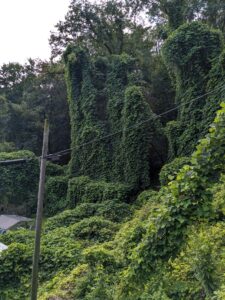
Kudzu, a fast-growing vine that overtakes anything in its way, has been spotted between Adams and Edgar streets in downtown Steubenville.
Councilwoman at large Kimberly Hahn described it to council last week as "unreal."
"It has filled trees and cascades down, it's going to a second-floor window" of a house, she said. "We have to actually tackle it immediately; we have the ability. It's not about one house having weeds that are out of control, we really need to eradicate it."
Kudzu, native to Asia, was introduced as an ornamental plant in the United States during the Philadelphia Centennial Exposition in 1876. With its red and purple flower clusters and grape Kool-Aid-like smell, from the 1930s through the 1950s it was promoted for erosion control and the government paid farmers to plant it.
Some see it as a threat to native vegetation.
"It's a really aggressive-growing plant," OSU Extension Educator Erika Lyon said. "It was initially brought in to be used as pasture forage, but it got out and took over just about everything. It's known for smothering trees and other plants."
The vines easily grow a foot a day -- and in ideal conditions, "up to four feet a day," said Aaron Dodds of the Jefferson Soil and Water Conservation District.
"It takes down trees, kills other plants, takes down structures," Dodds said. "The vines get under the eaves of houses, barns and garages, and as they grow, they slowly twist and contort structures. Eventually the weight of the vine will cause collapse."
Dodds said the pesky vine was found "behind a rental house, slowly overtaking two abandoned houses." He said they've reached out to the state, but as of midweek they hadn't heard back.
"Traditionally, this area hasn't had much to worry about because winters would kill it off, but because of the warmer winters (we've had) it's been able to get a foothold," he said. "Now we need to eradicate it, because even if we get a cold winter and it kills the vines back, the roots would still be able to survive."
Lyon said kudzu takes over everything in its path.
"It grows in such a dense mat it essentially smothers other vegetation -- it puts native plants at risk," she said.
And once it takes hold, getting rid of it can be tricky.
"Goats are the best option -- because it is a legume, they actually favor it," Dodds said, though that's not really an option in city limits. "There are strong commercial herbicides that keep it in check, but you need a commercial applicator to utilize (them), which is often expensive."
Lyon said cutting kudzu back isn't easy.
"Anytime you're dealing with aggressive-growing weeds like kudzu and Japanese knotwood, it's not going to be 'once and done.' It's going to take frequent cuttings," she said.
Still, she said, "if you see it, rip it up and throw it in the trash. Don't leave it on the ground because it can potentially spread. And there are some herbicide treatment options."
Lyon suggests contacting your local extension office.
"We see it a lot with invasive species," she said. "Just because it's so prevalent now, a lot of it is just the side effects of global trade. The key part is management: Very rarely are you going to be able to eradicate it, but you definitely don't want to let it go--when you see it, remove it. Once it starts growing on a tree it's going to take off and get out of control, that's when the costs to manage it go up. It's much easier to identify it early on. If it's early enough you can easily hand remove i.
"It should not be just left alone," Lyon added. "But is it something to panic about? Not necessarily. Very few invasive species do we go for eradication. For some species like kudzu, Tree of Heaven, even the spotted lantern fly--complete eradication is not going to be feasible."
Dodds said in this case, a landowner reached out to a councilwoman who, in turn, reached out to JSWCD. He said the kudzu is "engulfing garages right now and engulfing an abandoned house. Five or six trees were completely covered."
"They are literally watching it grow and start to touch the house they're living in," he said."I would venture to say from the looks of it, this particular batch is growing between 10 and 12 inches a day. Right now there's a little bit of concern because it's blooming, so it's going to start producing seed within a couple of weeks. That's when it can really take off -- birds get hold of the seed and spread it throughout."
City Manager Jim Mavromatis said he and Sanitation Superintendent Bob Baird already talked to the resident and assessed the situation. For now, he said, "We're not going to do anything with it."
"We looked at a couple of areas," he said. "The vines are growing, but some of it is on somebody's personal property and they're going to have to deal with it. There's some in an alley but it's not used anymore. "Right now it's not causing any major harm to anything."
Mavromatis also pointed out it's not new growth.
"It's been there the eight years I've been here," he said. "It didn't happen overnight, it's been here quite a while."