
Thankful for her hometown roots
Area native embraces life of military, mentoring, acting
Trending
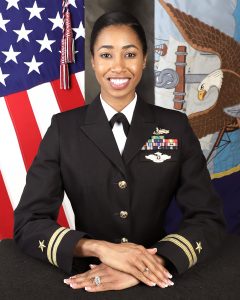
As Thanksgiving nears, one thing Steubenville native Navy Lt. Arabia Littlejohn Shanklin is grateful for, it's her hometown roots.
Stationed in San Diego, where the 2009 graduate of Steubenville High School serves as manpower analyst officer and the first inclusion and diversity officer for the Navy Region Southwest and is the co-founder of the U.S. Naval Academy Minority Association, Shanklin appreciates her upbringing and foundation laid by family and community.
"Steubenville was such a great place to grow up in," said the 29-year-old daughter of Genevieve Littlejohn and the late Franklin Littlejohn Jr. during a recent phone interview. "It always will be very close-knit and supportive and hard-working, and I was able to use those principles and values that were established there in the Navy and across the globe."
Her success and life path are something she hopes to share in a mentoring capacity -- locally, too, when possible -- encouraging youth to consider an option they might not and one she initially hadn't either.
"The message I want to get across is that I want to be able to help catalyst a recruiting effort for my hometown and show that the Navy is an option for those who don't think it is," she said.
Attending the Naval Academy and having a military career weren't always on Shanklin's radar, at least not until her senior year at Steubenville High School when a father-daughter trip morphed into a detour to the U.S. Naval Academy, what her dad called "the boat school on the water."
Shanklin was getting recruited by quite a few NCAA Division I colleges for track and field and at the end of her visit to Georgetown University, the anticipated trip right back to Steubenville became instead an unexpected drive to Annapolis, Md.
"I fell in love with the campus," Shanklin said of a visit that would motivate her to attend a service academy and ultimately be a life-changing experience.
"I didn't know about military service academies until my dad had brought it up," she said of her father, who died in 2018.
Serving in the military was always an option, though, having been raised by two parents who were enlisted in and met in the Air Force. "My mom is an immigrant from Jamaica, and she got naturalized in the Air Force, and they came back to Steubenville after they got out," she said of her parents.
Her family is one "full of public servants," she noted, singling out her grandfather, the late Frank Littlejohn, who was Steubenville's first Black fire chief.
Serving country and giving back to the community were attributes engrained in her from the get-go, according to Shanklin -- she just didn't initially know which direction she would go to do that.
"I decided to go to the Naval Academy, and it was a tough process, because you have to get your congressman's endorsement," she said. "You have to show that you have leadership skills and talents from when you were a kid. I was highly involved in the YWCA when I was there. I used to volunteer all the time at the Urban Mission. I went to the Ohio Christian University to Ohio Business Week, and I was able to win a couple of leadership awards when I was there, so I had the resume that is needed to attend the Naval Academy," she said.
It also involved performing a fitness evaluation, according to Shanklin, who would go on to letter four years in women's track and field at the academy, where she holds a record in the 400-meter dash.
Shanklin graduated in 2013.
Her first tour of duty was aboard the now-decommissioned USS Simpson (FFG 56), based out of Jacksonville, Fla.
"Being one of the three female officers onboard an all-male crew (of 300) as the ship's first lieutenant was an amazing experience as I assumed the role," she said. "My main responsibility was to ensure the 35 sailors I led in my division were on track with their promotions and personal development. The first lieutenant is the officer in command of the deck department responsible for line handling during mooring, under-way replenishment and air operations, which require specialized knowledge of engineering, communications and weapons," she noted.
She then conducted an AFRICOM and EURCOM deployment on USS Simpson and, upon return, received orders to Little Creek, Va., to became the command training officer and legal officer aboard the USS Whidbey Island (LSD 41), an amphibious ship with more than 500 sailors and Marines.
"It was my responsibility as the training officer to coordinate a comprehensive shipboard training program, train and supervise all division training petty officers and maintain and execute a training budget," she said.
"As the dual-hatted legal officer, it was my responsibility to administer the command legal services through military law and technical assistance in court martials, investigations, administrative boards and personal affairs."
From May 2018 through April, Shanklin was a flag aide (Navy verbiage, she notes) and aide-de-camp (Marine Corps verbiage, she adds) for commander, Expeditionary Strike Group Three, the largest expeditionary strike group in the world.
"It was my responsibility to assist the admiral in all official duties and coordinate protocol activities. Official duties could include, but were not limited to speechwriting, preparing communications on the admiral's behalf and coordination of visits and travel with distinguished guests and senior government officials," she explained.
"As a flag aide, you are on the clock, around the clock, and ironically, my husband, Capt. Gerrico Shanklin, was serving as an aide-de-camp to a general during the same time period, which was beneficial when needing to coordinate among the Navy and Marine Corps senior officers," she added.
In April, Shanklin transferred from the surface warfare community to the human resource community, assuming the role as a manpower analyst officer and the inclusion and diversity officer at Navy Region Southwest based in San Diego.
"The human resource community provides operationally experienced uniformed leadership and core human resource expertise to define, attract, recruit, develop, assign and retain America's best and brightest talent," she noted.
Shanklin found her niche in the Navy.
"I love it. I love the Navy, and I say that in the aspect of it's been able to expand my horizon in ways I didn't know was imaginable being from such a small town, like Steubenville, you know, I've traveled the globe. I've been able to sit at dinners with amazing people. I've been able to lead sailors and Marines on deployment. I've been able to help bridge the gap between the military and civilian communities at every duty station, so the education that I got from public school at Harding to Big Red has set the foundation for me to be successful at the Naval Academy and then along when I commissioned in the Navy," Shanklin said.
Shanklin is the co-founder of the U.S. Naval Academy Minority Association, established in March 2018 as a 501(c)(3) by six male alumni from the 1970s and Shanklin, brainstorming ideas on what minority midshipmen may need to be set up for success in the pre-admissions, while attending and post-graduation phase of the Naval Academy experience.
"We assist the Naval Academy admissions with recruiting in underserved markets, retaining in mentoring and encouraging minority midshipmen and Naval Academy Preparatory School candidates to successfully complete the course of study and serve with distinction the fleet, provide a network for minority grads and collaborate with other special interest groups," she explained.
The NAMA also embraces philanthropy. "We provide scholarships for minority STEM and summer seminar candidates who cannot afford travel to participate in Naval Academy candidate programs."
Since its inception, it has donated $20,000 to the U.S. Naval Academy and Alumni Association and supports the Task Force One Navy Initiative to promote culture, inclusion and diversity amongst the Naval ranks. It works to actively outreach, she added, by participating in and empowering all minority groups on the campus, to include the Italian Club, Chinese Club and Native American Heritage Clubs.
Another involvement for Shanklin is sitting on the board of directors for Mentorch, a social development network for mentorship.
The company was launched by Lavontay Santos, a classmate of Shanklin's from the Naval Academy. It is "a social network innovative hub to connect proteges and mentors. Mentorch incorporates AL technology to connect mentees with the mentor that can best facilitate goal-setting and achievement plans based on their expertise, explained Shanklin, who is "passionate about enacting progressive changes in the military."
She notes a desire "to set an example to my sailors who will eventually become the future leaders of tomorrow."
"I'm honored to be the first Inclusion and Diversity Officer for Navy Region Southwest "because not only is it the first of its kind, but it is important for our organization to lead from the front in encouraging education and tough discussions amongst our military and civilian. There is so much to learn from the diverse backgrounds, experiences and stories that make up our Naval workforce," she said.
"I do believe the military is leading from the front with inclusion and diversity," she added. "When there is a big societal change, a lot of those changes are run through the military through default. And through the military, regardless of background, we've been able to execute as a cohesive unit. There is an unparalleled sister/brotherhood we build through our common military experiences and culture.
"There is a lot to learn from the way the Navy leads from the front in this process."
Shanklin does not live and work unnoticed.
In August 2017, for example, she was featured in Vogue as one of this generation's trailblazing Black servicewomen.
More recently she has pursued acting opportunities, appearing as a main character in the pilot for the television series "The Mayflower."
"Someone noticed the work I had been doing in the Navy and in my local community," she said of how she came to be featured in the magazine.
"I think as an officer, it's always good to set the best example possible. The Navy has shaped me into a leader, and I gravitate toward opportunities to be a leader, to set the example not only in uniform but in the civilian community as well. I was known to be an advocate of military-civilian partnerships at each duty station and often advocate the importance of military members -- officers and enlisted -- to get involved with the local community to better understand the community, the people, the cultures that I served," she explained.
"Whether through volunteering at the local food bank and school districts or speaking at naturalization ceremonies to our newest citizens, it was important for me to be a role model in the community because ultimately as military leaders, the community looks at us to set the example," Shanklin noted.
Acting has been a lifelong interest, as early as her days at Buena Vista Elementary School in Steubenville when she was in a school play.
When first stationed in San Diego, Shanklin said she was approached to do a couple of spots in TV commercials and wanted to give it a try. "I just wanted to take advantage of the opportunity," she said, noting she did a commercial for a local casino there and has a commercial due out Tuesday for Sony.
Shanklin appears as Nadia, one of the main characters in the pilot for the television series "The Mayflower," a local TV series in San Diego centering on a restaurant employing workers from across the world, according to its website.
It's about "a diverse group of regular people navigating modern-day America."
"It's very important to me to balance my military career and multi-passions," Shanklin said of her acting interests.
"I am fascinated with learning and being creative enough to keep my interests alive and active. Performing in the arts industry has become a catalyst to my creative decision-making abilities -- I think outside the box and consider a multitude of options in order to make a sound decision," she noted.
"It is a goal of the Navy to foster a dynamic and talented civilian and military workforce, which is how I've been able to pursue acting professionally on nights and weekends. However, it is ultimately important to ensure the roles I play in a TV, film or commercial are ethical and reflect positively on myself, the Navy and can inspire others to do the same," she continued.
"Right now, I don't know what's going to happen next with the filming of the numerous episodes but we're already on episode two," she said, noting COVID-19 has put things on hold.
Being a role model for others, including in her hometown, is important to the former local resident.
Shanklin said she was inspired to join the Navy because of her family and many of the leaders from Steubenville who paved the way for her.
"The Navy has afforded me an incredible amount of opportunities that I never would have had as a kid growing up in Steubenville. I've been able to travel and volunteer in over a dozen countries, lead division and departments of sailors and Marines, and foster lifelong friendships with great people from across the globe," she said.
(Kiaski can be contacted at jkiaski@heraldstaronline.com.)