In search of island history
Stories, information about Brown’s Island sought for book project
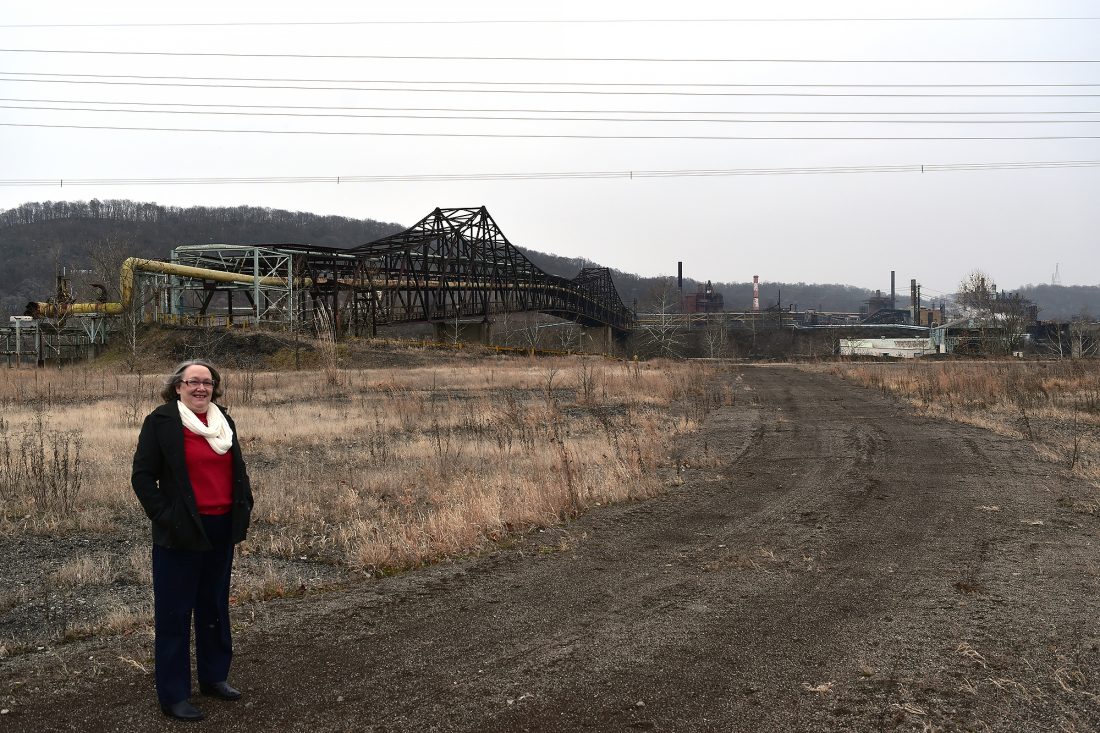
ON THE ISLAND — Jane Kraina of Weirton stands on Brown’s Island, which holds what she believes to be a fascinating history that she’d like to compile into a comprehensive book, a project she has been researching and working on for more than a year. Assistance from members of the public who might have stories, for example, or be survivors of the coke plant explosion there in 1972 is something Kraina is after and can be contacted by phone at (304) 797-1176 or by e-mail to yellowzoobananas@gmail.com. -- Contributed
WEIRTON — While the 50th anniversary of the Brown’s Island coke plant explosion that killed 19 workers and injured others is more than three years away, Jane Kraina hopes to have a book about this piece of land with a fascinating history written well before that.
The Weirton woman has some knowledge of Brown’s Island, positioned in the middle of the Ohio River, just north of Weirton’s Half Moon Industrial Park, but she wants to know a lot more, all in hopes of preserving an important part of history.
“I hope to have it done much sooner, but I definitely want it seeing the light of day by the 50th anniversary of the explosion on Brown’s Island that happened Dec. 15, 1972,” she said. “Every piece of research leads to more references. A lot of material exists about the island, but it is dispersed in many places. I am quite serious about finding as much as possible and completing a comprehensive book on the island.”
The public can help, she believes, on the project which is not limited exclusively to the explosion, but certainly a part of it. That would include hearing from survivors, those who were on the island that day, as many as 600 workers in some estimations. Or accounts from those involved in rescue operations, for example.
“Because of the number of people on the island, I am seeking stories, especially those on the island at the time of the explosion,” Kraina said. “The coverage right after the incident was plentiful, and then the story died out. I would like to expose more of what happened there. I welcome all experiences on the island. What might seem insignificant adds dimension to the history. I also would like some reminiscences of those on the Ohio side of the river. I am looking for information on Lorenzo and Sumner Jewett, Wellington Cooper and Henry Miser, all who owned parts of the island. We also are seeking information on lawsuits. Another point of interest is any artifacts found on the island,” she added.
The overall history of the island encompasses the various Indian tribes who were there; the first owner to cultivate the island, Col. Richard Brown, and other owners who followed, such as Richard Hooker, Lyman Stedman and Harry McGinnis.
There is interest in hearing from anyone in the area who may be kin to them or Samuel Burnell, first keeper of the lighthouse on the island.
How Kraina got interested in Brown’s Island reflects, in part, a love of libraries and research.
Kraina was born in Weston, W.Va., and lived overseas as a child before moving to Morgantown. While attending West Virginia University, she met her future husband, Michael. After they married in 1973, they moved to Weirton, his hometown, where he got a job at Weirton Steel, working there for the next 30 years.
“I finished my education at West Liberty and worked as a teacher and as a ward clerk at the Weirton Medical hospital, before beginning employment at the Mary H. Weir Public Library. I started in circulation and then assisted in the reference department,” she explained, noting that Rik Rekowski, library director, trained her on how to run the computer system.
“I continued to work in the library system as a network technician for the Library Commission based in Charleston. I covered the northern six counties in West Virginia,” Kraina said. “I also worked for the Brooke County Public Library as a second job and eventually became a museum coordinator for their special World War II collection centered around the Americans who became prisoners of the Japanese,” she noted.
“In the later 1980s and early 1990s, I commuted to Morgantown and obtained a master’s degree in journalism. I worked at the Brooke Review for a couple of years as a second job. I finished my career at the Mary H. Weir Public Library, but have had to quit working to take care of my husband. I love libraries and research,” said Kraina, who frequents the Mary H. Weir Public Library and the Schiappa Branch of the Public Library of Steubenville and Jefferson County for their resources.
Kraina explained that when she worked at the Weirton library, she needed a working knowledge of the books it offered, particularly local history and genealogy.
“I read all the histories and found the story of the Brown family unique,” she said of the family that owned the island at one time. “It came from ‘The History of Hollidays Cove’ — part of present-day Weirton. I also had seen a photo of the petroglyphs (Indian carvings) in the ’20th Century History of Steubenville and Jefferson County and Representative Citizens’ published in 1910. From that book, I also learned that George Washington passed by the island. I thought about how many happenings in American history also occurred on the small two-mile island in the Ohio River. I talked to a friend whose father had worked on the island and wrote an article on Brown’s Island, and Goldenseal, a West Virginia culture and history publication, bought it. It was my first sale and special to me,” she said.
Being a writer intrigued her as early as age 9, according to Kraina. “When I was 18, I made a bucket list. Item No. 19 was to write and publish a book. I wrote several books — mostly bad novels — but none of them seemed worthy of publication. I would look at the island on walks on Marland Heights in Weirton where I could see the island through some of the houses. Sometimes I called it the Emerald Isle in the summer when you could see the greenery,” she continued in response to a question about how she decided to write the book about Brown’s Island.
“While I was working at the library, Bob Brandt came in, asking if we had information on Brown’s Island. We began talking. He had collected some Indian artifacts and also had worked on the day of the explosion,” Kraina said.
“This topic still held people’s interest. Then I realized like a lightning bolt — I need to write a book on Brown’s Island. Bob Brandt has helped with locating relevant items and research. I have spent over a year so far on the book. Some research requires going to museums and libraries further away, plus conducting interviews. Some might think ‘How much history could this island have?’ All I can say is it is surprising the information available with digging and more digging,” she noted.
Kraina said Mary Zwierzchowski, an assistant reference librarian, has supplied her with a good deal of background information on Brown’s Island as well as reprints from local newspapers held on microfilm library archives.
“She has completed several interviews of workers on the island the day of the explosion and continues to collaborate in bringing this book to publication,” Kraina said.
Brown’s Island follows American history, according to Kraina.
“When George Washington passed Brown’s Island in 1770, he found it ‘unremarkable,’ but its history is anything but ordinary,” she noted. “People have defined it as ghastly, beautiful, fun, haunted, delightful, horrifying, romantic, despairing and mysterious. All would be accurate, according to the experiences of the beholder,” she continued.
The island is within 20 miles of Meadowcroft Rockshelter near Avella, the oldest prehistorical site on the mainland of America, shoe noted. “An archaeological report from West Virginia discusses a professor from Bethany possessing a mastodon bone found in Follansbee. Closer to the island, the Half Moon area, formerly a verdant area, attracted Indians and later settlers. Artifacts from the Archaic Period — after the massive animal hunter era — have been found on the Half Moon property as well as mounds with skeletal remains,” she added.
“On the island itself, Carnegie Museum did studies in the 1950s sending samples to chemists for carbondating of an Indian hearth. The chemists determined the items were from 1200 AD. They studied Indian-carved petroglyph drawings in stones. French explorer Robert de la Salle, George Washington and Lewis Clark all passed the island on their trips down the Ohio River,” Kraina said.
“After the settlers pushed the Indians to the west, the Brown farmed the island. Slaves served the Brown family. Later, a W.Va. legislator supporting abolitionism lived there. His daughter married on the island. A series of families lived on the island. Houses became elaborate. Some were renters. Children were born, and adults died, some of them gruesome deaths. In the late 1800s and early 1900s, pleasure seekers enjoyed company-held picnics. During prohibition, bootleggers served the ‘thirsty,'” she noted. Waters from the great flood of 1936 covered the island, submerging it.
“Like the rest of the country, the industrial age affected the island, beckoning industrialists in the area. Weirton Ice and Coal Supply Co. bought the island from Cyrus Ferguson for its sand and gravel,” Kraina said. “After Weirton Steel purchased the island, they built their innovative state-of-the-art coke ovens. As they started up for production, a gas leak caused a horrible explosion, killing 19 men and injuring 10. Production began in May the next year and lasted until the early 1980s, when the steel industry faltered. Owners purchasing WSX received the property. In February of 2017 Frontier Industrial bought the land to offer to industries forming again in the area,” she added.
“From ancient peoples to modern industry, Brown’s Island kept in step with the happenings of America in a quite, tiny space. Its history is intriguing, reflecting both the drama and quiet existence of the nation’s inhabitants,” Kraina said.
Asked what message she most wanted to get across to readers, Kraina responded, “Someone recently told me they heard of Brown’s Island in history class. What really alarmed me was they went to school in the Carolinas. We forget history happens right around us, and others are studying us. Archaeology studies have been going on as recently as 2018 from Pittsburgh, and Ohio University also has been here.
“Brown’s Island and the surrounding Ohio Valley area are considered archaeologically important,” she continued. “Prominent citizens lived on the island. They served in Holliday’s Cove and the W.Va. Legislature. A Jewett family member born on the island became a doctor and appeared in ‘Who’s Who’ for the invention of a medical device. He graduated from Steubenville High School,” she pointed out.
“The explosion was the largest industrial accident in Weirton Steel history. The men who perished deserve some attention and remembrance. Like most people losing their lives in our industrial history, they were just doing their job. But, because of their labor, great companies made America what it is. Brown’s Island has an amazing history. Its events reflecting American history are worthy of documentation.”
Kraina can be contacted by phone at (304) 797-1176 or by e-mail to yellowzoobananas@gmail.com.
“We are putting information we find in a file at the Mary H. Weir Public Library for those interested in this topic,” she added.
(Kiaski can be contacted at jkiaski@heraldstaronline.com.)
Local News

From unfilled gas tanks to fewer frills, retailers see US consumers rethink their spending

Steubenville native first in clinical trial using mixed reality in the operating room

Steubenville Grecian Food Festival a chance to celebrate
Wintersville officials hear mapping presentation
New Super Kids race expands Wellsburg Independence Day festivities