
Serra Hall opens at Franciscan
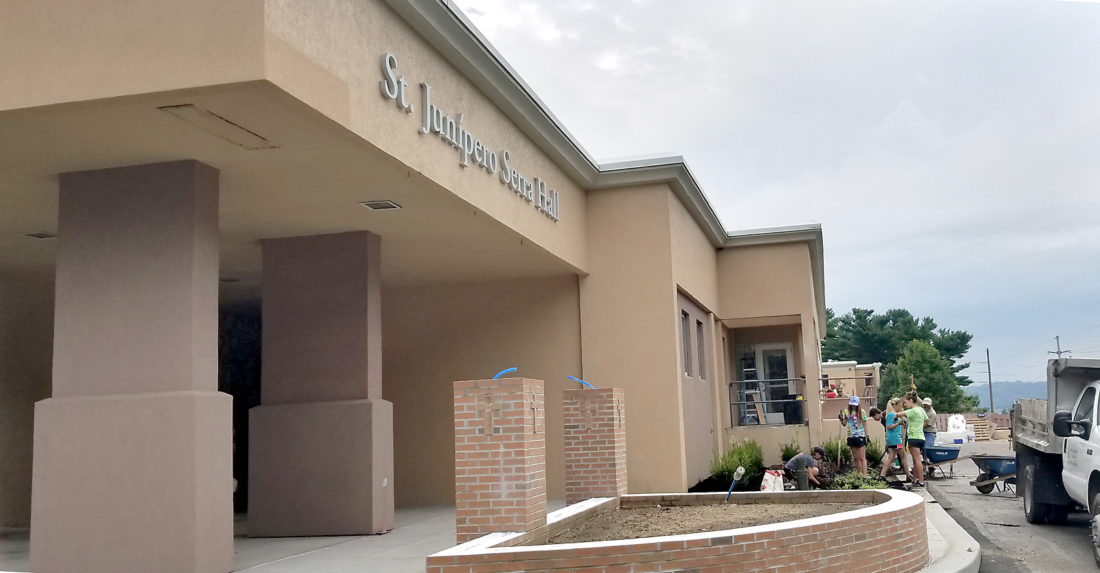
SERRA HALL — Student workers and contractors are putting finishing touches on the St. Junipero Serra Residence Hall on University Boulevard as the Franciscan University of Steubenville begins to welcome students back to campus for the new school year. The hall represents the culmination of years of planning and months of construction in a $4.5 million project to convert a former hotel into a modern residence hall with common spaces, room for 181 students, a chapel and a connection to the university’s computer network. -- Paul Giannamore
STEUBENVILLE — The St. Junipero Serra Residence Hall at the Franciscan University of Steubenville is welcoming its first guests this week, but it’s no stranger to serving as a place to stay.
Built in the mid-1960s as the Holiday Inn of Steubenville, the space will be home to more than 145 students as the university begins its fall semester. A $4.5 million construction project started in February to repurpose the former hotel into a modern university residence hall, but the work was more than just moving out some furniture and repainting.
The university held an open house for its staff at the hall Tuesday.
As Joseph P. McGurn, university director of physical plant services, leads a visitor on a tour, he points out the many major changes made to create the men’s residence hall.
Some are obvious and dramatic: Rooms were eliminated on each floor to make room for a grand central staircase to make it easier for students to visit and use common areas in the building. Others are subtle: Fiber optic cable was run over the bluff where the main university campus sits above the hotel to provide a full connection to the university’s network.
One is part of the university’s Catholic mission: A chapel was installed in the place of three rooms on the upper floor.
The hallways no longer are a long stream of doors leading to sleeping quarters, but a place filled with eight common rooms for the university’s Franciscan faith households, two gamerooms, a number of study rooms and dedicated quiet study room with rearrangeable furniture. There is a big TV lounge across the hall from the residence hall laundry. There is a common kitchen space and plenty of space for students to socialize. The hotel’s former pool was filled and the area now is a recreational lawn.
McGurn credited architect Ben Wetmore of McLaughlin, Cornelius and Filoni of Pittsburgh, who has been designing projects for the university for about 15 years. He said “it’s incredible insight” to be able to have the vision to create the spaces in what was a building of long hallways and little common space.
“It makes it into a space where you want to be,” he said.
McGurn said the crews from Fort Steuben Maintenance worked hard during the past six months to make the residence hall ready for its first students for the fall semester.
“They have been wonderful to work with,” he said. “They worked weekends. They worked nights. They just worked. It was a lot of work to do in six months.”
An example of the hard work: To create the chapel and sacristy on the top floor, three rooms were removed. Load-bearing walls were replaced with new reinforcements.
The residence hall’s conception as a project dates back about five years, McGurn said.
“To take it from discussions around a table with drawings and go back and forth and see it come out of the ground and come to life on a day like today, there is such a sense of satisfaction to see people come in and say, ‘Wow!'” he said.
Among those he credited, McGurn thanked Vince Oliver, university project manager, as well as support from the university, Student Life and the administration.
“And, thanks to God for keeping everybody safe and getting the job done on time,” he concluded.
Energy-saving ventilation units were installed to adjust to the needs of each room. Where the quiet room of the former Damon’s restaurant was is now the Baron Lounge, a meeting room retaining the stone fireplace and the booths.
The furnishings and fixtures and colors have been updated and changed to match what the university has in its main campus residence halls.
McGurn said the need for open spaces for the household gathering areas was a major part of the design for space a typical hotel wouldn’t have. The building is fully Americans With Disabilities Act accessible, with an elevator, but the grand staircase was included to allow students to meet and see one another.
One major difference between Serra Hall and other residence halls: Private bathrooms, which is a trend in modern dorms. McGurn said that’s not ideal at helping students to create a true social circle because it removes a reason to leave the room and to interact, but Serra Hall includes more social gathering areas and parlors and open spaces than other dorms.
Serra Hall has room for up to 181 students. Because of its original architecture, some rooms are large enough to house three students, but the university won’t be doing that this fall. The option will exist for the future.
“Whenever you do a renovation and you don’t have supporting documents as to how it was built, you have surprises lurking for you,” McGurn said. He said the building had to be brought up to modern safety codes, for example. A sprinkler system has been installed throughout, and security systems for the entrances were installed as was a new fire alarm system.
McGurn pointed out that, even with the safety updates, the project remains less than half the cost of building a new residence hall. Sts. Louis and Elizabeth halls, opened in 2007, were the last new residence halls at Franciscan, he noted. The university converted the former hotel annex into the Padua Hall private residences years ago.
Among the first residents of the three-level building will be the priestly discernment students who are considering answering the call to religious life. The students have been housed in Vianney Hall, itself part of the former Twilight Motel further east on University Boulevard near Franciscan’s main entrance. Entering the fully renovated lobby of Serra Hall, the priestly discernment program offices are to the right, where the front desk and manager’s office of the hotel were.
McGurn pointed out there are about 5,000 square feet of space in Serra Hall with future use to be determined, including the former restaurant kitchen and dining space. The former hotel business meeting rooms and access hall were reconfigured into a large parlor space and study rooms, as well as a common kitchen.
Junipero Serra was a Franciscan friar canonized by Pope Francis on Sept. 23, 2016. Serra is the principal patron of vocations and has been called the saint of missions and the “Aposte of California,” where he established nine Spanish missions during the 1700s.
Local News
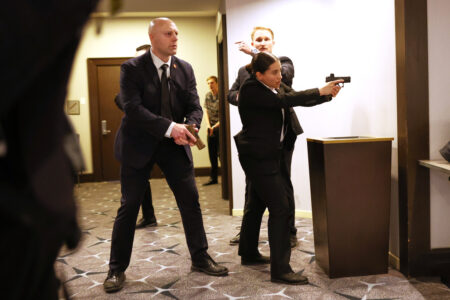
Shots fired as gunman charges toward ballroom at White House correspondents’ dinner. Trump unharmed
Weirton Senior Center builds community and connection
Job & Family Services recruiting foster parents
STEUBENVILLE — If you’re thinking about becoming a foster parent — or are simply curious about what is ...

New America250 mural unveiled in Weirton

Take Me Out to Community Night: Pirates Trip Returns to PNC Park
A full schedule of events planned in Weirton this summer
WEIRTON — There will be a packed summer of activities at the Weirton Event Center, with the City of Weirton and ...