
Urban Mission builds community through food and fellowship
Trending
STEUBENVILLE -- It's important to bring members of the community together so they can better understand the work done by Urban Mission Ministries, agency officials say.
That was one of the main goals of a series of open house sessions held Wednesday.
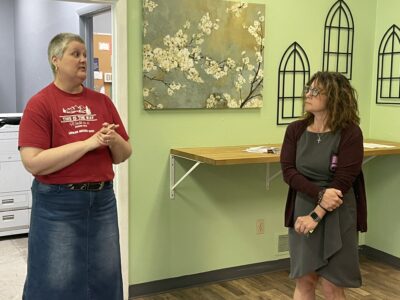
"This allows everyone to see what we do and ask questions and to let people know that the Urban Mission is very much open. We are still very much thriving and we are very excited to be a part of the community and serving those around us," explained the Rev. Kimberly Arbaugh.
She has been the executive director of the Urban Mission since December 2024. Since then, the organization has undergone changes in how it serves the community. Its emergency shelters were closed last fall, a move that allowed the mission to concentrate on supplying healthy food.
"As we have, during the past few years, been looking at our programs and the best way we can serve the community, we have launched the Back to Basics Campaign, where we are going back to the root of who and what the Urban Mission is," Arbaugh explained. "This is a way for local officials and members of the community to learn more about the services that we offer and ways they can get involved, either by financially donating, donating their time or donating goods."
The Urban Mission has served the area for nearly eight decades, going back to 1959, when it was founded as the Mill Men's Hostel. It was, as Arbaugh explained, a place where steelworkers could get some rest, receive pastoral care and enjoy a meal. The saying then was that the coffee was always on, she added.
"As time has evolved, the food ministry has come into play as well, because as times changed, the hostel wasn't needed as much. Transportation became more available and a food ministry was needed," she explained while preparing to lead a tour of the warehouse at 311 N. Sixth St.
Today, the mission is one of the largest food pantries in the region, she said. Its coverage area includes Jefferson, Harrison, Carroll, Belmont, Brooke and Hancock counties. Residents throughout that area who need assistance are welcome to come to the pantry, she added. It is a choice pantry, which allows participants to select the items they want.
The pantry is open from 9 a.m. to 4 p.m. Monday through Thursday, and participants are allowed to receive food every other week. The registration process has been streamlined -- you need a driver's license or state-issued ID showing residency in one of the service-area counties. Those without that type of identification can use a utility bill or rent statement as proof, Arbaugh explained.
"Overall, we help out about 3,000 families a month in our pantry," she said. "We have about 10,000 families a year come through the services of the Urban Mission. The number of families coming through the pantry has gone up during the last 12 to 18 months and we are doing everything we can to provide the best offerings and the best services. There's a nice variety of food, fresh food and produce -- it's healthy food instead of just food."
To do that, the Urban Mission partners with the Columbus-based Mid-Ohio Food Collective, the largest food bank in the state. A truck brings in fresh produce every Wednesday, which makes that day especially popular, Arbaugh added.
"Being able to access that produce at no charge is one of the great blessings we are able to give to our community," she added. "We want the emphasis to be on fresh food, not just prepackaged food. We want to have as much fresh food as possible."
All of the food that goes through the pantry is weighed as it comes in and as it goes out, she said, adding that this allows them to track how many pounds of food they handle in a year.
"We do have some wonderful partnerships with grocers -- Kroger, Riesbeck's, Aldi, the Walmart Distribution Center and the Walmart Supercenter," Arbaugh added. "We do pickups every day at these stores and that's where bread and a lot of our sweets come from."
While the food pantry might be its most visible service, the mission also offers a Unity Kitchen from noon to 1:30 p.m. Mondays, Wednesdays and the last Friday of each month. It is a gathering that provides a hot meal and fellowship.
Mission Rejoice is held from noon to 1:30 p.m. every Saturday and offers a worship service and a free lunch.
"One of the things that we really strive for is that it's just not about handing people food, it's about building community," she explained. "We are sitting down with our neighbors, having a meal and we are encouraging them to have conversation, praying with them and seeing what other needs they might have that we might not be able to fill but for which we can connect them with the right agency."
The third component of the mission's services is the Urban Thrift and Opportunity Center, located in the Seventh Street Plaza.
"It's one of the largest thrift stores in the area," Arbaugh said. "And the wonderful thing about it is that 100 percent of the profits go back to the mission."
The store is filled with clothing, housewares and even toys, she added.
Another section of Urban Thrift has been set aside for several uses, including a Bible class and worship, Arbaugh said.
"We have a lot of regulars who come every day because they are looking for a place to belong and for fellowship. It's more than just a thrift store -- it's a piece of the community," she said.
Helping to make it all work are volunteers, and there is always a need for more, officials said.
Two open house sessions were held Wednesday -- one in the morning geared toward public officials and agency representatives and one in the afternoon open to the general public. For information about any of the services offered by the mission, call (740) 282-8010.
"We have been around since 1959 and have gone through a lot of changes," Arbaugh said. "Part of being a strong agency is being able to step back and evaluate where you are and where you need to be to best meet the needs of the community. Our ministries are evolving as the times and the community evolve."