
Black history focus at Weirton museum
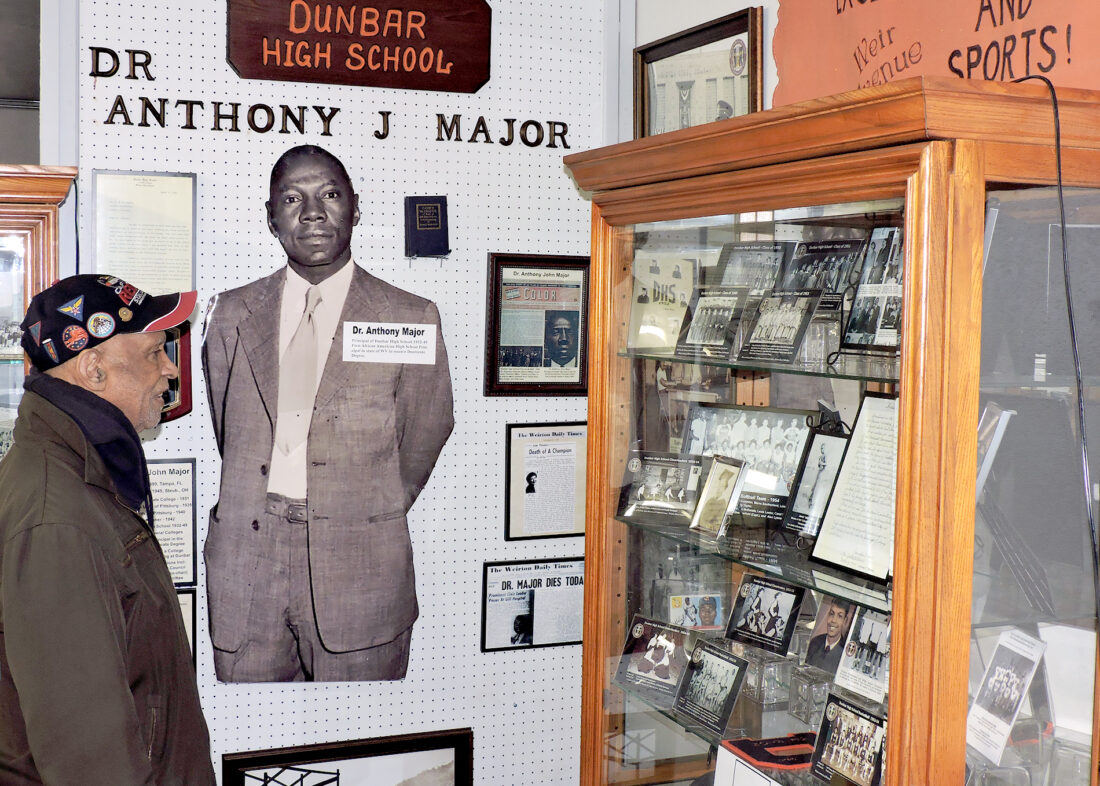
A LOOK BACK — Bob Kelley, a volunteer with the Weirton Area Museum and Cultural Center, surveys a display on the history of the Dunbar School. -- Warren Scott
WEIRTON — When many think of segregation, they think of the deep south, but it also existed in northern West Virginia, including the city of Weirton.
Area residents and visitors are invited to learn more about that as well as the achievements of local Black Americans through multiple displays at the Weirton Area Museum and Cultural Center.
Located at 3149 Main St., it is open from 10 a.m. to 2 p.m. each Friday and Saturday. Those interested can call (304) 224-1909 or visit its Facebook page to verify inclement weather hasn’t affected its opening.
Tours outside of those hours also can be arranged by calling that number.
Bob Kelley, a member of the museum’s volunteer board, noted that among local schools showcased at the museum is Dunbar School, which opened as a segregated school for Black youth in 1917.
Named for poet Paul Lawrence Dunbar, it had operated at locations on County Road and Avenue F before a building was constructed specifically for it on Weir Avenue in 1939.
Between 1932, when it began serving high school students, to 1955, when it was desegregated, it produced more than 200 graduates.
Kelley was among Dunbar students who were transferred to Weir High School.
Asked if there were problems with the white students, he recalled a couple of fights involving a white teen gang but nothing major beyond that.
Kelley said many of the youth had played baseball together in the city’s Little League, which had been integrated in 1953, though Black Weirton residents lived primarily on Weir Avenue and at the city’s north end.
He said one neighborhood on Weir Avenue was called Calico Hill, likening its mixed population of Blacks, Italians and people of Serbian and Polish backgrounds to the multicolored breed of cat.
Kelley said many youth of various races had fathers who worked together at Weirton Steel by that time.
He said his grandfather had moved from the south to work for the Phillips Steel and Tin Plate Co., a forerunner of Weirton Steel, in 1915.
The museum includes many items related to the steel company’s history, from helmets and numbered badges worn by its employees to three 200-pound howitzer shells produced for the military during World War II.
The Dunbar School display pays tribute to Anthony J. Major, the high school’s first principal and the first Black principal in West Virginia to earn a doctorate.
Major also was involved in various organizations, including Boy Scouts, the West Virginia Cancer Control Program and the Negro College Fund, prior to his death from a heart attack in 1949.
Kelley said he has kept in touch with one of his teachers at Dunbar, Dorothy Hill Phillips, who is 98 and living in Tennessee.
Among local athletes spotlighted at the museum is Quincy Wilson, the first West Virginia football player to rush more than 3,000 yards in one season, who went from the Weir High Red Riders team to play for West Virginia University and the Cincinnati Bengals.
Since returning to his hometown, he has been named head football coach at his high school alma mater.
A display at the museum notes Wilson received the Harrison Kennedy Award, given annually by the West Virginia Sports Writers Association to the West Virginia high school football player rated best for that year.
The museum’s guest speakers through the years have included Dwayne Lester, a Weirton native, artist and author of “Through My Eyes: An Illustrated History of 20th Century American Athletes.”
Beside a copy of Lester’s book at the museum is a painting he produced of Cleveland Browns running back and later actor, Jim Brown.
On March 7 at 1 p.m., the museum will be visited by Valerie Van Orman, author of “Helen of Holliday’s Cove,” a novel set in the early 1900s about a young woman living in the early American settlement that would become part of Weirton.
The museum’s many displays include rooms dedicated to Holliday’s Cove; Weirton Medical Center and its forerunner, Weirton General Hospital; and an area covering films shot in the city, including “Super 8” in 2010.
It has two floors, with access to the second available by stairs or an elevator.
Local News
Candidates set for May 12 West Virginia primary
Pending any last-minute filings, including those with registrations postmarked by the Saturday deadline, the ...
Johnson: No quick end to shutdown
WASHINGTON — House Speaker Mike Johnson said Sunday it will be a few days before a government funding package ...
More winter weather leading to heavy snow — and falling iguanas
MEMPHIS, Tenn. — A huge swath of the U.S. from the Gulf Coast into New England was mired in extra-cold ...
Local Briefs
Recreation board to meet TORONTO — Toronto Council and the Toronto school board’s joint recreation board will ...
Outstanding service, teaching recognized
Marijuana, abortion voting are on ballots
Alongside a battle for control of Congress, voters in states across the country will take up ballot initiatives to ...