
Holocaust survivor discusses experience
Trending
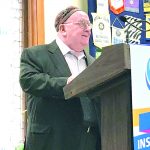
STEUBENVILLE -- Judah Samet leaned forward in his chair, shaking his head slightly as he considered how political differences dividing America have made otherwise level-headed Americans turn their back on their leaders.
"Never quit on America," he said emphatically. "Anybody who complains about this country, let me take them to Bergen-Belsen for a couple weeks."
Samet, a Holocaust survivor, was guest speaker Friday at Steubenville Rotary, telling its members and guests how he'd spent more than 10 months in the notorious Bergen-Belsen concentration camp in northern Germany -- and how he survived it, becoming hardened to the stench of rotting corpses and the sounds of bones being crushed underfoot as he and a friend wandered the camp, searching for food scraps. He said his mother encouraged her children to eat lice, which were plentiful in the camp, reasoning that, "they were bloodsuckers, so if we ate them it would keep us alive."
He told the Rotarians Europe, particularly Hungary, have traditionally been anti-Semitic, and recalled how when he was 6 the Nazis rolled into his hometown of Debrecent at lunchtime in 1944. His parents owned two factories, so the family was wealthy.
"Lunch, in Europe, is the big meal of the day and they knew every Jew would be home for lunch, so they wouldn't have to search for us," said Samet.
He said the Nazis drove their Jewish prisoners to the railyard "like you'd drive cattle." Those who couldn't keep up "were clubbed," he said.
"When they were taking us to the railroad, people were walking past. Many of our neighbors, people who worked for us…they just looked at us," he remembered. "It's a pretty bad thing when nobody knows who you are or they know who you are and ignore it."
The Germans told them they were going to a "better place," he said, but the cattle cars that were to take them there were delayed. When the first one finally arrived, he remembers his aunt insisting on boarding it with her six children, despite his mother's warning it was going to Auschwitz.
"When you arrived at Auschwitz, within 40 or 50 minutes you were coming out of the smokestack," Samet said. "You were dead."
Bergen-Belsen wasn't much better: According to the U.S. Holocaust Memorial Museum, during its existence roughly 50,000 people died there, including Anne Frank and her sister Margo. Most of the victims were Jews.
Samet figures his family was spared because his mother, an educated woman, spoke German fluently and acted as interpreter for her captors.
"I think the reason I survived, you saw it here today," Samet said, pointing out so many survivors are no longer alive to tell their story. "Maybe that's my mission, tell my story. I'm 81 years old, there aren't many left who can tell it. It's an important story to tell."
It was made even more important in October, when he found himself in the crossfire in the parking lot at Pittsburgh's Tree of Life Synagogue, where 11 of his friends were slaughtered. The alleged gunman, 46-year-old Robert Bowers, has been charged with multiple hate crimes.
Samet said he was running several minutes late for services or he would have been inside the synagogue when the shooting started. As it was, he was still in the parking lot as police traded fire with the alleged gunman.
"People ask me what I was thinking when I heard the shots," he said. "I said, 'It never ends.' You can't change the world, unfortunately there are too many haters, they hate one thing or another. One thing that unites them in Europe is their hatred of Jews, it's been going on for thousands of years."
Samet recently accepted First Lady Melania Trump's invitation to attend the State of the Union Tuesday in Washington, D.C.
"I keep hearing love is 'stronger than hate,'" he said. "I disagree with that. Love is easier than hate. To hate you have to have ammunition and all kinds of stuff."