
Milan and Cortina cauldrons extinguished, ending of Winter Games
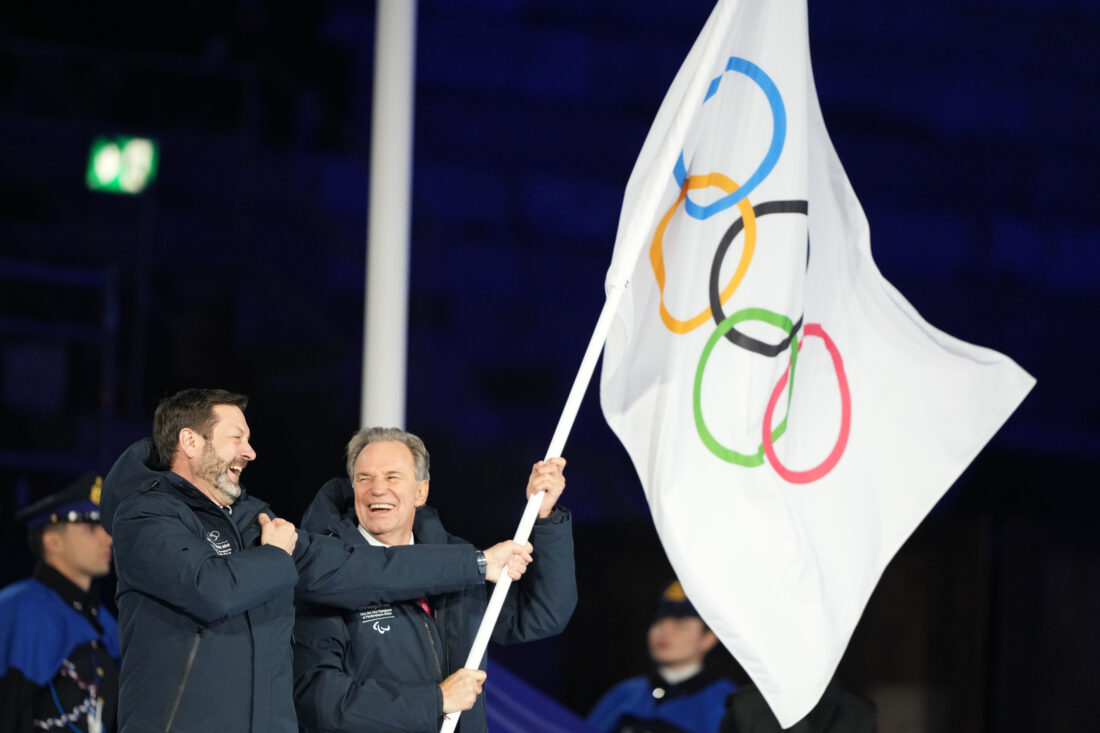
President of the Provence-Alpes-Cote d'Azur Region Renaud Muselier, right, and President of the Auvergne-Rhone-Alpes Region Fabrice Pannekoucke wave the Olympic flag during the closing ceremony of the 2026 Winter Olympics, in Verona, Italy, Sunday, Feb. 22, 2026. (AP Photo/Natacha Pisarenko)
VERONA, Italy (AP) — The Milan Cortina Olympics ended Sunday as the twin flames in co-host cities Milan and Cortina d’Ampezzo were extinguished during a closing ceremony inside the ancient Verona Arena, roughly mid-distance between the far-flung mountain, valley and city venues that made these the most spread-out Winter Games ever.
In declaring the 2026 Games over, International Olympic Committee President Kirsty Coventry told local organizers that they “delivered a new kind of winter games and you set a new, very high standard for the future.”
The next Winter Games will be held in neighboring France, which received the Olympic flag in the official handover earlier in the ceremony. Following the same spread-out model, the 2030 Winter Games will stage events in the Alps and Nice, on the Mediterranean Sea, while speedskating will be held either in Italy or the Netherlands.
A total of 116 medal events were held in eight Olympic sports across 16 disciplines, including the debut of ski mountaineering this year, over the course of 17 days of competition. With the final events wrapping up just hours before the ceremony, the 50-kilometer mass start men’s and women’s cross country medals were awarded by Coventry inside the Arena.
Host Italy won its highest Winter Olympic tally ever with 30 medals — 10 gold, six silver and 14 bronze, crushing the previous record of 20 set at the Lillehammer Olympics in 1994.
“Your outstanding performance united Italians everywhere and played a fundamental role in the success of the games,” Giovanni Malagò, the president of the Milan Cortina Foundation told the Italian athletes sitting behind him wearing headbands emblazoned with ”Italia.”
The closing ceremony paid tribute to Italian dance and music — from lyric opera to Italian pop of the 20th century to the DJ beat of Gabry Ponte, who got the 1,500 athletes on their feet and dancing while color confetti exploded on stage. Italian Achille Lauro delivered the last word with the song “Incoscienti Giovani,” or reckless young people, just before athletes who so aptly harnessed their youthful energy for these Games filed out.
The 2½-hour ceremony opened with a whimsical tribute to Italian lyric opera, with the stage director rousing not only the closing ceremony cast, including Achille Lauro, but also long-dormant opera characters tucked away in crates within the amphitheater’s tunnels.
On stage, Madama Butterfly in a bright pink and green costume and Aida in golden tiers were unpacked from mirrored crates while 17th century musicians played the joyous “Libiamo ne’ lieti calici” from La Traviata, a nod to the Arena’s long history as the venue for a summer opera festival.
The opera characters, led by the jester Rigoletto, spilled out into the piazza outside, mixing with the bemused athletes who were flag-bearers for their countries, some ofwhom pulled out their phones to film.
In a later sequence, internationally acclaimed ballet dancer Roberto Bolle made his first-ever aerial performance inside a blazing ring meant to represent the sun. He was lowered to the stage that mimicked the Venetian lagoon, replete with gondolas, where he danced to a haunting song by Italian singer Joan Thiele.
In a key moment, the Olympic flame encased in a Venetian glass vessel was carried into the Arena by Italian gold medalists from the 1994 Lillehammer Games. The Olympic rings illuminated in white appeared high on the stone stairs behind the stage, flanked by national flags, when one raised the flame in the center of the stage.
This was the first Olympics for Coventry, a two-time Olympic champion in swimming, who watched much of the ceremony alongside Italian Prime Minister Giorgia Meloni.
Some 12,000 spectators joined the athletes and officials for the closing ceremony, which was much more intimate affair than the opening ceremony starring Mariah Carey and Andrea Bocelli inside Milan’s San Siro soccer stadium, attended by more than 60,000 people.
The Milan Cortina Games spanned an area of 22,000 square kilometers (8,500 square miles), from ice sports in Milan to biathlon in Anterselva on the Austrian border, snowboarding and men’s downhill in Valtellina on the Swiss border, cross-country skiing in the Val di Fiemme north of Verona and women’s downhill, curling and sliding sports in co-host Cortina d’Ampezzo.
The closing ceremony concluded with the Olympic flames extinguished at the unprecedented two caldrons in Milan and Cortina, viewed in Verona via video link. A light show substituted fireworks, which are not allowed in Verona, to protect animals from being disturbed.
The Milan Cortina Paralympics’ opening ceremony will also take place in the Verona Arena, on March 6, and the Games will run until March 15.
LAST DAY OF ACTION
Eileen Gu defends
Olympic halfpipe title
Eileen Gu is now six-for-six in Olympic medal events after another halfpipe victory.
The 22-year-old Gu, American-born but competing for her mother’s homeland of China, is already the most decorated freeskier in the short history of the sport at the Olympics.
She also captured two silver medals at the Milan Cortina Games, to pair with two golds and a silver from the Beijing Games.
Gu won her last event on the strength of her second run, a clean, technically sound pass. She got even better in her final run — pumping his ski poles after landing the final trick — and finished with a score of 94.75. Her teammate, Li Fanghui, took silver and Zoe Atkin of Britain was third.
The event was rescheduled to Sunday following a big snowstorm the night before.
Sweden’s big day
First, Ebba Andersson pulled away from the pack to win the 50-kilometer mass start cross-country ski race and earn redemption for her crash that cost Sweden a gold medal in the team relay.
“I’ve dreamed about this day for a long time now and it’s almost unbelievable that everything went as planned,” she said.
And then Sweden’s curling moms beat Switzerland to give the Scandinavian nation another gold.
Diggins concludes
glittering Olympic career
Jessie Diggins finished fifth in the 50-kilometer mass start cross-country ski race. Just a few seconds shy of one more medal.
She’s OK with that.
“I can confidently say I could not possibly have tried harder or gotten more out of my body,” the 34-year-old Diggins said.
It marked the final Olympic event for an athlete who transformed American cross‒country skiing and became a symbol of endurance.
Lochner’s bobsled sweep
In bobsled, Germany’s Johannes Lochner added the four-man gold to his two-man title.
Lochner — who announced his retirement months ago — capped his career with his second gold medal of these Olympics, winning the four-man event over two-time defending Olympic champion Francesco Friedrich by 0.57 seconds.
“It’s just such a dream. … It’s indescribable,” Lochner said. “A moment for eternity. A perfect finish, the most perfect finish ever.”
Local Sports
Milan and Cortina cauldrons extinguished, ending of Winter Games
U.S. beats Canada in OT for first men’s hockey gold since 1980
MILAN — The United States is on top of the hockey world for the first time in nearly a half-century. No miracle ...
Hall of Famer Bill Mazeroski, Pirates legend and Ohio Valley native, dies at 89
Bill Mazeroski, the Hall of Fame second baseman who won eight Gold Glove awards for his steady work in the field ...
12 locals advances to state tourney from Div. 2 regional
WEIRTON — A dozen local wrestlers are headed to the state tournament in WVSSAC Division II after regional action ...

Brooke sending five to the state wrestling tournament