
Ohio Valley WWII POW’s Remains Coming Home For Final Rest
Trending
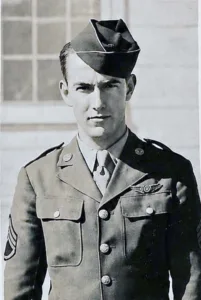
MOUNDSVILLE — For Moundsville resident Joe Richmond and his family, this Veterans Day will be even more special. His great uncle Raymond Carl Richmond, a World War II prisoner of war who died in a Japanese camp, will be coming home for his final rest.
After 81 years, Raymond Richmond’s remains have been identified and are scheduled to arrive in Pittsburgh in that morning. During his escort to Moundsville, Marshall County’s annual Veterans Day ceremony at 11 a.m. at the courthouse will be dedicated to his memory. His remains are expected to reach Grisell Funeral Home by 2 p.m.
Richmond’s aircraft was shot down April 2, 1945, and he was captured by Japanese forces and taken to the Tokyo Military Prison on April 16, 1945. On May 26, 1945, he was killed during the firebombing of Tokyo that also hit the prison.
Richmond's remains were identified July 7 by the Defense POW/MIA Accounting Agency.
“I find it very fitting and the family is very appreciative that the county Veterans Day ceremony is honoring Raymond,” Joe Richmond said. “I hope that his story highlights the sacrifices of the men and women who serve, as well as the families who had no closure.
“I don't think a lot of the younger generations understand the sacrifices. Since Vietnam we have not seen the POW and MIAs and unidentifiable casualties that we had in conflicts in the past,” he added. “The younger generations understand that there is death and heartache in war, but they have not seen what the families go through when there is no closure.”
Raymond Richmond was born Oct. 19, 1919, in Cameron. He graduated from Moundsville High School in 1939. He and wife, Alberta Christina "Bert" Wade Klug, had a home in Proctor in Wetzel County. They had no children.
Raymond Richmond was a technical sergeant and flight engineer in the U.S. Army Air Forces during WWII. He served with the 881st Bombardment Squadron, 500th Bombardment Group (Very Heavy), Twentieth Air Force. He flew aboard the B-29 Superfortress, which had 11 crew members and was based in Saipan in the Pacific.
Raymond Richmond was the son of Joshua Litten Richmond and Susanna "Anna" Myers Richmond. His siblings included Charles Edward Richmond, Floyd Ralph Richmond and Beulah May Richmond Rine.
“It has been very interesting since finding out that the remains had been identified. I had known what happened to him and the general events that took place, but this has gotten me curious. I started looking for any information on Raymond and the events that led to his death at the Tokyo Military Prison,” Richmond said.
“As plans for his return home started to come together, the family started to try to collect all the information that we could find and to build his biography.
Because of a fire at the National Personnel Record Center in 1973, Richmond’s official records are unavailable because they were destroyed along with approximately 80% of the Army records up to 1960. When he was shot down and declared killed in action, his wife sent his personal belongings that did not consist of much. Richmond’s brother Floyd stayed in contact with her even after she remarried, and after she died in the early 1970s, her widower gave Joe’s grandmother a box of Raymond Richmond’s belongings he had found.
As years passed, the family found more items tucked away. In cleaning out his grandmother’s house, Joe Richmond found a box that not only included pictures and his great-uncle’s high school diploma, but also several letters home.
LETTERS HOME
While training at bases in Texas, Kansas and Nebraska, Raymond Richmond would write letters to his family. In one letter dated Aug. 13, 1944, he talked about the B-29 bomber.
“I am flying the famed B-29. She is a swell airplane but too da– big, 135,000 lbs. is a lot of metal to float around up there. Of course that 8,800 horse power is a lot too; my job is to keep those four, R-3350s putting out those horses.
“The pilot flies the ship and I keep the engines and a mess of other things going. We have an 11 man crew. I am going to some time going to take a little gunnery practice some day.
“I fired this new Army carbine the other day and did pretty well. I made sharpshooter with 174 out of a possible 200. Not bad. Maybe your little brother can shoot after all. Haha.”
THE CRASH, CAPTURE AND FATAL FIRE
According to information provided by Richmond, “On the night of April 1, 1945, Raymond's crew departed Saipan aboard B-29 serial number 44-69666, designated Z Square 11.
“Their mission was to attack the Musashino Aircraft Factory near Tokyo. After midnight on April 2, enemy fire brought down the aircraft.”
Their lieutenant was killed, but the remaining crew of 10 men parachuted to the ground.
“Raymond survived the loss of his aircraft, but Japanese forces captured him. On April 16, he and eight other members of the crew were taken to Tokyo Military Prison, also known as Shibuya Military Prison. There, they endured captivity during the closing months of the war,” according to Richmond’s information.
“During the night of May 25-26, 1945, fires from the bombing of Tokyo reached the prison. Raymond and eight members of his crew died there. His official casualty date is May 26, 1945. Sgt. Ray F. Hopper, who was held separately, was the only member of the 11-man crew to survive the war.
“For more than eight decades, Raymond's remains were unaccounted for. His name was honored at the National Memorial Cemetery of the Pacific in Honolulu, in the Courts of the Missing, Court 7.”
NEWS OF REMAINS
Richmond said he was surprised and “very emotional” to find out his great uncle’s remains had been identified.
“My grandfather passed when my dad was in his teens, so I never got to know him,” Richmond said. “But a conversation I had with my dad stuck with me. I remember him saying that his dad said the worst part of losing his brother was not being able to bring him home to be laid to rest.
“The thought that my grandfather’s wish to have his brother’s remain at home was actually going to happen.
“I thought of all the work that my dad did to get Raymond on the WWII memorial that he was not listed on because of the records that had been destroyed in the fire.”
He noted getting the remains identified was a difficult process. The Americans killed in the fire were buried in a mass grave. Dental records were used to identify several victims, but Raymond Richmond’s records and a other victim’s records were similar and could not be confirmed.
When the process finally started, DNA was collected from family members and the remains were taken to the Defense POW/MIA Accounting Agency’s DPAA lab in Hawaii to be tested.
“After my father passed away, I was given a letter that had come for him from DPPA and I contacted the casualty officer and got an update on where things were at. I did this every so often over the next couple of years.”
HOMECOMING
Regarding Raymond Richmond’s trip home, Richmond said his remains will be escorted by the Pennsylvania State Police and Patriot Guard to the West Virginia border. Then West Virginia State Police and local police will escort him through Weirton, Follansbee, Wellsburg, Beech Bottom, Warwood, Wheeling, Benwood, McMechen, Glen Dale and with an arrival time of about 2 p.m. in Moundsville. During the arrival ceremony at Grisell Funeral Home there will be pallbearers and an honor guard.
The Veterans Day program at 11 a.m. is anticipated to include exhibits about Raymond Richmond.
The visitation and funeral times are still being planned.
Richmond said people can donate to the effort at https://www.gofundme.com/f/remembering-raymond-richmonds-sacrifice.
“We would like to have as many spectators a possible along the arrival route through the panhandle, at the arrival ceremony and along the route of the funeral procession in Moundsville,” he said.