
At last, Lt. Gilbert laid to rest
Trending
STEUBENVILLE -- Saturday’s funeral for 1st Lt. Raymond Banker Gilbert was solemn, but it also was a time to be joyous.
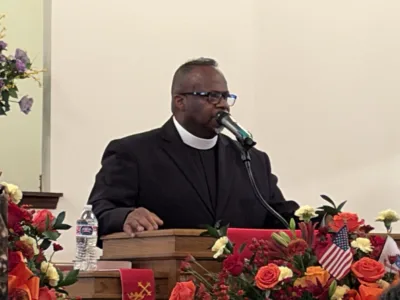
“We may have a casket here today, but it is not a sad occasion, because he is back home with his family -- I call that a celebration,” said Minister Alan Jeter.
A nephew of Gilbert, who died as a prisoner of war before he was born, Jeter delivered the eulogy during the service at Mount Carmel Community Baptist Church.
“It was a great honor,” Jeter explained after Gilbert was laid to rest in Union Cemetery. “My mom, the brothers and the aunts and my grandparents always kept him alive, through the stories and through the love. It was like he was never gone, you know, like he was never gone.”
Gilbert, who was born in Steubenville on April 26, 1927, was reported wounded, captured and missing in action during the Korean War on Dec. 1, 1950. He died of injuries in a POW camp on Jan. 31, 1951. His remains were not identified until April 4 of this year, and received a hero’s welcome when they were returned to Steubenville Tuesday, recognized by hundreds of residents from across the Tri-State Area along the route from Pittsburgh International Airport to the city, including hundreds who lined downtown streets.
“I have to think way back, to my childhood, when my mother, my grandmother and the rest of the siblings used to talk about this great man who sacrificed his life for our country,” Jeter said during his sermon. “Sometimes, it felt mystical, like it was Santa Claus or the Easter Bunny, because, as a child, you have to able to see it, to touch it.
“But the great thing about our parents was that they kept uncle Raymond current, and they never forgot. They kept him alive in our hearts and in our minds,” he added.
Gilbert, described by his nephew as very smart and a natural leader, was a member of the Big Red band, Jeter explained, and graduated from the school in 1944. From there, he would earn a business degree at West Virginia University. He then chose to join the Army and fight for his country, and was sent to Fort Bragg, N.C.
“We’re talking about the late 1940s and the early 1950s, and he was a young Black man. At 23, he went down to Fort Bragg during the Jim Crow era. During that time, you could just imagine what he was going through. He was an officer in charge of not only Black soldiers, but white soldiers. At the time, the military was going through desegregation, but everybody didn’t have the same mindset,” Jeter continued.
Despite the obstacles of discrimination, Jeter explained, Gilbert was assigned to Bravo Battery of the 503rd Field Artillery, where he had around 120 soldiers under his command.
His uncle, Jeter added, was a true patriot.
“You see the word patriot get tossed around a lot these days,” Jeter said. “You hear it all the time -- I’m a patriot, I’m a patriot. Just because you have a flag on your wall and you bad-mouth other people doesn’t make you a patriot. We are in the presence of a patriot right here --this man, because the definition of a patriot is a person who will sacrifice and support and defend his country. Right here is a true patriot, a true leader of men and a true war hero.”
Jeter, a 1984 graduate of Steubenville High School who now lives in Paducah, Ky., offered a glimpse into his uncle’s final days.
“He was wounded. He was captured. The North Korean people weren’t too nice during war time. They didn’t treat African Americans very nice,” he added.
Gilbert’s remains were among those that were interred in the National Memorial Cemetery of the Pacific in Honolulu. Because of advancements in technology, they were finally able to be positively identified, and after 75 years, they were returned to his hometown.
“This is not a sad day at all,” Jeter said. “I was talking to my cousin, and I said, you know, our family is blessed, because back in 1951, my mother, my cousin’s father and the rest of the siblings got to say goodbye to him, and 75 years later, we are blessed enough to say goodbye to him again.
“This is not a sad day -- it’s a celebration, because 1st Lt. Raymond Banker Gilbert has finally made it back home,” he said.
During the service, presentations were made from the offices of Gov. Mike DeWine and Secretary of State Frank LaRose. The Rev. Benjamin L. Calvert II, the pastor of Mount Carmel, read letters of condolence from several organizations, including the Greater Zion Temple, the La’Femme Progressive Women’s Club, Second Baptist Church and Mount Carmel.
Minister Shulorn Jeter offered a prayer of comfort and evangelist Melinda Iverson and organist Michael Thomas offered musical selections.
The service at the cemetery included a three-volley rifle salute and the playing of taps.
“It’s monumental to be able to bring a soldier home after more than 70 years and give him his final resting place in his hometown among other veterans,” Mayor Ralph Petrella said before the service.
Virgis L. Vinson, director of Vinson Mortuary, which handled the arrangements, told members of Gilbert’s family that numerous local individuals, businesses and organizations had contacted him and asked what they could to help with the funeral plans. A custom burial vault lid included Gilbert’s name and photo, Vinson added.
That his uncle’s memory remained through three-quarters of a century was not a surprise to Jeter.
“You know, that’s the great thing about family,” he said. “They may be gone, but they are never forgotten.”