
Three, including former president, indicted in EGCC case
Trending
STEUBENVILLE -- A long-anticipated 23-page indictment released by the Ohio Auditor of State’s office Thursday details what investigators allege was an elaborate scheme to divert millions of student aid dollars meant for disadvantaged students into the pockets of a former Eastern Gateway Community College president and at least two business associates.
The indictment, returned late Wednesday afternoon by a special grand jury in Jefferson County, suggests the three alleged co-conspirators -- Michael Geoghegan, the college’s fifth and final president, and Michael Perik and Nicole Rowe Colclasure, cofounders and officers of the Student Resource Center and several other entities -- were part of a criminal enterprise that “stole more than $20 million” from EGCC, the federal government, students and the state of Ohio during a five-year period beginning in 2017.
The three are charged with aggravated theft in office, tampering with records, telecommunications fraud, money laundering, receiving stolen property, bribery and having an unlawful interest in a public contract.
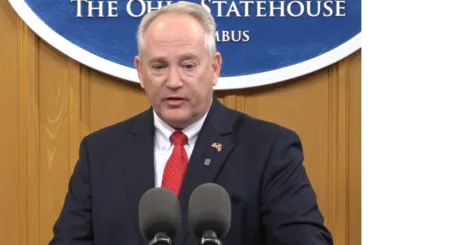
At a press conference announcing the indictments, Auditor of State Keith Faber described EGCC’s collapse as “a simple story about greed,” suggesting the Student Resource Center had “bribed ... top financial aid and admissions officers, and tampered with college records to hide (the alleged scheme) from regulators and auditors.”
Perik and Colclasure were cofounders of the SRC, with Perik serving as CEO and Colclasure as president.
A third SRC employee, Chief Student Experience Officer Luis Rosa, was not indicted. According to investigators, Rosa was on SRC’s payroll and was paid about $80,000 at the same time he was serving as EGCC’s interim financial aid director in 2018.
Even though he was never employed by the college, the indictment suggests Rosa was given the title, a college email address and access to EGCC’s internal systems and the federal financial aid systems. It alleges Rosa used that access to disburse more than $1.5 million in federal financial aid “to students who were not eligible to receive it,” and when they realized disbursements wouldn’t match up to individual student accounts, investigators say a consultant was hired to serve as an interim financial aid officer only to be terminated after he determined student aid had been improperly disbursed, student eligibility hadn’t been confirmed and the school “was not properly reporting students (who) withdrew from class.”
The indictment alleges the consultant had identified a $3.6-million student aid overpayment and began correcting the data, which triggered electronic notifications to Geoghegan that the college would have to repay the funds. The indictment alleges Geoghegan told him the college “had already spent the money and could not pay its bills” if the money was returned and instructed the consultant to stop correcting the data, ultimately firing him after he refused.
“The fallout goes far beyond dollars and cents,” Faber said. “The collapse and eventual closure of Eastern Gateway left a multi-county region in Eastern Ohio without a local community college option, creating effectively a higher education desert.”
Faber said the state of Ohio ponied up “more than $15 million in subsidy advances and emergency funds to (cover) the mess and prevent state-backed bonds from defaulting statewide.”
“Because Ohio’s state share of instruction operates from a fixed funding pool, Eastern Gateway’s ballooning online enrollment syphoned critical state subsidy dollars away from other Ohio community colleges,” he said, “while on the student front, thousands of students (were) left in complete disarray, dealing with forced transfers, risking Pell grant eligibility and creating a federal liability of more than $44.4 million for future educational opportunities.”
The indictment suggests the so-called criminal enterprise “functioned for the general purpose of obtaining as much money as possible from the disbursement of federal financial aid and state subsidies and then diverting those disbursements ... through fraudulent reimbursements and as incentive compensation in violation of federal law.”
According to the indictment, it did that by “creating the facade” that entities controlled by Perik, Colclasure and others “were independent and unaffiliated third party contractors” and by “disbursing and retaining financial aid for ineligible students, falsifying data and records and concealing data and records that would reveal (them), engaging in a fraudulent reimbursement scheme and obtaining Payroll Protection Program loans and loan forgiveness for reimbursed expenses and for ineligible payments, falsifying records and falsely stating that union scholarships were funding tuition and paying public officials for the purpose of improperly influencing them.
“The enterprise generally functioned to operate Eastern Gateway Community College primarily for the financial benefit of the entities owned and operated (by Perik and Colclasure) at the expense of the college’s mission, its students, the community and the taxpayer-funded financial aid and subsidies,” it alleged.
Faber said the indictments “demonstrate why inter-agency collaboration between local prosecutors, state auditors, federal law enforcement and the Department of Education are essential.”
Undersecretary of Education Nicholas Kent called the indictment an “important moment in our collective fight to combat fraud, waste and abuse” in higher education.
“This indictment today shows that we are resolved to protect the integrity and the long-term stability of our nation’s federal financial aid programs and going after those who seek to profit from low-income students,” he said, pointing out he himself is the son of an Ohio Valley steelworker and grew up about 10 miles from Steubenville and EGCC. He said the Trump administration “is proud that we are doing everything we can to promote federal aid programs that are free from fraud.”
“Our aim is to implement lasting reforms that make higher education more affordable, more accountable and also more transparent, so that these institutions truly serve in the communities,” he said.
Faber said one of the most troubling aspects of the alleged scheme is that “there are students who may not even know they had Pell grants taken out in their name.” He urged anyone who suspects their information was compromised “to check their records and protect themselves” and report their concerns to his office.
He said it took forensic auditors thousands of man-hours to unravel the alleged scheme, which he said “was made more complicated by the fact that the participants were in there changing records and doing things internally.”
“This has been a massive undertaking, but you don’t often run into a fraud scheme that is in the tens of millions and has cost hundreds of millions of dollars to Ohio, Ohioans and taxpayers,” he said, adding that if and when it goes to trial he expects the evidence to show “this was a scheme that was managed from the top and (that) made it much more difficult to discover.”
Kent and Faber thanked Jefferson County Prosecutor Jane Hanlin and Sheriff Fred Abdalla Jr. for their help with the investigation.