
Jefferson County 911 levy renewal vital for system
Trending
WINTERSVILLE -- Voters in Jefferson County will have the chance to show their support for the county’s 911 system when they cast their ballots for the Nov. 3 election.
They are being asked to renew the 1.5-mill, five-year property tax levy that provides most of the money required to ensure access to emergency help is available when it is needed. That works out to $26.25 for every $50,000 your property is appraised at.
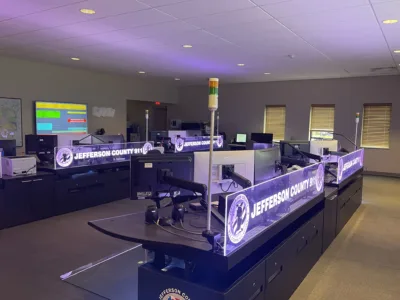
The levy, which generates around $2 million a year, represents 85 percent of the money needed to operate the 911 system, which, as Director Rob Herrington explained, is more than just the operations center.
“We also pay for the management and maintenance of the county-wide radio system, which is used by every agency in the county,” he said. “We provide the backbone system, which is six transmitter sites. We also provide all of the mobile radios for all of the police cars, ambulances and fire trucks."
Agencies are responsible for providing their own portable radios, he added.
The other big expense is running the system and all of the software and technology associated with it, as well as staffing.
There are three people on duty to answer calls around the clock, every day of the year, Harrington added.
Those people are part of a 16-person full-time staff which includes a deputy director, who manages software and handles discussions with agencies about addresses and other issues; two radio technicians, who manage cameras and infrastructure, all of the radio equipment and all of the network activity inside the building; and Herrington.
Their work ensures that the 38,000 or so 911 calls that come into the center can be answered promptly, and the needed help can be dispatched.
“Just figure about 100 calls a day,” Herrington said. “But at the same time, we have around 22 police cars on the road that are tied to us. When you add the traffic stops, missing people, stolen cars and all of the things that are managed through the system, there’s a lot going on.”
It means the center handles about 250,000 incidents a year, Herrington said.
During a recent Friday, morning, for instance, the center had handled multiple medical emergencies, a road rage incident, a structure fire and an emergency at a school -- and that was all before 10 a.m.
The remaining 15 percent of the operating money comes from the wireless surcharge, which in Ohio is 60 cents per line.
This renewal, Herrington said, is appearing on the ballot one year early. The board likes to allow time for two opportunities for the issue to pass, if needed, which means the renewal would have normally appeared on next spring’s primary ballot. Because there will be very few candidates or issues to vote on in that primary, it’s likely every precinct in the county will not be open. That means money needed to open every precinct in the county would have to be paid for by the 911 board.
That made it more practical to schedule a vote for this year’s general election.
Herrington is blunt about what would happen to the 911 system if the renewal does not pass: “I don’t see anything else other than to say it would close,” he explained.
“I don’t know of any other source for funding,” he added. “Nobody has really identified any other source. It’s not practical to look at a user fee. How would you do that? How would you collect that?”
Historically, Herrington added, some counties have placed surcharges on landlines. While that was an option 25 years ago, the majority of landlines have gone away as people have become more reliant on cell phones. That would make that surcharge astronomical, he said.
Ohioans pay less for their cell phone 911 surcharge than residents of neighboring states. In West Virginia, that monthly rate is $4.38 per line, and in Pennsylvania, it is $1.95 per line.
Early voting is underway in Ohio. The polls will be open from 6:30 a.m. to 7:30 p.m. Nov. 3.