
Credit unions share affordability agenda
Trending
STEUBENVILLE -- No matter where you turn these days, it’s very likely you will face a question about affordability.
From the price of food to the cost of gasoline and diesel fuel, the rising cost of living seems to take center stage on a daily basis.
While there are no easy answers, there are some things that can be done to help mitigate rising prices.
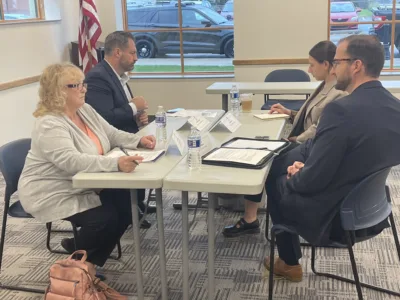
“Credit unions are uniquely situated to help people make life more affordable and to help people who may be struggling financially,” Matt Keyes, director of communications and marketing for the Ohio Credit Union League explained Friday at the start of a roundtable session in the community room of the Main Branch of the Public Library of Steubenville and Jefferson County.
Lisa Callahan, manager and CEO of S&J School Employees Federal Credit Union in Wintersville; Brendan Healy, president and CEO of Marietta-based Riverview Credit Union; and Hannah Ross, advocacy manager for the credit union league, shared their thoughts on a wide range of issues during the 45-minute session.
“Most of my members are struggling to pay minimum payments on credit cards, buying groceries, paying for medicine and things like that,” Callahan said. “We have a small base, and deal with school districts in the county. We see a lot of people with high credit card debt who come in and want to know how we can help them lower their payments, giving them a lower rate or helping them pay off their credit cards and things like that.”
Healy explained that inflation was the biggest issue facing American consumers. That’s something people have no control over, he explained, adding that one of the biggest factors he looks at in the economy is the price of diesel fuel.
“It’s gotten north of $6 a gallon -- we’re at about $6.53. When the price of diesel gets north of $6 a gallon, that means for a semi driver to go 1,000 miles, it now costs close to $1,000. When it gets to $8 a gallon, it’s about $1,333. That trickles down to manufacturing, to food and retail and is a big issue in agriculture.”
Friday’s session was one of 10 being held across the state this fall by the credit union league. Steubenville was the sixth stop in the series.
The tour comes as Ohio’s gubernatorial race heads into the home stretch -- Election Day is about a month away, and Republican Vivek Ramaswamy and Democrat Dr. Amy Acton are locked in a tight race to succeed Gov. Mike DeWine, who was prohibited by term limits from running for re-election.
That led the credit union league’s advocacy action league to put out a five-point affordability agenda that they shared with both candidates, offering to work with whoever wins the election to make life more affordable for Ohioans.
“Ohio credit unions are proud to serve 3.3 million Ohioans, and we work every day to meet the financial needs of each of those Ohioans, as well as the families they love, the communities they live in and the small businesses they patronize. As not-for-profit, member-owned financial institutions, Ohio credit unions are uniquely positioned to help make life more affordable for Ohioans and help them keep more of their hard-earned money in their own pockets,” the letter read in part.
Key pieces of the plan include more affordable housing, lower and fewer fees, reinvestment in Ohio communities, people-driven financial services and a focus on financial literacy.
“There are a lot of times people don’t have anybody to talk to,” Callahan said. “They don’t have anybody they can go to and figure all of this out, especially the younger generation. They weren’t taught this in school. They don’t teach a lot of banking, they don’t teach how to do a budget. So, teaching them these skills enables them to be better equipped for the future.”
Healy agreed, saying that a solid background is critical.
“I got my MBA in finance, and not once did they tell you what a FICO score was, or how to get a mortgage or how to pay your taxes. You know, the things that are going to deal with in life,” he said. “And it’s up to us to really pick up the baton on that one.
“Your foundation has to be on rock,” he added. “If you don’t have your budget in mind, if you don’t know how many streaming subscriptions you have, right? We will go down and get three months of statements and make a pie chart, and the first thing we look for is the Starbucks. Every single time someone says, ‘I need to make more money,’ it’s usually the case that they are not good with money, and it’s not their fault -- we were never taught this stuff.”
Making sure there is a steady supply of affordable housing is important in a community, participants said. That can be challenging as the area’s economy and demographics change.
“There are programs in the Ohio Valley that are offered to first-time homeowners,” Callahan said. “When I graduated from high school, you graduated and you followed in the footsteps of your parents and worked in the mill, and you were guaranteed a good wage. Now, these kids are graduating, and they are going away to college, and then they are staying away.
“I think the area’s school districts are growing, and we do have better schools here than in most of the areas around,” she added. “I do think people are coming here because of our proximity to Pittsburgh. A lot of people live here and work there.”
Housing stock is only one part of the issue. Making sure people know what they need to purchase a house is another.
“We have to educate them, realistically, about what it’s going to take,” Healy said. “This is the biggest loan you will have in your lifetime unless you become an entrepreneur. We have to get them to save for their down payment. You have to get them with four years of good credit history -- some guys will do two. So, if you’re buying a $200,000 house, you need $10,000 -- the best you’re going to have is 5 percent. You have to tell them about private mortgage insurance. So, realistically, people have to know what it takes to get a mortgage.”