
Costly projects on the horizon for Steubenville’s water, wastewater departments
Trending
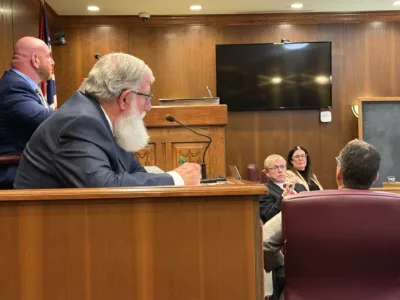
STEUBENVILLE--Utility Director Jim Jenkins gave council a rundown Tuesday of a lengthy--and expensive–to-do list for the water department.
During council's finance committee session Jenkins said the water department's long-awaited capital improvement plan was completed after an updated hydraulic model was completed earlier this year.
"(They) evaluate the distribution system and look at concerning areas of water flow, pipe age, break rations and critical user supplies to determine the projects," he said. "With the Phase II filtration plant improvement project underway with a completion date, it allows us to put the focus where it needs to be--on our distribution system or water lines."
The consultant identified 20 water projects across the city that, together, would span 15 years and cost a combined $34.5 million. Jenkins concedes it’s a big price tag, but pointed out they'll pursue federal and state funding opportunities wherever possible. He said, though that there's no guarantees they'll get funding and even if they do, it's typically going to be only "a small portion of the total cost."
He also pointed out Phase II of the $35.3 million water plant improvement project is in its early stages, while the Belleview water tower rehab was completed in August.
"Council has been discussing reducing the rates," he said. "There's a lot of work that (still)needs done in the city and the long-term plans are what determines what those rates need to be."
Jenkins said they'll do another rate analysis once the sewer long-term control plan is approved.
"(But) everything can't be paid for by grants or federal funding," he said. "For instance, funding for most water or sewer projects from state or federal agencies are only a small portion of the total cost."
On the wastewater side Jenkins said they're looking at replacing sewers on John Scott Highway, a non-negotiable drying bed at the wastewater treatment plant, required under the city's storm water permit, as well as the CSO12 Slack Street sewer elimination project and rehabbing the administration building which, while not cheap will cost substantially less than building a new one.
Jenkins said the wastewater department is "focusing on EPA-mandated projects and projects that have received federal grant money."
Mayor Ralph Petrella reminded council that as they determine spending priorities in the 2027 budget, they need to keep in mind the dire straits the sanitation department is in.
"Our sanitation department has been operating in the red for several years," he said. "We should have been incrementally increasing rates to keep up, but we haven't. There is a suggested rate increase to put us back in the black–that rate increase is under $10/month, which would be about $2.30 a week. This is greatly needed to get sanitation out of the red and to better our services."
City Manager Mike Johnson, meanwhile, told council they're "aggressively enforcing" the city's vacant property registration law.
While the ordinance was adopted several years ago, the city had been lax about making sure landlords followed the rules.
"It's an essential tool for protecting public safety, preserving neighborhood integrity, maintaining property values, and holding property owners accountable," Johnson said. "However, the effectiveness of this law depends on consistent and meaningful enforcement. When vacant properties are allowed to deteriorate without consequences, surrounding residents and responsible property owners bear the burden," he said. "Enforcing the law enables the city to identify responsible owners, address unsafe conditions, reduce blight, encourage rehabilitation, and protect taxpayer resources. Consistent enforcement is not simply about penalizing property owners; it is about ensuring that every property owner meets their responsibilities and that every neighborhood remains safe, attractive, and economically viable."