
‘United for ALICE’ to help struggling Jefferson Co. families
Trending
STEUBENVILLE -- A sobering reality faces many parts of Jefferson County: Nearly half of the county’s households -- 42 percent to be exact -- find themselves struggling to make ends meet.
A program being launched by the United Way of Jefferson County is looking to provide assistance to those who are in that position.
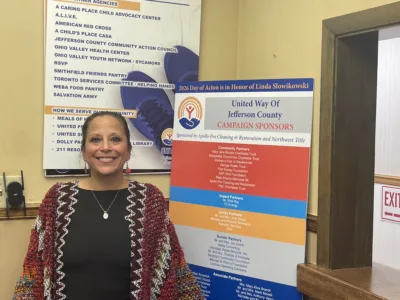
United for ALICE will help working individuals who are experiencing financial hardship. They are fully employed, but don’t earn enough to cover rising costs and find themselves constantly battling to stay above the poverty line, explained Marci Crawford, the executive director of the United Way of Jefferson County.
“These are working individuals who are earning money but are still struggling to pay for their basic needs,” Crawford explained. “So, they are living paycheck-to-paycheck, and say their car breaks down or they need a tire repair. Anything like that can throw them into a bad situation and leave them asking themselves, ‘What am I going to spend my money on?'”
The goal of the program is to help those who fall into the category of ALICE -- Asset Limited, Income Constrained, Employed -- maintain stability, stay employed and overcome barriers that affect their health, safety, housing, accessibility or their ability to work.
“I started looking into this program because I feel that our job as a United Way is to find gaps in services in the county and then look for ways to try and fill those gaps,” Crawford explained.
An application for the program can be found at unitedway-jc.org. There’s also a calculator there that allows potential applicants to determine their financial eligibility. Applicants must reside in Jefferson County and must demonstrate financial hardship or financial need. They also will have to submit documentation as part of the application process.
The program has $22,500 to distribute, thanks to funding from AEP and FirstEnergy. There’s a limit of $500 in assistance per household per calendar year, Crawford explained. When that money is exhausted, the program will have to quit making distributions. Crawford said she is exploring options to help continue funding for the program, including additional corporate sponsorships and help from local foundations.
There are several categories under which applications can be considered, she added. Those include prescription assistance, medical expenses, vision care expenses, dental expenses, transportation vouchers, auto repair (excluding cosmetics and general maintenance), wheelchair ramps and accessibility modifications, home repair (excluding cosmetic), essential appliance repair or replacement (including a refrigerator, stove, washer and dryer and hot water tank; air conditioning and furnaces are limited to repair only); and work uniforms and employment expenses.
“When you think about it, uniform and work expenses are important,” Crawford said. “Look at if you get a job with a company that requires you to wear steel-toed boots to start. What if you can’t afford those? We’re going to help offset any of those uniform expenses or employment expenses.”
Those categories were chosen after a lot of work by members of the committee that had been assigned the task of pulling the program together. Their work was not easy, Crawford explained, and they had to make some tough decisions about what they would -- and would not -- be able to initially cover.
If approved -- a process that likely will take five days after all of the information is provided -- the money will be sent directly to the vendor of the product or service. No dollars will be distributed to an individual who applies.
For Crawford, the institution of the United for ALICE program in Jefferson County is an important part of the organization’s mission.
“We have amazing agencies, but the need is unbelievable,” she said. “We get phone calls all of the time, and we are trying to offset some of that.”
One of the things Crawford said she likes about United for ALICE is that the levels needed for eligibility are set on a county-by-county basis. They are determined using a formula that takes into account the local costs of household basics -- described by the United Way of Ohio as housing, childcare, food, transportation, health care, technology and taxes. It is, the United Way explains, the gap between household income and what is needed to make ends meet.
That means, in Ohio, a person who lives in Jefferson County will have a different level than a person who lives in Franklin County (where Columbus is located) because of the difference in the cost of living.
The ALICE threshold -- the combination of households at or below the federal poverty level and the ALICE figures -- is a more accurate way of determining need because it takes into account those differences that exist among counties, the United Way explained.
Statistics show that in Ohio, 13 percent of the households are at or below the federal poverty level, while another 23 percent of the state’s households are in financial hardship. When you take into account the rounding of the numbers, that means 37 percent of Ohio’s 4,910,723 households are at or below the ALICE threshold.
Numbers in Jefferson County are higher or lower than the statewide average, depending on the community involved, Crawford detailed. In Adena, 59 percent of the 274 households are below the ALICE threshold, while in Brilliant, 59 percent of its 537 households are below that number. In Stratton, 57 percent of the 132 households have that status. In Dillonvale, it’s 55 percent of 259 households; in Amsterdam, it’s 52 percent of 145 households; in Empire, it’s 52 percent of 114 households; and in Steubenville, it’s 51 percent of 7,097 households.
The lowest number in the county, 28 percent of 106 households, can be found in New Alexandria. In Wintersville, it’s 30 percent of 1,803 households, while in Toronto, it’s 47 percent of 2,561 households.
Crawford said she plans to go to each of the communities in the county and make sure residents know what the United Way is doing.
“We want to try and see what the smaller towns need,” she said. “The problem with some of the smaller towns is that it’s harder for some of the residents to get to Steubenville, where most of the resources are. My goal is to try to bring the resources to them and see how we can help.”
For all of that to work -- and for the United Way to continue to offer new and expanded programs -- Crawford said finding additional funding and donations is important.
“I’m excited to kick it off,” Crawford said of United for ALICE. “It’s another example that we are not just the agencies that we raise funds for. We also have United Sole, Meals of Hope and Dolly Parton’s Imagination Library, and now we have this. I want people to realize that our job is to see the biggest needs in the county and try to fund those agencies that can help, or create our own support for those people.”