
Flock cameras spark debate in Steubenville
Public comments focus on privacy, transparency and Flock camera use
Trending
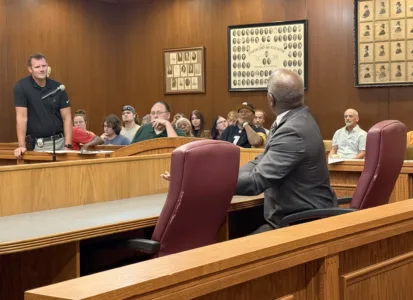
STEUBENVILLE -- A 14-year veteran of Steubenville's police force did his best Tuesday to allay concerns about the city's use of license plate-reading cameras on major thoroughfares, telling critics they've helped the department solve shootings, identify big-city drug traffickers trying to bring narcotics into the community and even identify stolen vehicles.
Detective Jake Mannarino's comments came during what turned out to be an hourlong public meeting on whether the department can continue using its 15 LPRs, better known as "Flock" cameras, to monitor major routes into and out of Steubenville. The cameras were leased through a grant from the Steubenville-based Mary Jane Brooks Charitable Trust. That lease expires in March 2027.
The discussion, surprisingly amicable, was peppered with concerns over privacy, the potential for information to be accessed or even sold to third parties, the potential for abuse by law enforcement and where they're located.
"The issue isn’t whether someone can be seen in public," Fourth Ward resident Marc Gregory said. "We have always understood that being in public means you may be observed at a particular moment. The real issue is the difference between observation and surveillance. Flock cameras don’t simply allow law enforcement to observe a suspected criminal in real time, they create networks that collect and retain information on countless law-abiding citizens first, with the ability to search through that information later. Just because I can be seen in public does not mean the government should be able to build a digital file documenting my movements everywhere I go."
Gregory said it's the kind of thing voters, not council, should decide, adding he has "over 100 names on a petition now" calling for a referendum.
"I'm trying to get 500 so we can put this on the ballot," he said. "This needs to be voted on, not just by the council but by the people, that's how I feel. It shouldn't be one man or five men that decide on these ... nobody here voted to put them up, so why are we even talking about it? [You] need to table this until we can get more information."
Resident Aubriana DiCarlo argued that "statistically speaking, there are more efficient and cost-effective uses for our money ... if what we are claiming to care about is actually reducing crime." She read from a long list of suggestions ranging from cleaning and maintaining vacant lots, improving or adding lighting to parks and other dimly lit spaces and ensuring students have safe routes to walk to and from school to investing in schools, education and youth programs as well as good-paying, quality, stable jobs and improvements to treatment and intervention services for mental and behavioral health, as well as substance use recovery services, mentorship and job training programs.
Mannarino pointed out the cameras are typically used for things like locating specific vehicles when there's an Amber Alert issued for a missing and endangered child, when a missing person alert goes out or to identify drug traffickers or those involved in other serious crimes.
Because Steubenville is just a few hours' drive from Chicago, Pittsburgh, Cleveland, Columbus and Cincinnati, he said "we're at the center of a lot of things, so we end up with a lot of people we're not familiar with. We also use LPRs to identify stolen vehicles and ... to develop investigative leads on burglary thefts and other criminal investigations."
"I use these cameras pretty much daily," he said. "I can tell you this -- they are fantastic for our major crimes. There’s some shootings we have solved within, you know, several days that would normally have taken months or never been solved [without them]. But the big things that these are assisting people with are thefts and burglaries and other minor crimes that would more likely go unsolved. I can tell you the business that has benefited the most from this would be our smaller stores and our gas stations that normally have you know $2 to $10 thefts, their camera systems aren’t as good. I’ve also had cases where we had multiple vehicles broken into -- I actually had a case [a few years ago] where we had a group of juveniles that actually hit cars in every neighborhood in the city. It took us two or three weeks to catch [them]. I can tell you right now, if I would have had these cameras at that point, we probably would have caught them in two days."
Mannarino also pointed out LPRs "don’t record voices or conversation, they don’t use facial recognition technology, they do not identify drivers or passengers, they cannot access your cell phone or your personal information. They do not detect speed, they do not issue traffic violations, they do not monitor people inside of vehicles."
He also pointed out the department has strict guidelines governing camera use as an investigative tool -- spelling out how information from them can be obtained and used, with stipulations that the data can be used for official purposes only. Users must log in and any unauthorized activities would be flagged -- with violators subject to disciplinary action.
"Why were they put up in secrecy?" Gregory asked. "This [council] didn't even know [they were put up]."
Councilman Royal Mayo, who took over as chair of Steubenville's Safety Committee in January, complained that he wasn't even aware Steubenville had LPRs until Gregory sounded the alarm last month and insists he should have been consulted and any policy and decision should have run through council -- not the police department.
"I don't know, I wasn't involved in [that]," Mannarino replied. "I know people are concerned, I totally understand it, for privacy. One of the discussions we had was where they'd be most useful, where they'd be least intrusive. Our cameras are more on major thoroughfares. I believe one could possibly be considered a neighborhood camera."
Gregory and Mayo, in particular, questioned why roads in low-income and predominantly Black neighborhoods were chosen, among them Seventh Street.
Mannarino pointed to it being "one of our busier areas" with a high population density.
"You have more people living in a smaller area," he said. "Where you have more people living in a smaller area you tend to have more crime."
"That's an assumption," Gregory muttered.
"I’ve been here 14 years, I have a degree in criminal justice," Mannarino replied. "One of the things that I’ve been doing since I’ve been here is I regularly checked crime reports from the FBI, I checked that [information] against areas of the city and when I was in the patrol division I would actually go through each week and I’d mark off, 'OK, we had this many cases, this many thefts in this area of the city' and stuff like that, just to know where my patrols would be focused and I can tell you Heritage Place has been consistently at the top of that list.
Mannarino also pointed out there "are cameras in the west end where we have crime ... John Scott Highway, Sunset Boulevard. Lowes has a camera of its own camera [pointed at the business]."
"I'm not against the cameras as long as they're used right," Gregory said.
"You have every right to voice your opinion," Mannarino agreed. "You have every right to discuss this with us. I can tell you right now, I was a field training officer for seven or eight years and the biggest thing that I stressed to the newer officers was how [that] badge is the most important thing that [they] have because the trust of the community is in that badge. You trust us with a lot -- you trust us with making life or death decisions. You trust us with protecting you and your family and everybody else."
DiCarlo pointed out there have been 10 reported cases of Flock abuse in Ohio, but Mannarino explained Steubenville Police Department has strict guidelines in place limiting how and by whom they are used.
"Unfortunately there are bad actors in everything," Mannarino replied. "But I would say the same officer who abuses the Flock cameras has access to LEADS [Law Enforcement Automated Data System] which has access to your personal information. The same police officer has access to a firearm every day when he goes to work. It is a scary thing. You know, one of the big things that everybody’s pushing now is a stronger hiring processes. Fortunately for us, we’ve always had very strong hiring processes."
Mayo complained that the city has six LPRs in two neighborhoods, saying "you catch your fish where you cast your net." Mannarino, however, pointed out that the cameras are typically deployed in pairs, one pointing in each direction.
"The cameras aren't probable cause, they're a tool," Mannarino said.
Mayo also pointed out there can be "bad people" accessing the information.
"There's the potential for bad actors everywhere, but I don’t think you punish [everybody]," Mannarino replied, adding the department's "strived to be on the top of a technological ladder for our citizens."
"Our job is to improve the lives and quality of life of our citizens," Mannarino said. "And I can say that by using this type of [equipment], it does improve."
"I thought your job was to protect and serve," Mayo countered. "I thought [council's] job was to do what you just said, you understand what I’m saying? I think by protecting and serving properly, you can help everybody."
Mannarino pointed out that a few months ago there were two "shots-fired" incidents in town for which they were able to make arrests in minutes “because we had because we had descriptions of the vehicles, we had an idea of what model the vehicles were, we had an idea of the plates and the owner of the vehicle."
He said in one instance the driver fled the city, headed to Wheeling but "we were able to locate that vehicle within 24 hours. We created a search warrant for that vehicle. We obtained a lot of information through that search warrant, through that investigation, so they could ultimately [obtain] a conviction for a person who'd shot at a house where there was a baby sleeping."
Gregory, though, pointed out that "old cops did their jobs on the streets. The new cops are in the office, looking at TV screens."
Mannarino said he views a lot of footage during the course of his workday, sometimes disproving false claims. He said a preteen recently claimed he'd been hit by a vehicle while a woman claimed her parked car had been hit outside a downtown repair shop. He said he used cameras to disprove the bicyclist's claim and to verify the damage to the woman's car was done weeks before.
Council is slated to vote next week on authorizing continued use of the LPRs. Even if it passes, Mayo said they'd have 30 days to get enough signatures on petitions to force a referendum. He said his preference would be to "take them down or cover them up."