
Waterline dispute puts Jefferson County Commissioners at odds
Trending
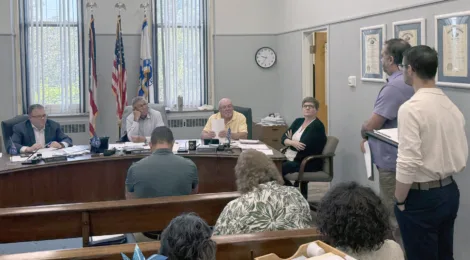
STEUBENVILLE -- Long-simmering tensions surrounding a sewer line relocation that somehow was done without an official vote, a contract being signed or a work order issued spilled over Thursday after Jefferson County commissioners were asked to approve payment of a $240,000 invoice submitted by the company that did the work.
That invoice, submitted by Border Patrol owner Jeremy Yeager, was to relocate a waterline on State Route 213 that was in the state’s right-of-way. If it wasn't done, ODOT had threatened to cut service to some 2,000 county water customers.
While former water superintendent Mike Eroshevich brought it to them in 2024, they didn't have the money to get it done and it ended up being filed away. It wasn't until this year, when the state Department of Transportation announced work was to begin in March, that it moved to the top of the priority list.
Auditor E.J. Conn, however, has said the invoice cannot legally be paid "until the defects are corrected." He's already rejected several other bills for lesser amounts that were previously submitted by subcontractors for work associated with the same project.
Conn has said his hands are tied.
"The only thing that I know at the moment is that I still cannot pay (the invoices) until the defects are addressed," Conn said. "As for what's next, it will all depend on how they are advised to address the issue."
At last week's meeting, commissioners received permission from Common Pleas Judge Joseph Bruzzese to hire outside counsel to represent them as a board. So far, that hasn't happened, though they did meet in executive session after that meeting to discuss "potential litigation."
Commissioner Eric Timmons voiced frustration at the prospect of them as a board having to hire outside counsel because "I don't want the citizens to have to pay for (it)."
"We've...just got to figure out a way to get these people paid, you know, whether it was miscommunication, whatever it was," he said. "I mean, transparency-wise, I don’t think we need all the attorneys and all that, we've just got to get this figured out. I don’t know what happened."
Timmons asked Andrew Dawson, the water-sewer department's engineering consultant, "Did one of us tell you to do it, can I ask you? Do you know what happened?" a question Dawson declined to answer by saying only that, "I reserve my right to comment on that at a later date."
Commissioner Tony Morelli said he's also "sick and tired of it, just sick and tired of it" and said he'd talked with an attorney on behalf of himself and Timmons, an admission that drew an immediate reaction from Commissioner Jake Kleineke.
"Wait a minute, you two have your own counsel and I have my own counsel right now?" Kleineke asked.
"We have for a while," Timmons said.
"I didn't understand that that was happening, that you have the same counsel and I have a different counsel, that's what you said?" Kleineke repeated, bristling. "What I’m saying (is) singularly, one (attorney)?"
Morelli told him the attorney was helping "as a friend" and isn't interested in representing them as a board. He said they'd paid any fees incurred out of their own pockets.
"I don’t have a problem with anybody having their own counsel," Kleineke replied. "I'm just saying one person representing (the two of you) and one person representing me..."
"Remember, when we started this, you said you were talking to somebody...and we said the same thing," Timmons pointed out.
"I just didn't realize you didn't get singular counsels for your own self," Kleineke complained.
"Right now he's doing it as a friend, that was before this 'Writ of Mandamus' came up, so I asked him about that, and he was going to check into that...But what I think is if we do that, then it’s not over for all of us -- we can still get sued, we can still probably have to go to court."
Conn previously had told commissioners they'd have to ask a judge to issue a writ of mandamus -- a court order that, in this instance, would compel him, as county auditor, to pay the invoice. If commissioners were able to secure the writ, he would then issue the payment "under protest," which means he and his office could not be held liable for the expenditure and the Ohio Auditor of State would review it during the county's next audit.
No one has said what would happen if the judge declines to issue that order.
Kleineke described his understanding of a mandamus as "basically a backboard function to pay a bill that wasn't processed correctly in government."
"My thing is, let’s just get it moving.," Timmons said. "Like I said, I’m tired of. I get asked about it every other day, at least."
"Well, I wanted it done," Kleineke said, prompting Morelli to ask him if, when he left their work session, he was under the impression the project was a go.
"Did I tell somebody to go do it, did I hire a contractor?" Kleineke replied. "No, I don’t say that. I would say I wanted it done. I wanted to know where the parts were, I wanted to know what the status was ..."
Kleineke said his concern was that the state would follow through on threats to cut the service line if the water line was in their way when crews started working on a groundslip.
"So anyhow, it’s done. It’s done, and there’s nothing we can do about it...And we need to pay the bill one way or another, however, legally we can pay the bill."
"As I said last week, it was a public service necessity to get it done one way or another because we were going to lose service to all those people, probably more than 2,000 or 3,000, because the state wasn’t going to stop."
Morelli said if it ends up in court, "I'm going to tell the truth," decrying the fact that the work was done without bids, their approval or money being appropriated.
"We don’t look good, period," he said. "And if I’m asked, I’m going to tell what I know, what I remember."
Kleineke denied calling Yeager after the meeting to tell him work could proceed.
"I didn't call Jeremy right after this meeting, I had a meeting at the golf course by his house and we had a conversation," he said. "I told him 'that was pretty good work, you did with Arcadis, designing a way for this to get done. I sure would hope to see you get the job..."
"There was a phone call," Morelli countered. "There were other things mentioned and I hope I don't have to say them because there were some things that...I don't know if you don't remember about the call because I was very surprised, maybe we had a bad connection. But you called me and told me you told him it was his job and you also told him something about some other subcontractors and so forth. I think that's how we got here, Jake."
"I don't recall that," Kleineke responded.
"Well, you can only go by what you remember, that's for sure," Morelli said.
"We can place blame back and forth and say that I did it, that I ordered it, whatever," Kleineke said. "But one thing's for sure -- it probably saved the county $1.5 million and (those) 3,000 people still have water today."
Morelli said had it come back for a vote, "I think Eric said he would have voted yes. I think I would have still voted no and went out to do it the proper way -- there’s a way you can do it in emergency, but that's not the way we did it."
"I would have voted yes eventually, it needed to be done," Timmons said, though he questioned how an issue brought to them in 2024 could be considered an emergency two years later.
"Well, because they were ready to start," Water Superintendent Jonathan Sgalla said. "There wasn’t (time)...ODOT had a contractor on board, a signed contract. If that contractor couldn’t start when they wanted to start, they would charge ODOT liquidated damages so the state would have been paying liquidated damages until the water line was abandoned so they could start."
Morelli said he didn't find out the water line relocation was being done until he called Sgalla for an update on something else "and at the very end said, 'Hey, what’s going on with 213?' What I meant was, 'When are we going to see it again so we can vote on it,' and you told me they were 95 percent done."
He said somebody "had to have told the contractor to start...must have assumed that we were all in to do it," and asked Sgalla and Dawson if they left one of two water department work sessions with the impression that it was a go.
"I'm probably overspeaking," Sgalla said, "but it seems like, you know, potentially fingers are being pointed this way."
Dawson also declined comment, pointing out, "You can't ask me to testify right now when all three of you have your individual attorneys. I'm not that dumb. I know somethings going on but I'll happily comment (at the appropriate time)."
"All I want I to figure out how to pay the bill," Timmons said. "I don't care what even happened, at this point, miscommunication or whatever. We just need to figure out how to pay these bills and then (let it) take its course...We need to get these invoices paid, that's the bottom line. I'm not accusing anybody of anything, I don't care at this point but we just need to figure out how to get them paid."
Morelli said he wants the bills paid as well, "but I just want to make sure that it's clear that I'm not saying that I agreed to do something that was not done the way it was supposed to be done according to the Ohio Revised Code just because I wanted to help some residents. I think that's great, I had the residents in my mind, trust me."
Commissioners voted 2-1 to send the invoice to Conn, conceding it's certain to be denied but it would clear the way for them to take the next step.
"We have to hire special counsel for the board, that's the next step that was recommended to us," Morelli said.