
Vaccinations best measles defense, Ohio Valley health officials say
Trending
STEUBENVILLE -- Whenever you ask Andrew Henry a question, you are sure to get an honest answer.
That made his response to a recent question about the status of measles in the region interesting.
“If you would have asked me several years ago, when I was new in this position, if we’d be having a conversation about measles, I’m not sure it would have been on my bingo card,” Henry, the health commissioner for the Jefferson County General Health District, explained.
According to the Centers for Disease Control and Prevention, the number of cases that have been reported this year -- 2,566 -- already has exceeded the total cases reported in all of 2025 -- 2,289. And while there have been no deaths attributed to the disease so far this year, three deaths were reported in 2025.
“It was obviously coming in 2021, it just was not a communicable disease that we were watching closely,” Henry added. “Even last year, there was a growing concern to a level where we were monitoring it. This year, we might be proactively trying to vaccinate the community more, and we might be doing some vaccination clinics that we might not have otherwise thought we had to do.”
Officials with health departments in Jefferson, Hancock, Belmont and Ohio counties said there have not been any cases reported in those areas. There has been a case reported in Harrison County, and on Thursday, the Allegheny County Health Department said an individual who was at the emergency department at UPMC Children’s Hospital of Pittsburgh on Aug. 12 and Aug. 18 had tested positive for measles.
That individual was not from Allegheny County, the department said, adding privacy concerns prevented it from offering any other details.
Numbers from the CDC show that as of Aug. 13, Ohio had 47 cases, West Virginia had two cases and Pennsylvania had 280 cases. Those numbers were all higher than what had been reported through the same period in 2025, when Ohio had 40 cases, Pennsylvania had 16 cases and West Virginia had no cases.
“Measles is not a benign infection that has no consequences,” said Howard Gamble, administrator of the Wheeling-Ohio County Health Department. “Measles, mumps and rubella are the diseases that make up the MMR vaccine, and those diseases have had a devastating effect on society through the years. However, as lifetimes progress, many times we don’t remember what exactly happened.
“A lot of times, you will hear someone say, ‘When I was young, kids got measles, got over it and everything was fine,'” Gamble added. “For the majority of kids, that might have been the case; however, complications do, have and will arise.”
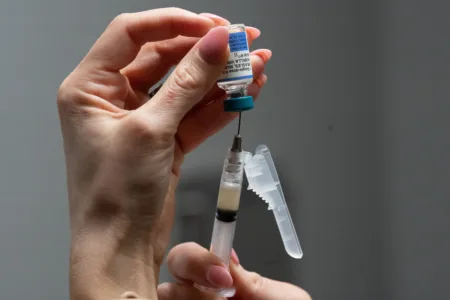
Henry, Gamble and Michelle Berneburg, a registered nurse with the Hancock County Health Department, agreed that vaccines are an important tool in helping to stop the spread of the disease. It’s critical because, as Henry pointed out, measles has a 90 percent attack rate, which means if you are exposed and are unvaccinated, there’s a 90 percent chance you will get the virus.
Berneburg said that the usual vaccination rate in Hancock County is between 95 percent and 98 percent. That number is from the 2023-24 school year, the last for which statistics are available in West Virginia.
Vaccination rates are off slightly during the past two years in Ohio and Pennsylvania. For the 2024-25 school year, Ohio’s vaccination rate was 88.3 percent, while Pennsylvania’s was 92.4 percent. In 2023-24, Ohio’s rate was 89.2 percent, Pennsylvania’s was 93.5 percent and West Virginia’s was 98.3 percent.
“We explain the importance of all vaccines, specifically how contagious measles can be,” Berneburg said. “If parents still have concerns, they can apply for a medical exemption with the state, and they can also contact the state if they have concerns over a religious or philosophical exemption.”
Henry said that the vaccine is highly safe and highly effective. It’s a two-part vaccine -- he explained that the first dose, given when a child is between 12 and 15 months old, is 93 percent effective and the second dose, which is given when the child is between 4 and 6, brings that number up to 97 percent.
“We’re seeing the virus spread in the non-vaccinated population more rapidly than we have seen,” Henry said. “Ultimately, the decrease in vaccination status is going to be your net No. 1 contributing factor. Obviously, there are no guarantees, but 97 percent is a pretty impressive number.”
Education about the vaccine is important, according to Gabrielle Timko, director of nursing for the Belmont County Health Department.
That includes a discussion about risks vs. benefits; an explanation about how a vaccinated child prevents the spread of measles, mumps or rubella to those who cannot receive the shot; and a discussion about herd immunity and how it’s crucial for maintaining community immunity, which protects those who cannot be vaccinated because of medical conditions, age or pregnancy.
Preventing measles, mumps and rubella far outweighs the minimal risks associated with the vaccination, she added.
“What we are seeing lately is an increase in opting out,” Gamble said. “That causes problems. If we stick with MMR, the problem we are eventually going to run into is that we are going to go below the threshold percentage that gives us herd immunity. This has happened before in society. Japan had it with pertussis and other countries have seen it when you drop the stringent requirements or people opt out of the vaccine for other reasons because of whatever the issue is. The disease finds a way to come back.
“It doesn’t care about politics. It doesn’t care about what’s going on with games, school or life. It finds a way to come back, and it gets a hold on the population,” he said.
Gamble said that when you see numbers about cases, it’s important to remember that those are cases that have been confirmed and reported. There are likely others who have developed measles and not sought any medical attention, which means the actual number of people who have been affected will be higher.
Henry said if a person is exposed and does contract measles, symptoms will begin to appear between seven and 14 days after infection. The first symptoms include a high fever, cough, runny nose and red, watery eyes. About three days after those symptoms, a person could develop tiny white spots that usually appear inside the mouth. The measles rash usually appears between three and five days after symptoms first begin. Most people will recover within seven to 10 days after the initial symptoms appear.
“The public health and physician communities are there to provide an opportunity for people to get vaccinated because we know it’s effective and efficient, and it does protect us against measles,” Gamble said. “Both groups are there to provide the vaccine in a very efficient and safe way.”
Vaccines remain the most effective way of avoiding the measles, the health professionals agreed.
“There is always a risk of contact with the virus, especially with travel and the unvaccinated,” Berneburg said. “Children who are too young to be vaccinated and children who are immunocompromised are at risk, especially if those around them are not vaccinated. That’s why vaccinations are so important.”