
McKinley STEM pupils keep things growing
Trending
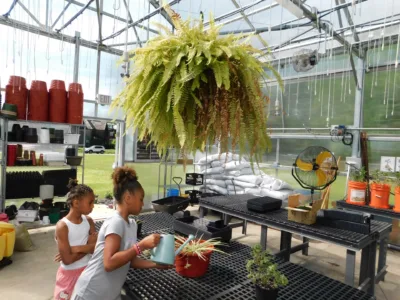
STEUBENVILLE -- Students at McKinley STEM Academy are continuing to learn about nature as they take time each week this summer to water flowers and other plants in the school’s greenhouse.
Dubbed the Summer Sprout Squad, the children gather there each Tuesday to weed and water the vegetation under the direction of Heather Ramsey and several other teachers.
As director of the school’s "ag" lab, Ramsey reminded the pupils that plants "drink" water from the soil that surrounds them through their roots, drawing from it the nutrients they need to grow.
The children went about their work using watering cans and spray bottles, depending on the children’s ages.
But Ramsey said even the young kindergarteners have learned the importance of directing the water at the plants' base so it can be absorbed best.
Heated to 65 degrees to 70 degrees in the cooler months, the greenhouse offers an opportunity for learning through the year.
Ramsey said pupils also grew cherry tomatoes and cucumbers during the winter using hydroponic towers.
The towers resemble 6 foot tall circular trellises and are equipped with a circulating water system and a timed light, allowing certain plants to be grown without soil.
"They couldn’t wait to taste the cucumbers and the second graders made pickles from some of them. They didn’t know that pickles come from cucumbers and were impressed by that," said Ramsey.
She said the elementary grades are a good time to expose children to agriculture.
"The kids are little sponges. They love to learn," she said, noting each class participates in a 45 minute agricultural experience on a weekly basis.
Mackenzie Filtz, who teaches fourth graders at the school, noted lessons in the students’ other subjects also are tied to principles taught through the ag program.
Science lessons are a natural fit, but the children also have learned in social studies, how a place’s geography and climate affect its plant life, she noted.
On a lighter note, Ramsey added that after hearing the fairy tale, "Jack and the Beanstalk," some of the pupils set about doing their own planting.
"The beauty of it is everything meshes together," she said.
Filtz said the school’s agricultural experiences also have extended to Historic Fort Steuben, where first graders planted flowers in observance of America’s 250th birthday and learned from historians there how various plants were used by this area’s early settlers.
She said fourth graders used math to determine the dimensions for bird feeders to be hung in trees outside the greeenhouse.
Filtz said during a visit to Steubenville High School, carpentry students there cut blocks of wood for the feeders, while the children assembled them.
Filtz’ students took a break from their recent turn at the greenhouse to inspect a bee hive added to the its grounds through Youth Bee Works, a non-profit organization that partners with schools and other groups to educate the public about honey bees and the role they play in the environment as pollinators.
The hive sits within a tall, wooden enclosure with a window through which the pupils may view the bees' activity.
Behind it is a wire fence that allows the bees to fly into nearby woods and the flowers from which they collect nectar for their honey.
The students also can listen to the bees’ activity through sound magnifying devices.
Ramsey said pending future grants, Lynette Gorman, the school’s principal, would like to add tiny cameras to the bird feeders to enable the children to view activity there.
Shana Wydra, Steubenville City Schools' director of Technology, Engineering and Math education, said, "McKinley STEM Academy’s location within a city school district in predominantly rural Jefferson County creates
a unique environment where students engage in agriculture, sustainable food systems, environmental stewardship and hands-on STEM learning."
She noted the greenhouse and other aspects of the agriculture program were supported by a U.S. Department of Agriculture Farm to School Planning Grant and a USDA Patrick Leahy Farm to School Implementation Grant.
Wydra said in addition to the USDA grants, the school also has benefited from a U.S. Department of Education School Climate Transformation grant and matching local funds for such grants from the school district.
She said in addition to Youth Bee Works, the ag lab has flourished through partnerships with the Ohio State University Extension Office and its master gardener and 4-H programs, collaborations with Bender Farms and Lowe's Home Improvement, and the involvement of the McKinley STEM Academy board, the students' parents and other community members.
CAPTION FOR GREENHOUSE PHOTO: Heather Ramsey, director of McKinley STEM Academy's ag lab, distributed supplies for pupils, parents and other volunteers watering and weeding plants at the school's greenhouse. Groups of students, parents and others have been visiting the greenhouse each week this summer to care for the plants under the direction of Ramsey and other teachers at the school.
CAPTION FOR WATERING PLANTS: Dominance Crawford, 8, of Steubenville, right, waters one many plants at the MeKinley STEM Academy greenhouse as her cousin, Serenity Dozier, looks on. Crawford is among many pupils at the school who have been caring for plants at the greenhouse, which is part of an ongoing effort to teach the children about agriculture.