
A forgotten cemetery, a family memory and questions beneath the soil
Trending
STEUBENVILLE -- Growing up, Maureen Gillespie Lovell recalls hearing how her great-aunt, Mary Ann Duffy, died in the mid-1870s.
"My grandfather always said when she was about 3 years old she drowned in a rain barrel on the side of the house and was buried in 'Leicy's field,' that's what we called it then," said Lovell, now 70 and living in Columbus. "Growing up, we always knew it was an old cemetery."
What Lovell recalls as Leicy's field -- better known in newspapers of the day as the "Catholic cemetery" or "Jacksonville cemetery" -- is located behind the Laundromat at the top of Washington Street Hill. The last burials there were in the mid-1880s, when Mt. Calvary Cemetery opened.
The abandoned cemetery made headlines in March, when about "five or six" gravestones were uncovered during preconstruction activities. The new owner, Woda Cooper Companies, plans to build as many as 50 senior citizen housing units. This week, human remains were found by an archaeological site inspection team in the vicinity of two of those markers.
Up to that point, a spokesman for the Diocese of Steubenville, which did not form until 1944, said this week officials believed all of the remains had been moved to Mt. Calvary when it opened in 1883.
If interment and reinterment records exist, the Diocese of Steubenville spokesman said they would be held in the archives of either the Diocese of Cincinnati, which had control through 1868, or the Diocese of Columbus (1868-1947). It is not known if diocesan officials in those communities have looked or are searching their archives for the records.
Lovell, though, said she does not need the Diocese to tell her where Mary Ann's remains are.
"She's still at Leicy's field," she insists. "Everybody wasn't moved, it was well-known in my family Mary Ann is still there. My mom and her four sisters, they always said a prayer for her when they passed Leicy's."
She recalls in her youth, when friends were sled riding down Leicy's hill, "we weren't allowed to because it was a cemetery," she said.
"It makes me furious. I don't understand how they didn't know (they were still there) -- I can't be the only person who knew about it," said Lovell, who concedes that for years she was consoled by the thought that even though the gravestones had long since toppled and they couldn't visit her grave, her family knew Mary Ann's remains were still there, undisturbed. "I knew she was OK."
But that sense of peace evaporated when she found out a contractor had been moving dirt at the old cemetery to prepare the site for construction of a 59-unit affordable housing complex for seniors, she said.
"The fact that all those graves were destroyed really upsets me," Lovell said. "And if she's in some 'dump pile' now ... oh, my gosh, that's so bad."
Whether Mary Ann Duffy's remains are already in or destined for "some dump pile" isn't known and may never be.
Earlier this week, the archaeological team discovered human remains -- described in police reports as a jawbone and several teeth, along with "the outline of the casket, including a handle" -- while excavating near the spot where a stone bearing the names of Patrick and Bridgitt Hargrove was found in March. The marker, weathered and covered by the soil that built up over the years, is difficult to read, but Patrick Hargrove died in the mid-1860s.
By midday Thursday, workers searching for human remains at the old cemetery appeared to have located at least two more areas of interest.
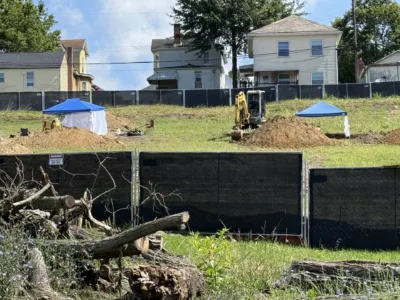
Pop-up canopies were put up and plastic sheeting was rolled out next to oversized holes workers dug in the soil of what local historians believe had, at one time, been the final resting place of 200 or more people. At one point, workers attached curtains to three sides of one of the canopies, then an individual stood at the open side with a camera memorializing whatever was on the plastic.
Over the years, the hillside became overgrown with vegetation, eventually overtaking grave markers that had fallen on their own or were knocked to the ground. Preservation professionals not affiliated with Woda or its consultant, ASC, say the stones that were found "were in topsoil but were covered with subsoil, so the whole cemetery had been covered at some point with dirt -- explaining why they were underground."
The markers, buried under years of soil buildup, are difficult to read, though the Hargrove stones bear a date in the mid-1860s.
Woda's pre-construction dirt moving was halted when a supervisor spotted stones from the Hargrove graves near the front of the cemetery, as well as a handful of smaller stones closer to McDowell Avenue that at one time marked the graves of children. Individuals who had been at the site the day those stones were found talked about "seeing headstones loaded and hauled away, large flat stones they thought were sidewalk pieces," a source recalled.
"Two headstones and a foot stone were found, as well as shards from dozens of headstones that had been strewn across the property," that source said.
In April, Woda had reported 146 truckloads of dirt, "more or less," were hauled away before the markers were discovered -- all of it to Follansbee -- but a Jefferson County property owner has since admitted to having four truckloads of dirt.
This week, an individual at the worksite declined comment, but when told about the truckloads of dirt deposited locally, did indicate that "164 truckloads" had already been inspected and nothing had been found. That person also said they "all were aware" of the existence of the four truckloads in Jefferson County but did not say if that soil had been checked.
As of noon Friday, no one was working at the abandoned cemetery site and the canopies were gone. City officials, however, last week confirmed they'd been told the team had identified nearly 100 potential grave shafts that merited inspection.