
Corabi honors wife’s memory with health center donation
Trending
STEUBENVILLE -- A memorial donation of medical equipment to the Ohio Valley Health Center will help provide important information to area women and their health care providers.
Local attorney Joe Corabi donated the device, a Sunlight MiniOmni Portable Bone Density Scanner, in memory of his wife, Kathy Corabi.
“After my wife passed away, I wanted to do something in her memory,” Corabi said Thursday during a presentation at the health center. “She worked in the medical field, and then she went to work at the School of Bright Promise. She was always doing something for somebody, and she created this legacy of love and care.”
A retired Toronto county court and Jefferson County probate and juvenile judge, Corabi said he had been looking for a meaningful and effective way to remember his wife, who died on Jan. 3, 2020. That changed after a discussion with Ann Quillen, executive director of the health center.
“I didn’t want a gift that would only help one person one time a year or just a couple of people,” he said. “When Ann started to talk about the bone density machine, a light bulb kind of went off in my head, because I thought, ‘Here’s a way for my wife to help many people for many years.
“So, I approached Ann, and I’m so grateful for Ann and the board and the health center, because it’s given us an opportunity to do what I wanted to do and what will carry on my wife’s legacy of love and caring,” he added.
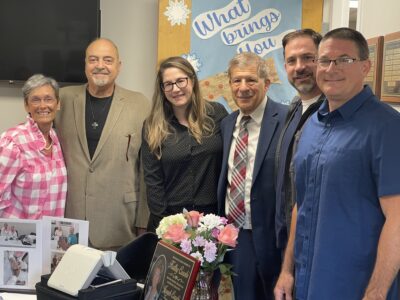
He was joined by his sons, Ryan and Craig; daughter, Krista Corabi-Spence; and officials from the health center for a ceremonial ribbon cutting for the device.
While not a diagnostic tool, the device does measure bone strength and assess a person’s risk of osteoporosis.
Dr. Diann Schmitt, a provider at the health center, said the scanner is an important tool and already has received a lot of use. In 30 days, she said, they had screened 44 women at various events, some of whom discovered their bone density numbers had reached critical levels that they were not aware of.
“We were able to provide education, vitamin D supplements and calcium,” she said.
Corabi’s donation came at a perfect time, she said.
“When Joe came to Ann and said that he wanted to do this, he did not realize that she was already working on a women’s health grant that we wanted this to be included in, and we were thinking, we can’t afford that,” Schmitt said.
“Then she calls me one day and said, ‘You’re not going to believe this,’ and I’m like, ‘I don’t -- this is absolutely wonderful,” she explained.
Quillen said her mother had fallen and suffered several broken bones, and that led her to push for the device.
“It was personal,” she said. “If my mother had had the treatment when she was younger, or the diagnosis, she wouldn’t have had to live through the pain and suffering. So, when Joe said he wanted to make a donation, I knew exactly what I wanted to do, because the women that we care for here at the clinic who are uninsured or underinsured, do not get this kind of screening.
“For us to be able to offer that service is very meaningful and will be life-changing,” she added.
Men can benefit from the screenings as well, Schmitt said.
After the presentation, Quillen said the device will provide important information.
“When people are medically uninsured, many health issues go untreated,” she reiterated. “You know, they don’t have regular screenings like other people do -- colonoscopies, mammograms, Pap smears and bone densities. It’s not available to them. So, for us to be able to offer this service, it’s about prevention.
“It’s teaching them how to provide for their bodies, and providing them with supplements, because supplements and eating a healthy diet will help prevent the onset of osteoporosis,” she added.
Quillen pointed out that the health center’s typical patient is a woman in her mid-to-late 50s.
“This falls right into taking care of the No. 1 type of patient we care for,” she added. “Right now, we have been using it at events, but, moving forward, we’ll make it a regular part of our patient visits.”
Schmitt said results of the scans can help identify the risk for osteoporosis, which helps providers.
“Practitioners can start talking to patients about what they can to mitigate those symptoms,” she said.
That includes a wide range of topics including good education, discussion about nutrition management, blood levels and exercise -- movement is a key, she added.
“That’s what it means for us, and then we don’t have to worry about our patients falling,” Schmitt said. “Once an older person falls, the likelihood of them returning to pre-fall is very, very low. It’s very challenging for them. So now, we give them hope.”
Corabi, a member of the center’s board of directors, said the organization, whose mission is to provide quality health care to the uninsured and underinsured members of the community, does great work.
“It’s awesome,” he said. “Every time you come to a meeting down here, every time you attend a function, you feel good, because you are helping people who are not as fortunate. If you take time to do that, you make the world a better place. That’s what I hope this machine does -- make the world a better place.”