
Hancock County considers conditions for addiction treatment funding
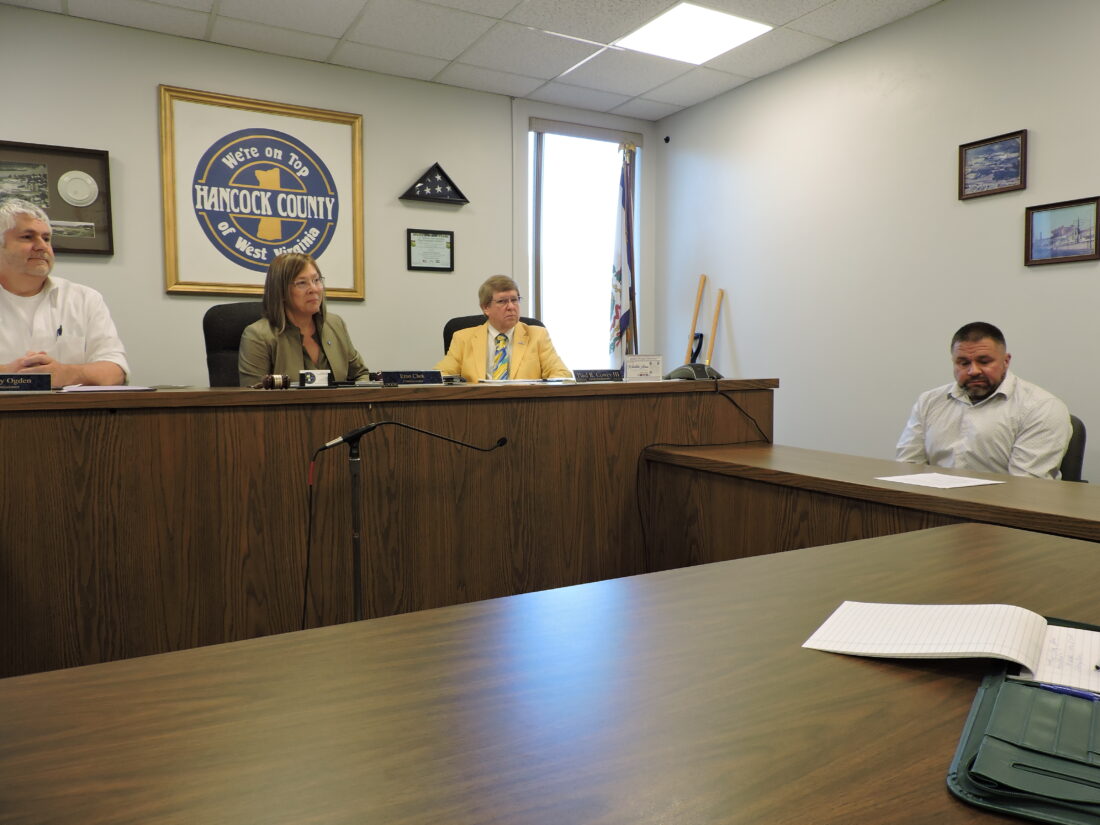
Craig Howell PROPOSING A FRAMEWORK – Hancock County commissioners, from left, Tommy Ogden, Eron Chek, and Paul Cowey, met with representatives of Family Care Excellence Thursday morning, including President Josh Lytle, pictured at far right, to discuss a potential memorandum of understanding to be tied toward a request from the organization for a share of the county's opioid settlement funds.
NEW CUMBERLAND – Steps are being taken to draft a memorandum of understanding between the Hancock County Commission and Family Care Excellence as part of a proposal to provide the local faith-based addiction treatment program with a share of the county’s opioid settlement funds.
Commissioners met with Family Care representatives President Josh Lytle and board member John Lane in a work session Thursday morning.
“The purpose of the meeting is to come to an agreement that will protect the money for the county and your agency,” Commission President Eron Chek said.
Family Care Excellence, also known as Family Care Ministries, had requested $800,000 of the county’s approximately $1.5 million in remaining opioid funding in support of construction of a new men’s dorm facility to be located at its Chester operations. Commissioners, during their March 26 meeting, voted 2-1 to provide $100,000 but made it contingent upon completion of the MOU.
Lytle explained the organization’s plan is to construct a two-story building measuring 60 feet by 120 feet by 24 feet, which would primarily serve as a men’s dormitory, with a portion used for those transitioning back into the community.
“It would have apartments for graduates of the program,” Lytle said, noting those apartments could also house families of graduates.
While no specific framework for a memorandum was completed during Thursday’s meeting, Assistant County Prosecutor Mike Lucas asked Lytle to review a series of recommendations and provide input along with additional requested information.
Among the suggestions were a periodic review of the use of funds if awarded; requiring Family Care to provide the county with all invoices related to fund use and for the county to pay them directly; assurances on the use or return of funds in the event the organization changes or shuts down; verification of contractor licensing; and possibly three years of financial records.
“Government money comes with strings out of necessity because it’s taxpayer money,” Lucas said. “There’s a process we have to go through.”
While agreeing on some of the proposed terms, Chek also questioned whether an MOU was needed, noting the county already had provided some funding – previously reported as $2,500 – to the Hope Dealer Project without such an agreement.
Chek also questioned whether the financial records were necessary, stating such a request has not been uniformly enforced by the county on other projects. She also expressed concerns about potential delays to the project as a result of the MOU’s development.
Lucas said there was no request for such an agreement with the previous disbursement, noting that while it is his opinion such measures should be in place anytime an outside entity is provided county funds, the decision ultimately rests with the commissioners.
“The buck stops with the commission,” Lucas said, adding he and others are there to advise when requested. “When you do it, you do it. If you have a question, you should have asked.”
Lucas, who noted such contracts help protect the county in the event of litigation, also agreed those conversations should have started sooner if project timelines were a concern.
Chek previously stated the county received the request from Family Care in September, with eight more applications received between then and the end of December. No other funding requests from those applications have been considered by the commission up to this point.
Commissioner Tommy Ogden spent a portion of the work session asking about the potential impact of the group’s programs on Hancock County residents, including how many participants are from the county, how many of the organization’s board members are from the state and how much of the program is focused on opioid treatment.
“I voted no on a lot of these because I had questions,” Ogden said, explaining he also has been approached by residents with similar questions.
Lytle said only he and one other board member are from West Virginia, and he could provide information on Ogden’s other questions, as Family Care keeps records on everyone who receives services.
Lytle indicated he understood the concerns and said Family Care would appreciate any amount of funding the commission decides to contribute, whether it be $800,000, $100,000 or even a smaller figure.
“If you gave $1,000, I would be absolutely grateful,” Lytle said, noting the organization would continue its plans to build the dorm facility.
Local News
Former East Springfield firefighters convicted of stealing nearly $30K from department
STEUBENVILLE — Former East Springfield firefighters John Andrew-Scott Dunkle, 50, and Steve Brian Harris, 52, ...
Hancock Commission joins opioid settlement case
Jefferson County planning for America 250
STEUBENVILLE — America 250 committee members told commissioners Thursday that activities are being planned ...
Daily Happenings
Police Beat Steubenville Police Big foot: A resident in the 1400 block of Pennsylvania Avenue reported a breaking ...

Stitching support: Quilt shop turns pet food bags into donations
GOP proposal would ban college sports, cell phone bets in Ohio
A group of Republican Ohio lawmakers want to significantly restrict sports betting in Ohio, banning all gambling on ...