Network tackles transportation
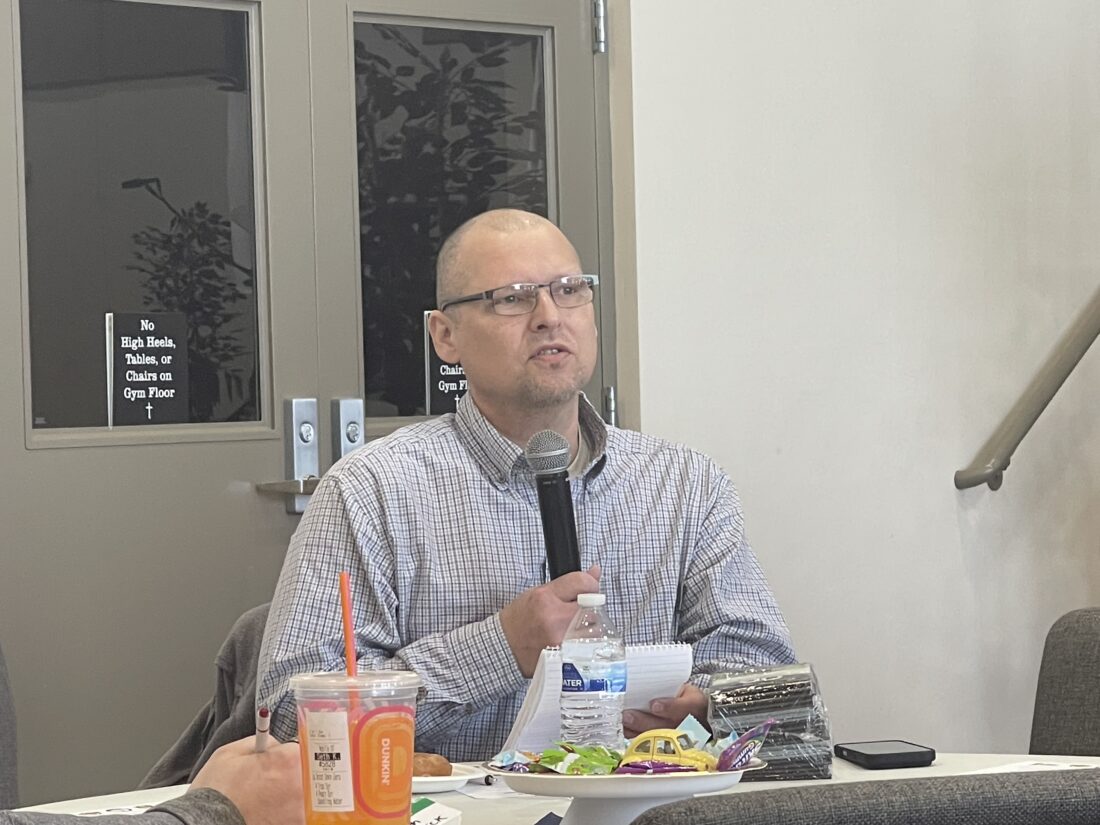
Ross Gallabrese SERVICE GROWS — Scott Fisher, the coordinator of transportation services for Go Bus, discussed its expanded service, which includes a stop in Steubenville, during the quarterly meeting of the Jefferson County Resource Network.
WINTERSVILLE — Depending on where you live in our area, it can sometimes be tough to get around.
That can affect a resident’s ability to work, shop or keep a medical appointment.
That’s one of the service gaps the Jefferson County Resource Network is working to address.
“The answers are here — we just need to get everyone involved, working together and thinking,” said Beth Rupert-Warren. “We definitely see there’s a need and there’s a gap.”
Rupert-Warren, community services coordinator for the Jefferson County Resource Network, spoke Wednesday during the organization’s quarterly community meeting. The discussion at the Center of Hope at Wintersville Methodist Church focused on transportation and included representatives from service providers and planners.
“If you go to Piney Fork, Smithfield, Adena or other rural parts of the county, you will find that people don’t have access to resources. They don’t have access to the internet, they don’t have access to transportation,” Rupert-Warren said. “We’ve really been trying to work with people in those communities.”
Tim Turner, transit manager for the Steel Valley Regional Transit Authority, said his agency operates local transit services in Steubenville, Wintersville and Mingo Junction. There is room for expansion, he said, but communities must be willing to help fund the service.
Toronto City Council, for example, declined the opportunity to extend SVRTA service there. There is also interest in the southern part of the county, but Wells Township trustees are hesitant to ask voters to approve another tax, said Mike Paprocki, executive director of the Brooke-Hancock-Jefferson Metropolitan Planning Commission.
With a push to eliminate property taxes in Ohio and shift funding for services elsewhere, Turner said it is unclear how SVRTA could be affected.
Ridership reached 174,000 passengers last year, Turner said, noting that represents a significant increase.
A growing number of residents are using SVRTA’s route to Robinson Township. A stop along that route is at the Findlay Industrial Park in Imperial. The route has opened employment opportunities at tenants including Amazon, Gordon Food Service and Niagara Bottling.
“A lot of people are using that to go to work,” Turner said.
The route includes a stop near the entrance to the IKEA store at Robinson Town Centre. From there, riders can connect with Pittsburgh Regional Transit and access Pittsburgh International Airport and the Oakland area of Pittsburgh via the 28X route.
Turner added that SVRTA connects with the Eastern Ohio Regional Transit Authority at the Rayland Park and Ride. He said passengers from areas served by EORTA use that connection to travel to and from jobs at Findlay Industrial Park.
SVRTA passes are affordable, Turner said, at $40 annually. The authority also offers paratransit and on-demand services and is working with Weirton Ride to expand connections between carriers.
Turner said SVRTA is developing a transit plan. One common request, he added, is for earlier hours of operation.
Local residents now have another option for travel to the airport or across Ohio. GoBus, a 15-year-old intercity bus service funded by the Ohio Department of Transportation and administered by the Hocking-Athens-Perry Community Action Council, recently added a stop in Steubenville.
Part of one of the system’s four main corridors, the Columbus-to-Pittsburgh route includes a stop at SVRTA’s headquarters at 555 Adams St. From there, the bus travels to Pittsburgh International Airport, said Scott Fisher, GoBus coordinator of transportation services. According to the schedule, the bus from Steubenville departs at 1:13 p.m. daily, with the return trip leaving the airport at 2:18 p.m.
Stops along the route include Belmont College and Wheeling. With connections, the service reaches many cities across Ohio.
Fisher said all vehicles are coach-style, 56-passenger buses that are wheelchair accessible, offer free Wi-Fi, provide power at each seat and include restrooms. Tickets are available online, through the service’s app or by paying cash at the stop. Exact change is required for cash payments.
Paprocki said challenges facing public transit have been building for decades.
“This is where it becomes difficult,” he said. “If it were profitable, it wouldn’t be publicly funded. We threw it away after World War II when we became an autocentric society. Public transit went by the wayside.”
He said that growing up in the 1970s, he and his friends used the P&W bus line to travel to Pittsburgh to watch the Pirates. When that service, operated by the private Starvaggi company, became unprofitable later in the decade, it was discontinued.
Rupert-Warren said expanding transportation access would help residents. Some people can get to work, she said, but struggle to find a ride home when shifts end later in the evening. Finding creative solutions will require broad community involvement.
“Even if we could do something from Dunkin’ in Wintersville to the Dunkin’ in Steubenville, operating from morning to midnight, that could provide transportation up and down Main Street and Sunset Boulevard, because there are so many businesses that need employees,” she said. “A lot of people would come to work if they just had transportation.”
Expanded transportation options could also help attract new businesses, she added, by making it easier for employees to commute.
The resource network operates in partnership with the Jefferson County General Health District, the Jefferson County commissioners, the Jefferson County Educational Service Center, the Jefferson County Board of Developmental Disabilities and the Jefferson County Prevention and Recovery Board.
Local News
Rates hiked for Jefferson County water, sewer customers
Daily Happenings
Police Beat Steubenville Police Agitated: A woman living in the 500 block of Dock Street called the police ...
Network tackles transportation
Briefs
Drawing to benefit beautification WINTERSVILLE — The Wintersville Beautification Committee is holding a ...
Wheeling man pleads guilty to murder of wife