
Less salt, better roads
Winter strategy gets an big upgrade by Steubenville officials
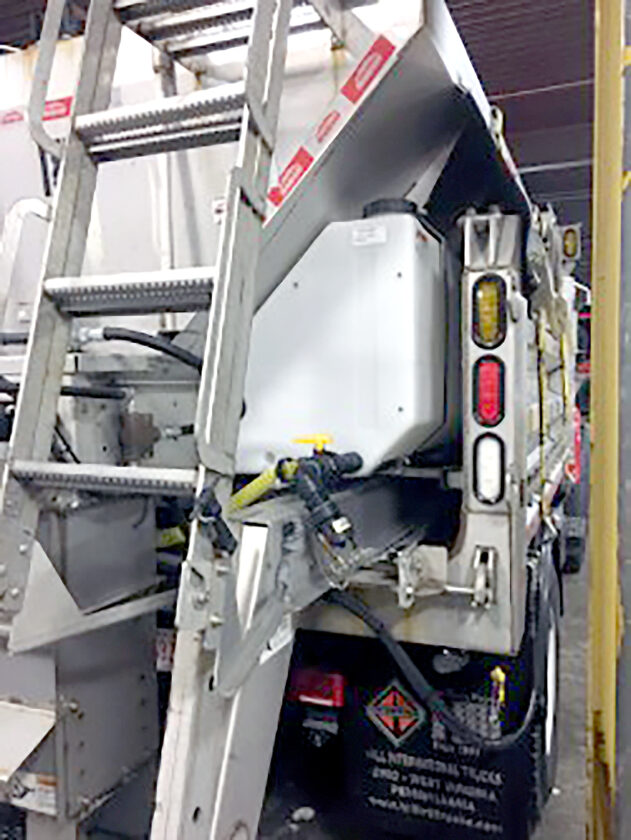
NEW DEFENSE — The last five trucks the city purchased for Steubenville’s street department are equipped with controls that will allow crews to use de-icing techniques, lessening the reliance on road salt. -- Contributed
STEUBENVILLE — It may be too late to impact the 2025-26 snow and ice season, but Steubenville Street Department Supervisor Bob Baird is hoping the department’s newest tool – liquid de-icing – will make it easier for motorists to navigate city streets the next time winter weather is in the forecast.
“There are multiple wins for everybody,” he said Wednesday. “It’s the right thing to do – it’s financially beneficial, it’s environmentally beneficial and it’s going to improve service and lower the cost. I’ve been wanting to do this since I got here.”
For the past three or four budget years Baird said he’s been ordering trucks – five in all – that are equipped with the in-cab controls needed to do liquid de-icing, but he credits a $75,000 grant from Ohio Environmental Protection Agency’s H2Ohio Rivers Initiative Chloride Reduction Grant with pushing the department across the finish line – giving them the funds needed to procure the actual brine-making equipment, which includes the brine maker, pump controls, truck fill station and storage tanks.
H2Ohio is a statewide water quality initiative that Ohio Gov. Mike DeWine has said aims to improve access to clean drinking water by supporting best farming practices, reducing road salt runoff, litter cleanup, dam removal, land conservation and revitalizing water infrastructure.
Baird said the H2Ohio RICR grant enabled Steubenville “to complete the final step in an effort it has been pursuing for years.”
“The grant program has a large focus on decreasing the presence of chloride in Ohio’s rivers and streams,” he said. “Although road salt plays an incredibly important role in road safety, high chloride levels in Ohio’s waters can be harmful to aquatic life and be corrosive to local infrastructure like pavement and concrete. And once salt enters the water, it cannot be removed by ordinary treatment practices, which is why reducing usage is so crucial.”
It’s also going to save the city money.
Baird said Steubenville typically buys 3,000 tons of road salt every year. Prices vary, but typically that means the city has to pony up $200,000-$300,000 a year to stock up for winter roads. While they won’t know how much they’re going to save until they have a season under their belt, Baird said other communities using liquid de-icing “have reported between 20% and 30% savings.”
“Adding this extra step in the process is going to help us reduce the amount of road salt we need and use in winter to deal with snow and ice,” he said. “It’s going to allow us to reduce the amount of road salt we use and lowers the temperature at which our efforts are effective. It’s going to allow us to be more effective and efficient.”
He said the city’s location on the bank of the Ohio River and high salt reliance in the past “make it a really nice fit” for the H2Ohio program, “that’s what made it attractive.”
“Ohio EPA gave us some financial assistance that allowed us to move forward,” he said. “We’ve been working toward this for years. It was just a nice little boost to help us get the stuff in. This is the final piece of the puzzle.”
Baird said all their new trucks have the “corresponding hardware…storage tanks, controls to turn in on and off and calibrate how much.”
“This is a project that will be completed soon. It will be in place before the start of our next winter season,” he said, adding, “It’s the right thing to do – financially, operationally and environmentally. I think it will make motorists happy, and I think our guys will like it, they’ll get faster and better results.”
Local News
W.Va. improves three spots in annual Reason Foundation Highway Report
Steubenville BOE accepts teacher resignation, recognizes champion
Less salt, better roads

Form Energy going global
Market Street Bridge discussed by BHJ officials