
Remembering MLK Jr. in Weirton
Performance focuses on hunt for James Earl Ray
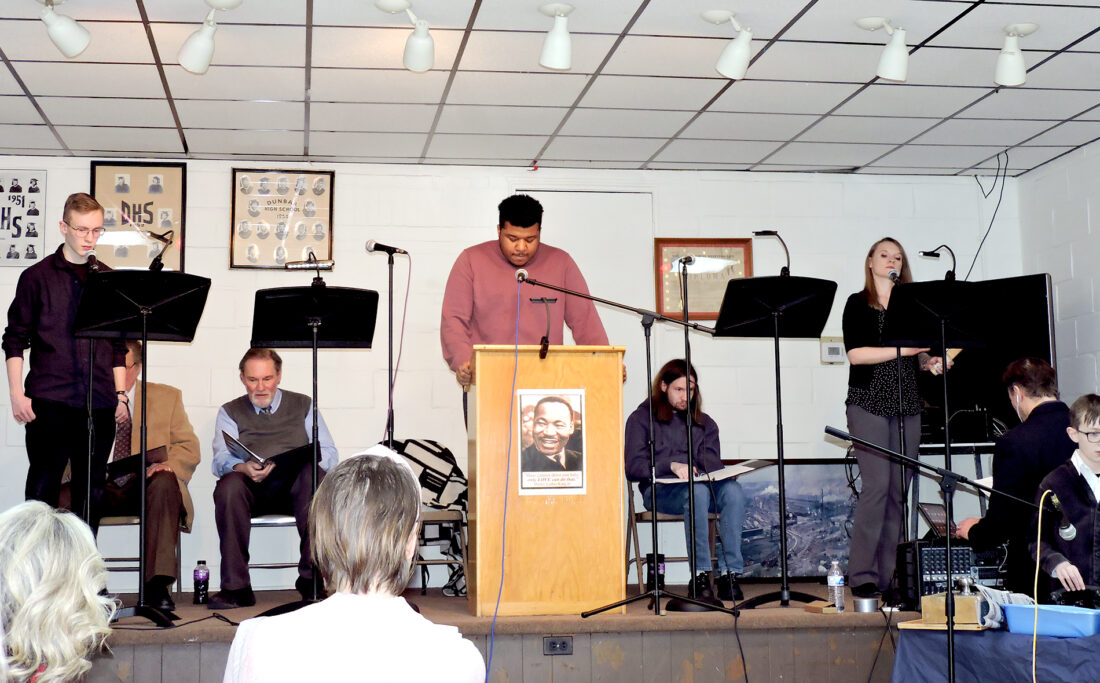
RECALLING HISTORY — As part of local observances of Monday’s Martin Luther King Jr. Day, area residents gathered at the Dunbar Recreation Center in Weirton to watch a performance of a docudrama by the Wayward Saints theater group, titled “Wanted by the FBI: James Earl Ray.” -- Craig Howell
WEIRTON — On the day set aside to remember Dr. Martin Luther King Jr., Weirton residents gathered to remember not only elements of his life, but the events surrounding his death.
On stage at the Dunbar Recreation Center Monday, the Wayward Saints theatrical troupe showcased their latest production, with a docudrama “Wanted by the FBI: James Earl Ray.”
“Each year we try to put this event together to support the community and tell how much Martin Luther King means to us,” noted Earleen Jones, president of the Dunbar center.
Monday’s program, presented in a docudrama format, similar to an old radio program, chronicled King’s final days as he prepared to give a speech in support of Black sanitation workers on strike in Memphis, Tenn., and his assassination in the city on April 4, 1968, as well as the search for James Earl Ray, the man later convicted on King’s killing.
“We wanted to represent this as accurately as we could,” said Pete Fernbaugh, the show’s producer, while explaining while much of the show is a dramatized re-enactment, they relied on historical documentation of the lives of King and Ray, as well as governmental records when putting together the script.
Intermixing speeches from King, the show focused much of its time on Ray, beginning with his escape from the Missouri State Penitentiary in April 1967, and his movements through St. Louis, Chicago and into Canada and back into the U.S. to Birmingham, Ala., where he purchased the white 1966 Ford Mustang noted by investigators to have been involved in the escape of King’s assassin.
He would eventually make his way to Los Angeles, graduating from a bartending school, and volunteering for the political campaign of George Wallace, to whose segregationist platform Ray was drawn.
He eventually made his way back to Birmingham, where he bought the Remington 760 Gamemaster used in King’s killing under one of many aliases he had been using over the years. Through a newspaper article, he learned about King’s visit to Memphis.
Following King’s assassination, Ray was able to evade capture, making his way into Canada, then to England and Portugal, and back into England from where he was attempting to reach Rhodesia, now known as Zimbabwe.
It was during those attempts that ticket agents noticed Ray had two passports, under different names, one of which had been placed on a Royal Canadian Mounted Police watchlist, and he was placed under arrest, returned to the U.S. and charged with King’s murder.
The show did, however, note that not everything clearly indicated Ray as the assassin, including his recanting of his guilty plea and claims his lawyer told him the plea would keep him from a death sentence, and the possibility of a man named “Raoul” had actually been involved in King’s death. There also were inconclusive ballistics tests as to whether the bullet used to kill King came from Ray’s rifle.
Members of King’s own family have publicly questioned aspects of the investigation, raising the possibility of a government-involved conspiracy.
“Sometimes investigations don’t answer all of the questions,” Fernbaugh said, drawing parallels with more recent assassinations and political events.
This is the fifth such show the Wayward Saints have produced in cooperation with the Dunbar center.
Previous performances have focused on the life of King himself, Coretta Scott King and her efforts to continue her husband’s work and the battle to establish the Martin Luther King Jr Day holiday.
Above all, Fernbaugh explained, King promoted non-violence in his efforts for equality and justice, something he hopes people remember.
“I hope we can take his philosophy and apply it to our times,” Fernbaugh said.
Local News

Sycamore MLK effort included food distribution for those in need

Preparations for Ogden Newspapers Wellness Weekend begin
Teacher association sees hope for future in state takeover of Hancock County Schools
WEIRTON — The association representing employees of Hancock County Schools sees the new oversight by the state of ...
‘Mission Possible’ for King’s dream
Remembering MLK Jr. in Weirton
Sims has initial appearance in malicious assault case
NEW CUMBERLAND — A former Columbiana County man won’t be getting out of jail for free after his initial ...