
Shelter for the area’s homeless a concern
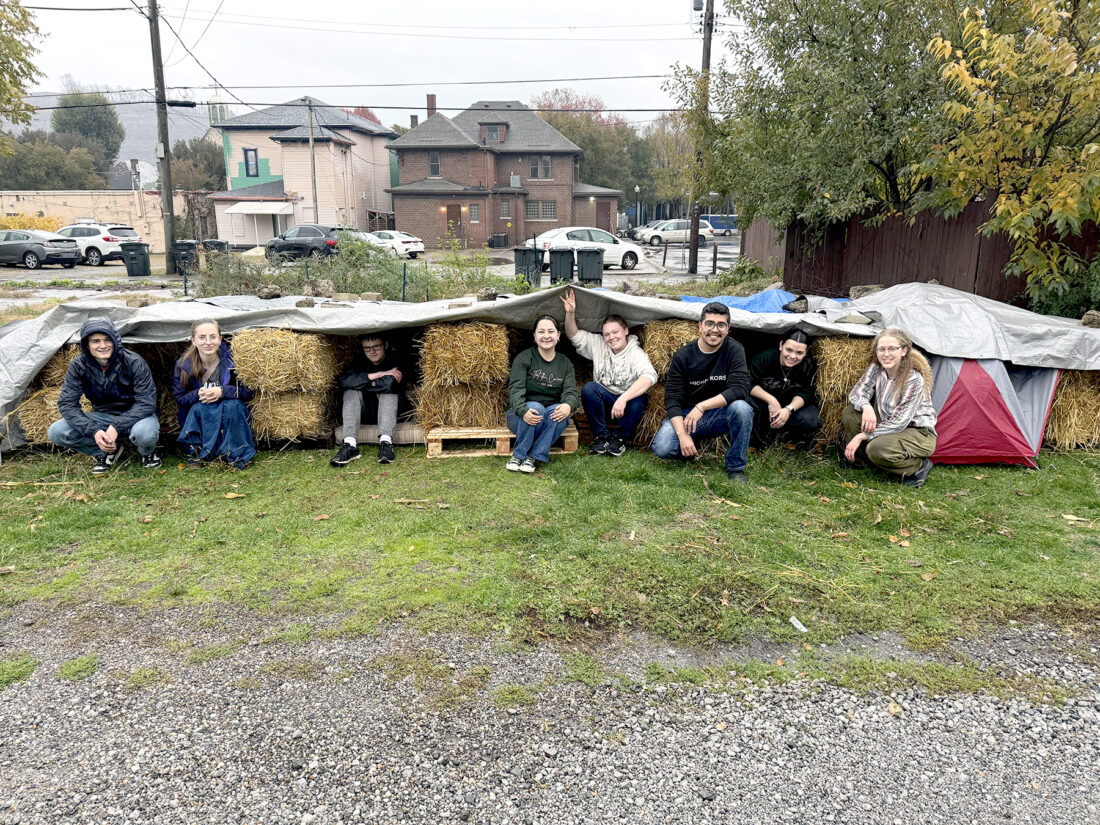
BUNKS — Makeshift bunks for the unhoused crafted by volunteers from Franciscan University of Steubenville. -- Contributed
STEUBENVILLE — Last week when homeless advocates were scrambling to find ways to get Steubenville’s unhoused population out of the bitter cold, volunteers who came up with a temporary — albeit far from ideal — workaround found themselves on the wrong side of city codes.
The Friendship Room’s Molly McGovern received cease-and-desist notices warning her that she could be cited into Steubenville Municipal Court for allowing volunteers to create cubicles for the unhoused out of bales of straw covered by tarps.
The makeshift cubicles — in keeping with the season she’s calling them mangers — were erected in a nearby field by students at the Franciscan University of Steubenville, where charity to others is seen as a rite of passage in keeping with the mission of St. Francis of Assisi, patron saint of the poor and downtrodden.
Those who couldn’t or wouldn’t warm up indoors were invited to unroll sleeping bags in one-person tents or under canopies with bales of straw to act as a barrier between them and the bitter cold that last week saw temperatures dip well into the teens.
McGovern was given a Monday deadline to remove the offending structures or risk being charged with a first-degree misdemeanor. As of late afternoon Monday, they were still there.
McGovern refused to comment Monday on the looming legal proceedings.
City Manager Jim Mavromatis said because the matter is pending he, too, is limited in what he can say, but he did point out ramshackle structures of that nature violate Steubenville’s property maintenance code and, good intentions aside, the Friendship Room must be treated as any other property owner believed to be in violation. That means notifying the property owner of the problem and giving them a deadline to correct it. If no corrective measures are taken, the information then goes to the city prosecutor to review and take appropriate action.
“We had a complaint about it, so they had to go and look at it and there were people in tents out there (amid) bales of hay. We can’t have that,” he said. “That’s how it came about; they did their normal job. Once a complaint comes in, they have to go out and respond. They went there and they did their jobs.”
Jamie Blanchard, chair of the Jefferson-Harrison County Coalition on Housing and Homelessness, said help is on the way, but it won’t arrive for several months: Prior to closing its three shelters on Oct. 31, Urban Mission Ministries had applied for — and was awarded — funding to operate just one of them. State officials agreed to reallocate that money to a successor agency provided it was one with experience running a shelter. Since no one locally was equipped to take on the responsibility with virtually a couple of weeks notice, Blanchard said the housing coalition turned to the lead agency for this region — the Community Action Council of Columbiana County — which has the mandatory management experience.
She said the Columbiana County group agreed to operate Steubenville’s shelter “but they are looking for a local agency (to eventually take over.)”
“Once the initial grant period for the funding to reopen the shelter (runs out) they’re hoping to find an agency locally that can be lead applicant for the shelter,” Blanchard said. “We’re hoping to have it open in the first quarter, but they have to hire staff, get some operational things settled. Hopefully that will be in the first quarter.”
But having a long-term solution on the horizon isn’t much comfort in the short term, she said, pointing out that so far, they haven’t been able to find a building with the appropriate zoning to be used as a temporary warming center.
“We’re doing the best we can to find temporary resources but it’s not moving along (to) getting buildings approved,” Blanchard said. “We can’t find a location that’s already zoned and meets the safety standards to be an overnight warming shelter. Lots of places can do it during the day, like the Martin Luther King Jr. Center and Beacon House, which is a drop-in shelter, but not overnight.”
Blanchard said they’ve had “a couple of meetings” with city officials, “they’ve gone in and done walk-throughs in a couple buildings but then (those buildings) have been identified as not up to code to have people there overnight.”
She did say they haven’t been privy to the city’s rationale, “we’ve just been told they’re not up to code.”
While the community has been overwhelmingly positive in terms of donations, she admits there hasn’t been much of what she calls “residential support” in neighborhoods where the volunteers identified a workable building but couldn’t get the necessary permissions — in essence the “it’s a great idea but don’t put it in my backyard” mentality.
“I don’t want to say that there’s not community support, especially since there’s been an overwhelming community response since the shelters closed, residents have been donating items for people who are on the streets,” Blanchard said. “The response has really been overwhelmingly positive. But when it comes to staying overnight and (having) an emergency shelter, there’s been a lot of pushback.”
Mayor-elect Ralph Petrella, who’s spent hours getting to know some of the Friendship Room’s regulars and trying to understand how they ended up living in cars, vacant buildings, tents and the woods, concedes safety issues “go both ways” when it comes to Friendship Room’s real-life reenactment of the Christmas story.
“There’s some safety issues (with the mangers),” he concedes. “I think what people are concerned about is that mangers and tents are not the answer, and Molly knows that, too, but there was immediate need. Yes, there is a finite risk and it is potentially unsafe — but dying (from being unsheltered in frigid temperatures) is unsafe, too.”
Petrella said he’s watched homeless people taking bags of gloves and food to distribute to other homeless people, “they have a community that is helping each other, I don’t think we see that.” He said he talked to one man who had told him he was at the end of his rope. “He said he was tired, he didn’t want to do it anymore. And right after that he passed away, I don’t know (why).”
Petrella said the unhoused “need help, hope and camaraderie.”
“If you have to wake up and your only goal is to survive, that’s a basic need,” Petrella said. “You can’t thrive if you’re always trying to find something to eat and a roof over your head.”
But critics contend in many cases homelessness is a hell largely of their own making, pointing out many of the unhoused locally were kicked out of Friendship Room or Urban Mission at one time or another “because of drug use, assaults, or causing fights” and need supervision. The problem with the Friendship Room’s tent city, they contend, is there’s no one to monitor it.
McGovern, though, insists Friendship Room “is not a homeless shelter and we’re not trying to be one.”
“But while there’s immediate risk, while we’re looking at severe conditions, we’re going to (help) … when the temperatures are dropping as low as they are and wind chills are in the single digits, it’s really a matter of life and death.”
McGovern said she tried unsuccessfully to coax one man inside during the cold spell last week “but his fear, his paranoia were too severe … He wears a metal bowl on his head to protect his brain from people trying to read his thoughts.”
She said, too, that there are military veterans living along the riverbank, “still in fatigues, some with their faces painted (black, for concealment), hiding in the woods because they still think someone is after them, but they know they can come here and get food. They know we’re a safe place.”
Beth Rupert-Warren, coordinating Jefferson County’s online Resource Network, said the lack of short-term warming centers is “a crisis” situation locally.
“There are organizations willing to do it during the day, acting as a daytime place people can come in and be warm,” Rupert-Warren said. “But we need someplace people can come in and be warm after those places close — a warming center where people who are homeless have some place they can go.”
“We have to be the solution, that’s the only thing we can really change,” McGovern agreed. “I’m not suggesting we’re the answer, that this (the mangers) are the answer. But this is what we can do here, and we can encourage everybody to think about what they can do in their community to help.”
Local News

College of St. Joseph the Worker offers job training, Catholic studies

Fathers, daughters enjoyed evening courtesy of Mingo

U.S., Israel pound Iran as Trump signals willingness to talk to new leadership after Khamenei’s death

Pat Campbell Run returning soon

Weirton Elementary learns about heart health