
Edison Local getting back to basics with JCESC Best Practice Grants
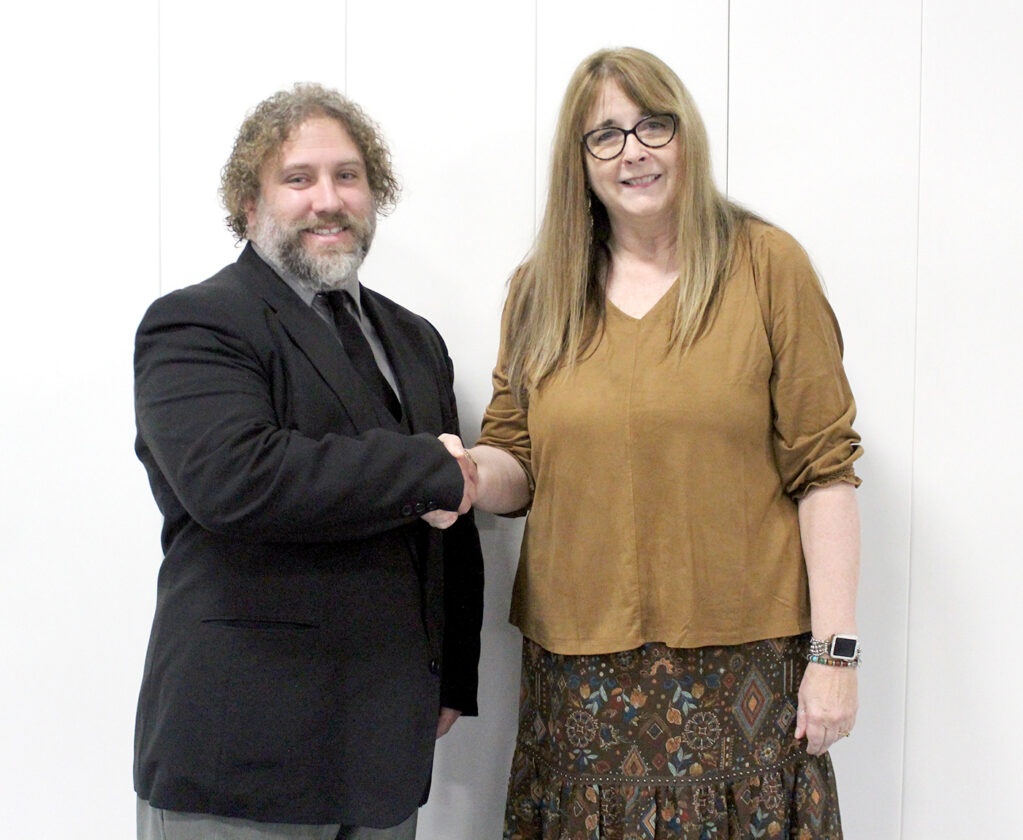
GRANT RECEIVED — Nathanael Kline, intervention specialist at Edison Local High School, receives a Beat Practice Grant from Patty Ferrell, intervention specialist with the Jefferson County Educational Service Center. Stephanie Kuca and Miguel Brun also were grant recipients. -- Contributed
RICHMOND — Students at Edison Local School District are building a strong foundation with an emphasis on critical thinking with the help of a round of Best Practice Grants from the Jefferson County Educational Service Center. Three grants of $700 each were awarded during the Nov. 19 board of education meeting.
Nathanael Kline’s students will be taking a step back to strengthen the basics with some paper-based interventions for students in English and language arts, science and social studies. More than 150 students will take part.
Kline said his students and their families had expressed an interest in introducing some low-technology learning tools including student planners, color-coded notebooks and flash cards.
“There’s a growing need to have limited screen time and electronics fasting where you just work with paper and use regular flash cards rather than electronic flash cards, make annotations on paper rather than electronically. The emphasis was on reaching mainly my ELA students but also some science and social studies students.”
Other families have asked for less screen time for children who have sensory issues, ADHD or who tend to be distracted.
Kline said the district has made an investment in strengthening students’ executive functions and them “thinking about their thinking.” He will be encouraging a more organized approach, with students working to meet deadlines. He anticipates the flash cards will aid in faster vocabulary recall. The students will also be working with fewer distractions.
He added the simple act of holding a pencil and writing may increase focus.
“There’s definitely an association between handwriting and being able to recall words, write, spell and decode. We definitely want to make that connection.”
While all the materials are consumable, Kline has two years’ worth of planners and will work with many of the same students during that time and observe how they organize their thoughts.
“I’ll see them for two years. I’ll be able to track the beginning and end of their planners, how much better they are at taking notes and learning what they need to write down and what they don’t need to write down.”
He is a past grant recipient and is grateful to everyone who supported the project.
Stephanie Kuca, who teaches 10th graders at Edison High School, is introducing physical activity through yoga and reflection on poetry with the Metaphors and Mindful Movement program. More than 20 students in her class will benefit.
“The idea for this project and course was inspired by my own experience with yoga and mindfulness during the pandemic. I wanted to give my students the opportunity to experience literature content in a different way and to include more movement in class,” she said.
Kuca added studies suggest yoga and mindfulness greatly increase teens’ self-awareness and emotional regulation. She hopes to see her students better manage stress, anger, anxiety and depression and increase their self-esteem. She noted other studies that suggest teens spend an excessive amount of time in front of screens, and it negatively impacts their mental health.
“So, this course should help students’ physical and mental well-being because exercise increases the body’s production of endorphins which can help boost one’s mood,” she said.
“My hope is that when the minimester class is over at the end of May, they continue to practice mindfulness in a way that feels right for them and contributes to their life in a positive way.”
Meanwhile Miguel Brun at John Gregg Elementary will be equipping young students with tools for literacy using orthographic mapping.
“The teachers at Edison Local have gone through extensive training on the science of reading, so they are now aligning their instruction with how the brain learns to read,” he said. “When we’re born, we are hardwired to speak, we’re not hardwired to read, so we have to be very intentional that the practices that we do are based on how our brains learned to read.”
He went on to describe how readers store words through the mental process of orthographic mapping.
“You have to be an accurate and instant word reader to free up the cognitive energy to focus on the linguistic processes that are needed to comprehend our language, such as vocabulary, background knowledge, language structures, verbal reasoning, literacy knowledge,” he said. “We want our students to be increasingly strategic.”
The program will give novice readers more opportunities to build the word-forming area of the reading brain. He has purchased decodable textbooks that will help translate word reading into passage reading.
“With that process of orthographic mapping, you’re basically supergluing the word’s pronunciation to its spelling and also attaching meaning to that.”
Kindergarteners through third graders will use the decodable texts, as will any striving readers still working on basic phonics skills.
“It’s for those students who are working in those tiers of support who need that additional practice.”
The initiative is very sustainable, with texts that can readily be reused.
“We’ll be using these books for years to come.”
Brun is a prior grant recipient. He purchased magnetic boards to build orthographic mapping using word chaining. The boards are still in use today.
“I definitely want to thank the Jefferson County Educational Service Center for funding our grant and allowing students to continue to build to the ultimate end goal of being proficient readers.”
Local News

JCESC Virtual Learning Academy to present at Ohio tech conference
Numerous candidates file for May primary
STEUBENVLLE — The area’s state representative and its congressional representative will face primary challenges ...
Yost alleges cannabis collusion in lawsuit
Ohio’s attorney general has sued nine large cannabis operators for allegedly colluding to keep prices ...

Pinewood Derby spurred competition, camaraderie and creativity
Indian Creek seeking substitute workers
WINTERSVILLE — Like many districts, Indian Creek Local Schools has dealt with a shortage of substitute employees ...
Hoder sentenced to two years in prison
NEW CUMBERLAND — A Hancock County judge sentenced a former county deputy to the maximum sentence allowable by law ...