
ICHS students excel in hellbender rearing

PROGRESS REPORT — Six students in Indian Creek High School’s natural resources management career technical education program presented on their hellbender rearing efforts to the Ohio Hellbender Partnership Thursday. -- Christopher Dacanay
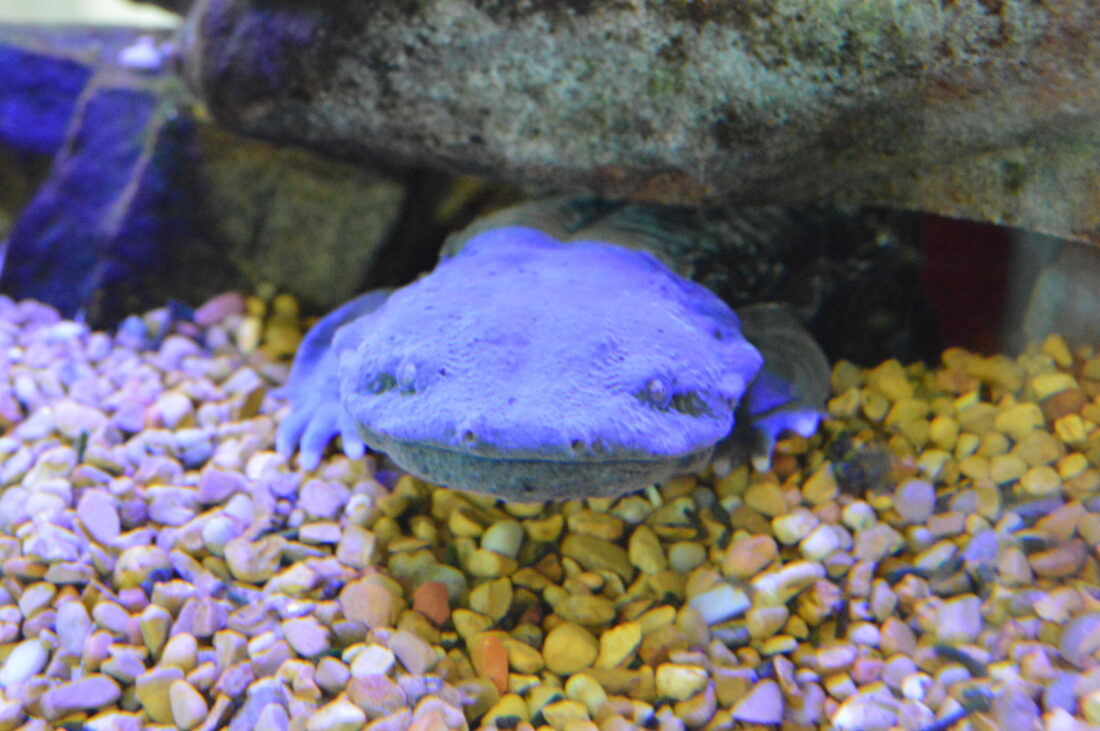
CHIEF — Indian Creek High School’s permanent resident hellbender, Chief, poked its head out from a cave in its tank. -- Christopher Dacanay
PROGRESS REPORT — Six students in Indian Creek High School’s natural resources management career technical education program presented on their hellbender rearing efforts to the Ohio Hellbender Partnership Thursday. -- Christopher Dacanay
CHIEF — Indian Creek High School’s permanent resident hellbender, Chief, poked its head out from a cave in its tank. -- Christopher Dacanay
Trending
WINTERSVILLE -- Part of a statewide conservation effort, Indian Creek High School students' rearing of an endangered salamander species has seen above average survivorship results.
ICHS is one of five rearing sites and the only public high school to participate in the Ohio Hellbender Partnership -- a group of zoos, county soil and water conservation districts, state agencies and more collaborating to reverse the population decline of the hellbender, North America's largest salamander.
In April, ICHS natural resources management career technical education program students began caring for 20 juvenile hellbenders in a special rearing room. Students will raise the hellbenders to maturity, at which point they'll be released back into the wild, around 2026.
Indian Creek and the other rearing sites present care updates to partnership stakeholders during biyearly meetings. The partnership's meeting Thursday saw six CTE program seniors discuss their progress in front of nearly three dozen professional wildlife biologists and conservationists.
Greg Lipps, amphibian and reptile conservation coordinator for Ohio State University, praised the work the students have done.
"They've had better than average survivorship of the young animals they're rearing, which is a testament to the good job that they're doing," said Lipps, who's also a conservation biologist for the Columbus Zoo and Aquarium.
Growing up to 2 feet long, hellbenders are native to the Eastern and Central U.S. and inhabit stream ecosystems. Jefferson County -- including Cross Creek and much of the Indian Creek Local School District area -- is a hotbed for the amphibians, which are experiencing a general decline in population because of several factors, including pollution and habitat loss.
Enter the Ohio Hellbender Partnership, whose supportive rearing efforts have led to 1,900 hellbenders being released in Ohio since 2012. Marking an important milestone, the partnership's 2023 field season team documented reproduction in the wild by hellbenders that had been head-started and released, according to the Columbus Zoo.
In addition to Indian Creek, the other rearing sites include the Columbus Zoo and Ohio Center for Wildlife Conservation, the Wilds safari park, the Toledo Zoo and Aquarium, Penta Career Center and several locations in the state of Indiana.
ICHS entered the picture in 2023, when it was awarded an Ohio Department Natural Resources Fluharty Aquatic Wildlife Education Grant. Funds paid for a new tank in the school to house its permanent resident hellbender, Chief, who'd prove to be a forerunner for the school's continuing partnership involvement.
A schoolwide effort preceded its addition as a rearing site -- students planned a camera system to watch the hellbenders grow, designed artificial tank caves and prepared for crawfish, which Indian Creek Middle School students raised to be a food source.
The tanks and additional equipment came about thanks to a donation from Pet Supplies Plus. ODNR grant funding assisted with procuring food, tanks, educational supplies and marketing materials.
After a year of being raised at the Toledo Zoo, 20 juvenile hellbenders arrived at the high school in April. The specimens were already returning home, in a sense, having been harvested as eggs from Cross Creek.
Now, students regularly feed the hellbenders; record their measurements, submitting data to the ODNR and Columbus Zoo; clean the tanks; and test the water's pH levels. The rearing room is biosecure to protect the animals from infections, so students work in small groups while wearing lab coats and protective gear.
During Thursday's meeting, students took turns presenting their latest data.
As of Thursday, the school had 18 juvenile Eastern salamanders and one educational ambassador, Chief. Across all rearing tanks, the hellbenders ranged from 24 grams to 72 grams in weight and 16 centimeters to 23 centimeters in length. Chief weighed in Wednesday at 330 grams, being 34 centimeters long.
The average mass for Eastern hellbenders between the ages of 2 and 3 is 24.5 grams to 279 grams, with average length ranging from 16 centimeters to 31 centimeters, students reported.
Crystal Fluharty, natural resource management CTE program instructor at Indian Creek, noted the pride she feels for her students, who gave their first progress report to partnership stakeholders Oct. 29 at the Columbus Zoo. Fluharty said she's witnessed tremendous growth among the occasionally shy individuals.
"I've seen these students who sometimes sat in the back, and I get to push them to get in the front and share their knowledge. To see them grow and become adults, they're just an amazing group. From the beginning of this program until now, we have had ups and downs, and they have just become these absolutely amazing people."
Participating in the presentation were seniors and CTE program students Nandhana Ranjith, Elijah Gilman, Chrissy Simpson, Grasyn Danielson, Aiden McMahon and Alayna Starr.
Gilman recalled how the CTE students are a tight-knit group, spending time together every day for classes and rearing duties.
"We've learned a lot of science, but we've all socially kind of gotten to know each other, too. It's a good group, for sure," he said.
Lipps said of the active involvement of the students in the partnership: "It's always great to have local involvement and excitement from young people who are obviously going to have a lot of influence on the future of animals living here in their backyard."
Unfortunately, two of the students' hellbenders have died due to skin conditions since April. Lipps noted such deaths are not uncommon, and part of the partnership's work is studying developmental challenges and preventing die-offs.
Lipps said rearing alone won't save the hellbender species, so it's beneficial that students hear about the other essential work being done.
"I think one of the strengths of this partnership is we're not siloed. We get to work together. So, the zookeepers and the students rearing animals get to hear about the work that's going on with restoring habitat in the wild (and vice versa). ... They get to hear all the things that we're dealing with in terms of protecting and restoring riparian forests or pollution, and I think exposing students to that is incredibly important and valuable."
Also participating in Thursday's meeting were officials with the Jefferson County Soil and Water Conservation District, which has been a member of the partnership for 15 years.
The district's own hellbender-saving work includes development of Jefferson County's Hellbender Preserve, which contains one of the largest known hellbender habitats. Featuring trails and historic elements, the preserve will open for public recreation activities April 26.
Mark Nelson, chair of the JCSWCD board, said the agency's goal is to protect that riparian corridor and promote hellbender populations. He added that Indian Creek's hellbender program -- a combination of education and conservation -- is a great asset for Jefferson County.
Partnership stakeholders discussed hellbender husbandry efforts, the Eastern hellbender's potential federal endangered species listing, riparian land reclamation and work being done to improve certain watersheds, including Yellow and Cross creeks in Jefferson County.