
Mingo thoroughfare to see redevelopment planning
Trending
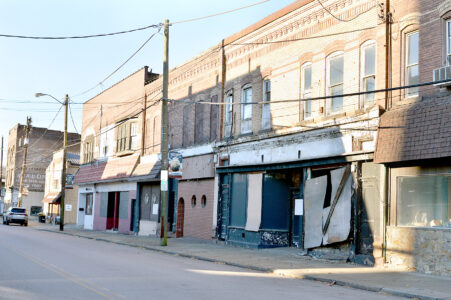
MINGO JUNCTION -- Three buildings on Commercial Street have been a pain to village officials for long enough. Now that they're slated for demolition through the Jefferson County Land Bank, the village is progressing with grant-funded redevelopment planning.
Mayor Judy Ruckman announced Oct. 23 that the village had been awarded $30,700 through the Mayors' Partnership for Progress to create the first phase of a market analysis and redevelopment plan. The village has contracted with CT Consultants for the project, the first phase of which will take about four weeks to complete after authorization to proceed is received.
The proposed plan will concentrate on a six-parcel, .22-acre area on Commercial Street that is currently occupied by three buildings -- property addresses 633, 645 and 655 Commercial St. Those six parcels will be turned over to the village following demolition.
Actual work on the buildings is scheduled to begin in February or March, with bid specs anticipated to reach contractors in January, according to Jefferson County Land Bank Director Tabatha Glover. Although the total project cost will be determined by the winning bid, estimates place the project at around $140,000, and the village will need to contribute 25 percent.
CT Consultans' proposal calls the Commercial Street site a "key reinvestment area on this main thoroughfare in the downtown." According to that proposal, the plan will identify current market demands for commercial, residential or mixed-use developments and include a basic site characterization review that assesses potential utility, environmental, slope and geotechnical considerations.
Ruckman believes this plan will give the village a "leg up" by providing potential downtown investors with pertinent information.
"(We will) be able to give somebody something who may have an interest in coming to our community and developing something," Ruckman said, adding later: "This gives them an idea of the analysis done. If the need is there, they'll know it right out the gate. And it'll help us market (the village). ... I can send it right to people and say, 'Hey, we've got a river view and we're affordable and we're accessible.'"
The project is made possible through assistance from the Mayor's Partnership for Progress, an association of mayors and city managers aimed at improving communities through access to resources, networking and advocacy. The partnership, which Ruckman joined in January, serves 201 communities across 24 counties in Appalachian Ohio.
From the MPP, Mingo received $30,700 for CT Consultants to accomplish the project's first phase.
"The Mayors' Partnership for Progress, through a partnership with the state, offers technical assistance to the members of the MPP," said Executive Director Amista Lipot. "Funding flows through the state's operating budget. Mingo submitted a request, and our staff worked to fine tune the exact needs and then select a vendor who is skilled in such a project."
Another $16,300 is needed for the project's phase two, as well as another $2,200 for miscellaneous expenses like mileage and printing.
"The second phase has not yet been approved," Lipot said. "The plan is to work through the first phase and then access the needs for the second phase and evaluate the funding available."
Ruckman said she was permitted to choose from approved contractors for the project. She reportedly selected CT Consultants due to its previous work with the village during her time as a councilwoman.
Set to begin as soon as CT and village officials can coordinate, phase one will start with a kick-off meeting to discuss project scope, schedule and key responsibilities, as well as any previous efforts the Commercial Street site has been subject to and other relevant data.
CT will then utilize village and county records to catalog the site's conditions before analyzing market demand and investigating development options. The final task will be analyzing engineering site characteristics. Village officials will receive a written report summarizing site characteristics and recommendations.
Recognizing the village is operating on a fixed budget, CT provided two optional tasks that may be completed as part of the project's second phase. Both options would be completed in three-to-four months, after phase one's completion.
If selected, the first option would yield an updated code enforcement and property maintenance code. CT states it would leverage existing conditions data for commercial structures and input from property owners and the village itself to generate a simplified property maintenance code. Mingo Junction's codified ordinances currently reference the International Property Maintenance Code, CT says in its proposal, but, like many small communities, the village would benefit from a less complex code that makes licensure less essential for efficacy.
The second option would see CT create a "proposed toolkit of policies and procedures for deploying incentives and development policies to further the village's economic development efforts."
Both options would be completed in three-to-four months, after phase one's completion. Ruckman said it's too early to say which option the village would like to pursue.
Ultimately, CT's plan will show what kind of development would best suit the Commercial Street site, but Ruckman has ideas of what she'd like to see.
"We could be a very nice bedroom community," she remarked, noting her affinity for housing that caters to students or young professionals.