Vehicle struck by boulder on Route 7, report describes
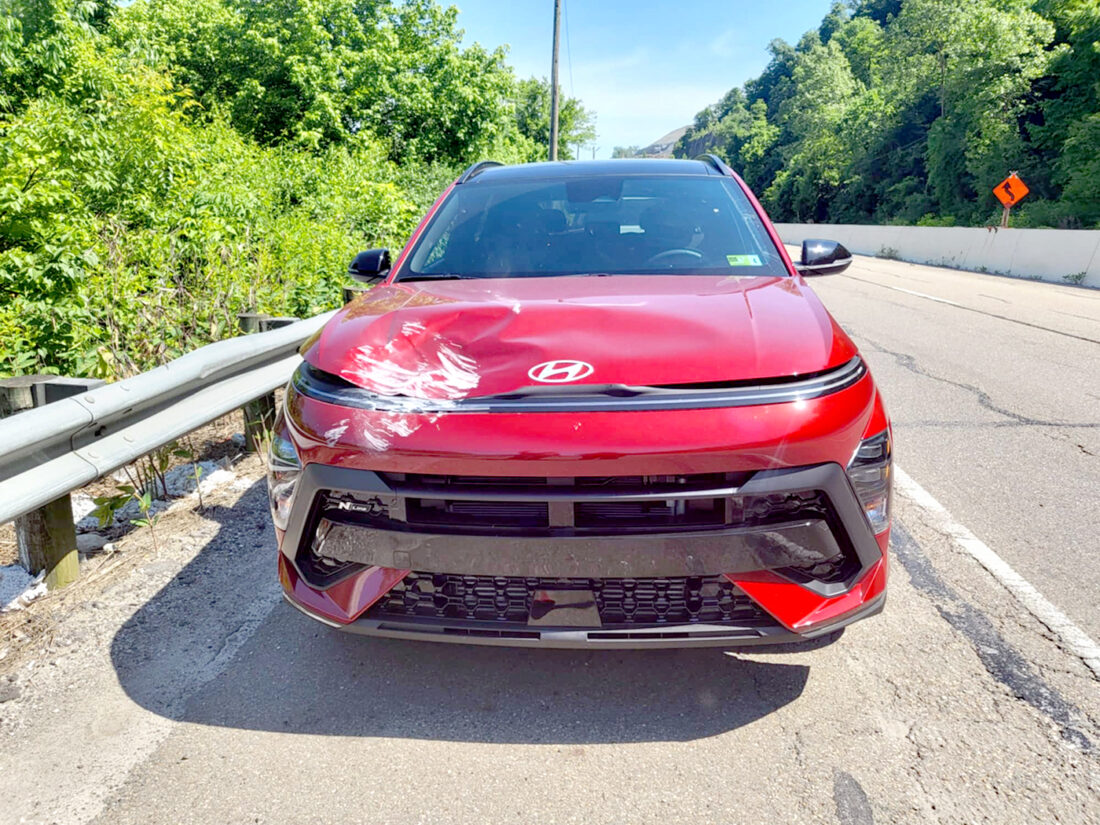
DAMAGE — In a photo provided by the Mingo Junction Police Department, Mingo Junction resident Charles McBride’s 2024 Hyundai Kona N Line is shown to have a large dent in the front hood, reportedly caused by a boulder that fell from the Ohio Department of Transportation state Route 7 hillside remediation project zone in May. -- Contributed
MINGO JUNCTION — An incident report from the Mingo Junction Police Department describes how a boulder from the Ohio Department of Transportation hillside remediation project zone struck a vehicle driving on state Route 7 earlier this year.
Reports state that, on May 20 at 3:17 p.m., an officer responded to Route 7’s northbound lane, just beyond the ODOT construction zone, for a call regarding a vehicle being hit by a boulder. The officer spoke with Mingo Junction resident Charles McBride, who stated he was not injured by the incident and did not need his vehicle towed.
McBride told police he was driving northbound on Route 7 when he observed a boulder beginning to fall down the hillside of the construction zone — part of the ongoing, $23.04 million project to cut back the hillside, mitigate its landslide risk and restore the nearby portion of Route 7 to its original four-lane configuration.
The boulder reportedly fell behind one of the protective barriers that stand between the highway and hillside’s base. McBride said he observed what appeared to be the same boulder continue over the barrier and cross over the southbound lane before striking the front hood of his vehicle, a 2024 Hyundai Kona N Line. Afterward, McBride said, the boulder continued over the side of the highway guardrail and down the hill.
Police observed a “large dent and gray marks” on the passenger side of the vehicle’s front hood. McBride also showed police where his vehicle was traveling at the time of impact, and police observed the area to be near where contractors were working on the hillside.
McBride’s vehicle was operable, and he reportedly continued driving to work after providing police with contact information for another motorist who allegedly observed the incident.
The motorist, Leslie Stingle of Smithfield, told police over the phone that she was driving northbound on Route 7 when she saw a boulder come down from the hillside, cross over the barrier and southbound lane and strike McBride’s vehicle. Stingle said she stopped to check on McBride and gave him her contact information in case he needed a witness.
Later, reports state, an officer spoke with business owner Michael Baker — whose Cast & Baker Corp. is one of the ODOT project’s subcontractors — and advised him of the incident.
Contacted about the incident Sept. 9, Lauren Borell, ODOT District 11 public information officer, said rockfall occurrences are “not uncommon along any hillside” and noted that signs have been strategically placed along Route 7 to indicate potential falling rocks. Such signage has been present around the hillside remediation project zone even before the project began.
As for the boulder crossing over protective barriers, Borell said, “It is evident that the barriers were not compromised; rather, it is likely that the rock rolled down the hill and bounced over the barriers. The catchment barrier (shipping containers) plays a pivotal role in mitigating the risk of debris falling into the travel lanes during blasting operations. It is not a fail-safe to prevent rockfall at any other time.”
The hillside remediation project occasionally utilizes controlled blasts for excavation purposes. Blasts are conducted around noon on weekdays, and law enforcement officials halt traffic on Route 7 in both directions while blasts are detonated and the roadways are cleared of any debris.
Asked about the boulder’s origin as either a residual effect of blasting or stray material from normal excavation, Borell said, “Judging by the projection of the rock and where it landed, there was no active excavation work occurring from the area the rock likely fell from. However, that is not to say that it was or was not from any previous excavation work that occurred in that area.”
Borell noted that rockfall “can occur at any time whether a hillside is disturbed or not.” Generally involving an individual piece of debris, rockfall is distinct from rockslides, which are large masses of debris moving down a slope.
“Given that this is an active project, it is impossible to eliminate the potential for unforeseen events,” Borell said. “However, ODOT and the contractor have consistently endeavored to mitigate the risk of incidents within work zones and are committed to maintaining these efforts.”
Borell continued: “The measures in place are meant to mitigate the risk of an incident occurring. We are constantly reviewing those measures, but again, there is no way to 100 percent prevent an incident from occurring.”
The remediation project’s scheduled completion date is June 30, and blasting operations will continue through the project’s duration. So far, Borell said, 1.25 million yards of dirt have have been excavated from the site, with another 200,000 yards left to go.
Cast and Baker’s Lou Piccin, who manages the hillside remediation project’s financial and contractual aspects, said he doesn’t think anybody made a mistake to cause the incident. Rather, the boulder’s falling and crossing the catchment barriers was a “fluke.”
“You’re kind of doing a risky project as it is,” Piccin said, “and if you have rocks up there that you can’t get to, there’s not really a whole lot you can do about it.
“After we shoot (blasts), we keep the road shut down, and we pull down whatever rocks we can pull back — reach over with an excavator — but sometimes … the excavator just can’t get to it. … That’s why we have the catchment wall, to stop rocks like that. That was just kind of a fluke that that rock got over the catchment wall.”
Prompted by this incident and the July 25 rockslide that resulted in Route 7’s closure for just over 24 hours, Cast and Baker has changed its blasting patterns, Piccin said. Hole sizes have been tightened up, load sizes are smaller and charges are not placed as deep. Piccin said those measures have been “working very effectively.”
McBride’s damage claim has been turned into the insurance company of Wampum Hardware, the project’s blasting contractor, Piccin said, adding that he’s glad mainly that “nobody got hurt.”
“(These are) risky projects. That that’s why we built the catchment wall,” Piccin said. “The catchment wall should have stopped that, but for some fluke reason it didn’t. … That’s why we’re moving the hillside because it was a danger, and it’s still a danger until we get it down.”
Numerous attempts to contact McBride were unsuccessful.
Stingle declined to comment.
Local News
Commissioners praise jail program’s early success
STEUBENVILLE — Commissioners celebrated the tangible gains recorded from a substance abuse program launched just ...

Two arrested in Brooke County on child neglect charges after 1-month-old’s death

Steubenville Educators Rising chapter going to nationals

Morrisey finishes work on legislation with 12 vetoes, 10 bills not signed
Daily Happenings
Today’s Birthdays April 3 Jenny Jo DeLauder, Bloomingdale Police Beat Steubenville Police Couldn’t hold ...