
Former EGCC trustee reflects
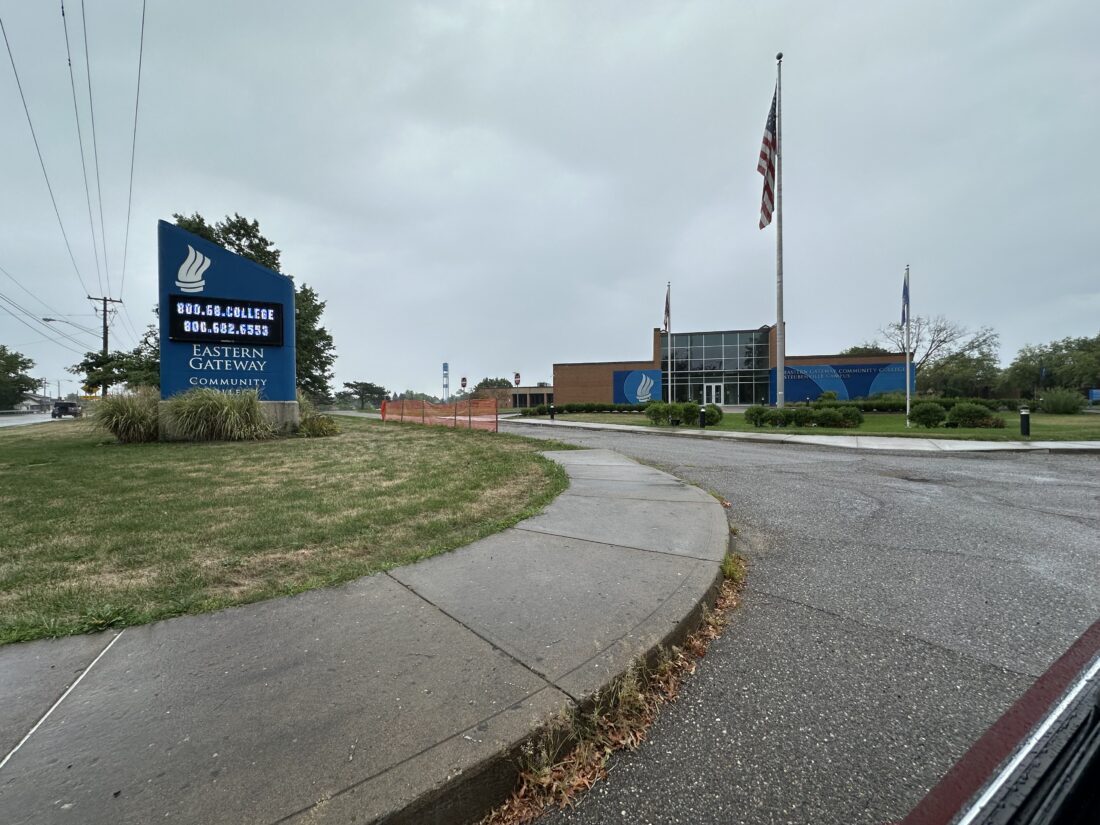
FINAL MONTHS — Questions remain about what led to the collapse of Eastern Gateway Community College. -- Linda Harris
STEUBENVILLE — When he rejoined the Eastern Gateway Community College board of trustees last September, Tom D’Anniballe had hoped there’d still be time to turn its sinking fortunes around.
Little did he know how close the end was: Within two months he was in front of the state controlling board with his hand out, asking for an advance on the college’s already-approved state subsidy. Two months after that, the Ohio Auditor of State Special Investigations Unit sent teams of investigators to the Steubenville campus to seize computers, filing cabinets and records. Weeks later, the Ohio Department of Higher Education pushed the trustees aside and announced a pause in enrollments for the spring semester, and not long after that came word the school would be dissolved.
By Nov. 1, it will all be over.
“Sad is the perfect word for it,” D’Anniballe said in an interview earlier this week.
As a trustee, D’Anniballe said he was limited in what he was able to say publicly about EGCC’s collapse, but with the board of trustees no longer functioning he doesn’t have to worry about that anymore. Now, he is one of five Ohioans who were appointed by Gov. Mike DeWine to a governing authority tasked with overseeing EGCC in its final days.
“I think the community, Jefferson County, especially, has been kicked in the teeth by a lot of entities — state agencies, federal agencies and mismanagement at the college — they all have their share of the blame,” he said.
“I wasn’t on the board then, and I really don’t know the whys of what happened, but to go from 3,000 students to 46,000 students in a short span of time caused a lot of agencies to look at that. And my personal opinion is that the administration at that time thought they were smarter than everybody else, and they had a new way of doing things which other colleges would copy … it was arrogance.”
That meteoric surge in students was spurred by online enrollments — the Free College Benefit program, a public-private partnership hailed as a way for union members nationwide to earn degrees. FCB helped transform EGCC into an online juggernaut, but the hype drew the scrutiny of the U.S. Department of Education.
The education department suspected the FCB had been wrongly funded with money meant for the needs-based Pell Grants federal aid program that helps low-income students get college degrees. USDOE claimed the college violated financial aid rules by subsidizing the FCB program with Pell Grant money and in July 2022 ordered the college to stop offering the program and submit a teach-out agreement. EGCC, then led by former president Michael Geoghegan, responded by filing a suit against the federal government to prevent the education department from enforcing its cease-and-desist order — a move that, in hindsight, might not have been the wisest decision that could have been made.
“I don’t know what transpired at the board level,” D’Anniballe admits. “My guess is that Geoghegan pretty much decided what they were going to do, and the board just put went along with him. But it’s easy for me to second guess now what the board’s role was at that time.”
Geoghegan, hired as chief financial officer in 2017, was named president in 2020 after trustees abruptly terminated Jimmie Bruce from the role after just five years at the helm. For 16 years prior to that — 1999 through 2015 — the college, then known as Jefferson Community College, had been led by Laura Meeks.
It was Meeks who was at the helm when JCC’s trustees — D’Anniballe himself was one of them in his previous stint as trustee — decided some 15 years ago that its long-term survival hinged on growing its footprint regionally to include Columbiana, Trumbull and part of Mahoning counties. He recalls his father, the late Arthur D’Anniballe, one of the founders of the original Jefferson Technical Institute in 1966 and a 27-year member of its board of trustees, was livid.
“He just read me the riot act about losing that local control of the college,” he said. “I don’t think he understood fully why we had to do that, but the chancellor at the time for then-Gov. (Ted) Strickland said, ‘You need to do this because, one, you’re landlocked, you’ve got Belmont on one side, you’ve got West Virginia Northern and the Ohio River on the other, and you have the Columbiana branch of Kent State University.’ We had nowhere to grow so the chancellor at that time came to our board and said, ‘We’d like you to do this.’ We felt we should take the lead in that, our board bought into that and said we want to include Columbiana, Trumbull and Mahoning counties with this ‘Eastern Gateway’ concept, and see where this takes us.”
Arthur D’Anniballe died on Dec. 16, 2010. His work with the school was recognized on May 6, 2019, when the main building on the Steubenville campus was renamed as the Arthur J. D’Anniballe Academic Center.
Tom D’Anniballe said the online program, in its infancy when Meeks retired, “just grew out of control.”
“But then, I don’t think the U.S. Department of Education was fair with the college at all, not at all. They just kept changing their mind and changing what they were asking for, and instead of working with the college, there was an adversarial role there for quite a bit of time. Now, I think a lot of that was generated by the college … an ‘I’ll sue you, you can sue me’ type of thing — but there was an adversarial role there and the U.S. Department of Education never helped the college get over the issues.”
D’Anniballe concedes the odds of winning that fight were never good.
“You don’t sue the U.S. Department of Education and win — your pockets aren’t that deep,” he said. “They went back and forth but when they finally made us adhere to the restrictions (pertaining to) the quality of the Pell Grant reimbursements we were filing, we couldn’t meet those levels, and it put us out of business. A lot of that was internal problems.”
Union leaders have long complained that faculty members and department heads who questioned the direction the school was headed in were reassigned or let go, and D’Anniballe says the board shares in the blame.
The college had always been a source of pride in the community and losing it–especially in the way it’s happened — “is just a kick in the teeth, it’s just terrible,” he said.
“We’ve lost jobs before,” he said. “Mills close, plants close, but just the psyche of losing your educational facility was, just, again, a kick in the teeth. It’s going to be hard to overcome.”
He said the challenge now is to “look at the larger picture of what they are going to put into that space in the next two years.”
That could be problematic: The county-owned parcel of land along Sunset Boulevard had been deeded to the former Jefferson Technical Institute in 1967 specifically for educational purposes, and included a provision that said ownership would revert to the county should that ever change. But one of EGCC’s former business partners — Student Resource Center — has the campus squarely in its sights in a breach of contract suit involving the Free College Benefit program that it filed in federal court.
“It’s going to be very key to serving the community, absolutely,” D’Anniballe said.
“And I think for as many people as we’ve educated during the past 50-some years, I think the college has been a valuable asset to the community. It’s been a valuable tool for our students to find jobs.”
Local News
West Liberty University celebrates record-breaking Topper Day of Giving
WEST LIBERTY — West Liberty University’s 10th-annual Topper Day of Giving, held March 25, generated more than ...
Hancock County’s America250 mural moving forward
Jefferson County grand jury indicts four
STEUBENVILLE — A Sherman Avenue resident who allegedly threatened an individual who had provided information to ...

The Health Plan to sponsor Bethlehem Apostolic Temple Easter food distribution
Kiwanians honor Steubenville High boys basketball team