
Festival offered look at role of surveyors, others in region’s development
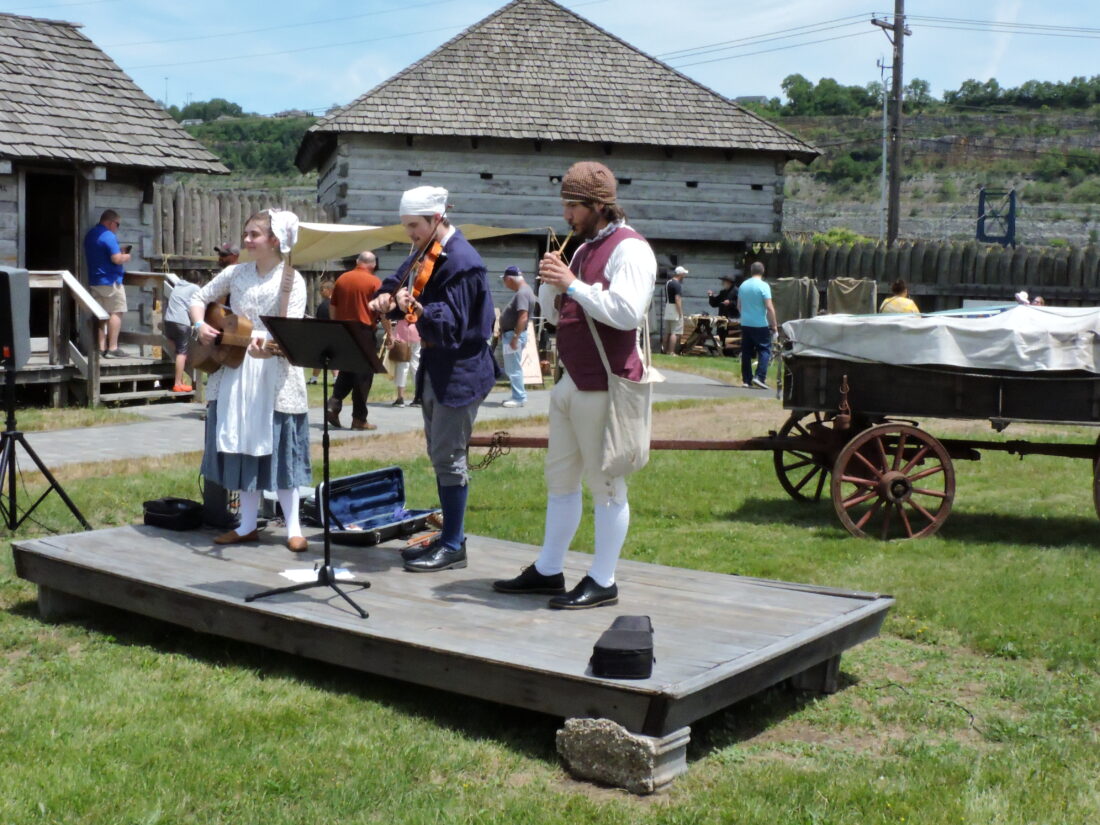
SOUNDS OF THE PAST — Members of Faire May performed period music for many attending Ohio Valley Frontier Days, a festival that offered a look at life at Historic Fort Steuben when it provided shelter and protection to surveyors mapping the Northwestern Territory in 1786 and 1787. -- Warren Scott
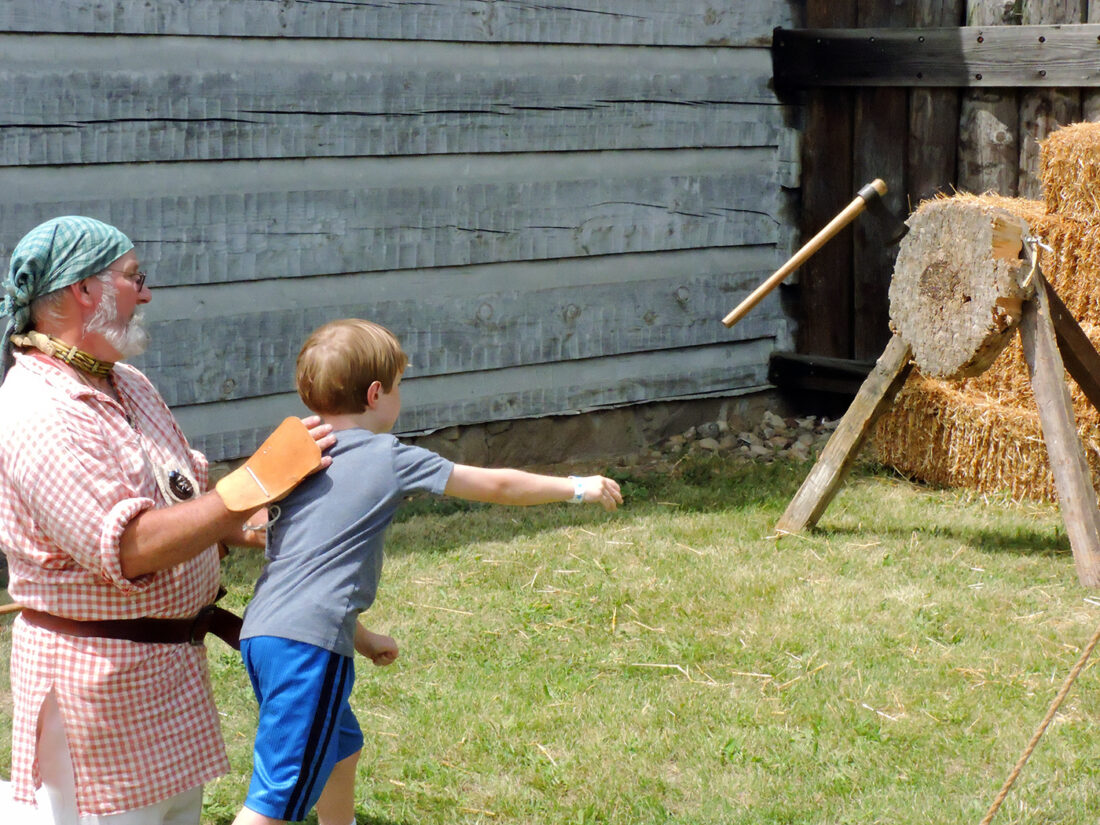
FIRING AWAY — Seven-year-old Nolan Savre of Columbus tossed a tomahawk toward a target with the help of Frontier Dan Filbert, one of many guides who shared skills and details of life at Fort Steuben in 1787, when it provided shelter and protection to surveyors mapping the Northwestern Territory, during Ohio Valley Frontier Days. -- Warren Scott
SOUNDS OF THE PAST — Members of Faire May performed period music for many attending Ohio Valley Frontier Days, a festival that offered a look at life at Historic Fort Steuben when it provided shelter and protection to surveyors mapping the Northwestern Territory in 1786 and 1787. -- Warren Scott
FIRING AWAY — Seven-year-old Nolan Savre of Columbus tossed a tomahawk toward a target with the help of Frontier Dan Filbert, one of many guides who shared skills and details of life at Fort Steuben in 1787, when it provided shelter and protection to surveyors mapping the Northwestern Territory, during Ohio Valley Frontier Days. -- Warren Scott
Trending
STEUBENVILLE -- Visitors to Historic Fort Steuben this weekend learned about the lives and work of the people who occupied it in 1787 and 1788 through a variety of guides and displays presented as part of Ohio Valley Frontier Days.
The two-day festival included a new addition to the reconstructed fort: The Surveyors Museum, which was developed by members of Professional Land Surveyors of Ohio and staff and students at the University of Akron's surveying and mapping program.
Ann Besch, senior lecturer with the program and retired Air Force officer, noted the PLSO has been involved with the fort and the festival for some time, but this year set out to organize display revealing the variety of tools used by surveyors from ancient times to the present.
Besch said such an exhibit is fitting because the fort was built to provide shelter and protection to surveyors who set out to map the Ohio Valley and other areas of the Northwestern Territory.
The Surveyors Museum was dedicated to her late husband, Thomas "Mike" Besch, who followed a 28-year Army career, including service in the Vietnam War and Operation Desert Storm, with 24 years as a surveying instructor at the University of Akron.
Ann Besch noted that through the Land Ordinance of 1785, the U.S. government established a system by which territory outside the current 13 states could be mapped, divided and sold to settlers and land speculators.
The ordinance created the position of a national geographer with 13 deputies, representing each state, under him.
Each deputy was paid $2 for each mile surveyed, from which they paid ax men, who used their bladed tools to clear paths through heavy vegetation; horse handlers; hunters and chain men, named for the 66-foot-long "Gunter's chains" used to measure the land.
Al Smith, another surveying instructor with the University of Akron, noted the property was divided into townships of 36 square miles each, and each of those into 1-square-mile sections.
Besch said except for land reserved for the development of schools, the property was sold at public auction, at a minimum of $1 per acre and a minimum purchase of one 640-acre lot.
She said the ordinance established a surveying process that was modified through the years but has remained the basis for establishing townships and sections within them.
Surveying tools displayed in the museum range from a sextant, which incorporated celestial bodies in determining latitude and longitude; a Gunter's chain, named for an English clergyman and mathematician who designed it in 1620; to a drone used for aerial surveillance and a robotic device mounted on a tripod used to record data in the field for later download to a computer.
Of the surveyor's role through the years, Besch said, "What we do is the same. It's the tools that have changed."
Smith said he and other surveyors involved with the project hope it will help to make students more aware of the field, for which there is a strong demand.
He noted his interest in drawing led him to enroll in a a combined drafting and surveying program at the former Belmont Technical College, where he learned of the various career opportunities in the latter.
Smith suggested anyone who likes math and working with technology consider entering the field.
Reflecting on the fort itself, Besch noted its first blockhouse was a collaborative effort after which enlisted soldiers of the First American Regiment were divided into three groups, each challenged to construct one of three blockhouses first.
She said several barrels of whiskey were offered as the prize to the group that finished their blockhouse first.
Regular visitors to Ohio Valley Frontier Days know they will find several guides ready to describe life among soldiers and others at the fort and demonstrate skills employed to provide goods and services needed for its daily operations, from blacksmithing to broom-making.
Among the many on hand this year was retired library director Alan Hall, who staffed the fort's hospital.
Hall noted the fort's medical needs were addressed by Dr. John Elliott, who had been trained at King's College, now Columbia University, in New York City, and volunteered his services during the American Revolution.
He said it was unusual for a military outpost to have a physician with Elliott's education, as many had much less training.
Even so, medical practices in the fort's day could be primitive and brutal.
Hall showed visitors a device used to swiftly chop off frostbitten segments of fingers, noting the physician did his best to pull remaining skin over the new "fingertips" and sew it together with the same needle and thread used for clothing.
A collection of old medical tools donated to the fort by a Pittsburgh doctor includes assorted scalpels and hooked objects. The latter includes a tenaculum, which was used during amputations to pull the cut ends of blood vessels so they could be tied off.
Hall noted during his operations, the doctor is said to have used as anesthesia either tintura thebaica, an opiate dissolved in alcohol, or opium gum, a derivative of poppies that was an almost pure form of the drug.
He said Elliott also is said to have drawn on the medical knowledge of Native Americans living in the area.
"They knew the things you could remove from (tree) barks and get medicine from," Hall noted.
Brady Dunlevy of Steubenville said he loves local history and frequently attends the festival.
"It's interesting to converse with the different demonstrators. You learn a lot," he said.
Many young visitors to the fort enjoyed learning to throw a tomahawk at a wooden bull's-eye under the watchful eye of "Frontier" Dan Filbert or seeking items pictured on a "scavenger hunt" list furnished by fort Director Judy Bratton and others with the fort.
There also was assorted food for sale, live period music and several displays in the fort's visitors center, including one detailing Steubenville's link to the Lewis and Clark Expedition.