
Early intervention program helps boy find his voice
Trending
STEUBENVILLE -- Theo Kennedy is a bundle of energy, playing with his cat and excitedly showing off some of his toys.
Theo, the 2½-year-old son of Ashlea Kennedy of Stratton, is finally finding his voice after working with the early intervention program through the Jefferson County Board of Developmental Disabilities. The EI program is currently coordinating services for 77 children, with 66 on individual family service plans who receive services in their home. About 15 employees, provide a variety of services including special instruction by developmental specialists, occupational therapy, physical therapy and speech therapy while the state has offered consultations for vision, audiology and mental health services.
Kennedy said the tyke did not speak when he was a year old and she wondered if it was something more serious. She described him as a very easygoing baby who generally made sounds but never vocalized words.
"I started to notice and compared him to other children his age," she recalled. "I didn't know if he was on track. Some said this was normal, but others said it wasn't. I also was concerned about autism. I know some of the symptoms are being non-verbal or having limited speech, but he's so active and so social. I talked to his pediatrician, and she suggested I take him to EI and have him evaluated."
Theo met with EI representatives who offered their services to help him thrive.
"Some of my feelings were validated," Kennedy added. "I said yes, I needed all the help I could get."
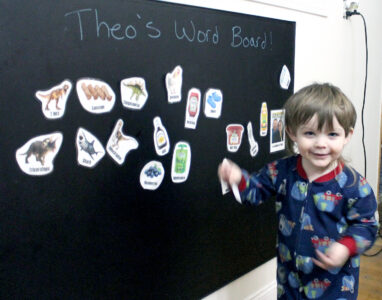
She and Theo would meet at home with speech therapist Jane Herron, who worked with Theo and showed Kennedy and the boy's grandmother, Elizabeth Kennedy, strategies that helped him improve upon his communication, such as sign language. They also used a board which could be written or drawn upon as well as to hang magnetic pieces bearing pictures and word descriptions of foodstuffs, dinosaurs and photos of family members for him to identify. Sessions were held weekly, then monthly and Theo finally began to speak a year ago.
"His first sign was for 'more,'" she added. "The first time he said 'Mama,' he was almost 2."
And to her, it was the sweetest sound.
"I was so excited that he'd talked. I thought he'd say more words and he just took off. He learned basic sign language so he could express his feelings," she said, noting that he has been speaking sentences for the past six months.
Herron recalled Theo being very receptive to learning and said the sessions were based on play interaction with a blend of sign language. Contrary to some beliefs, she said sign language does not stop a child from talking but helps them transition to speaking. Another plus is that Theo's mom and grandmother were able to work with him themselves.
"I think the program helped him and helped his mom. She and his grandma were really involved and got the word board," she said. "I think that really helped him because he never expressed his wants and needs, and soon he was able to express them on his own. When parents stay involved, you are more like a coach. The program is done through play and his mom watched and would do what I did. He then progressed at a nice pace."
Herron continued that the EI program benefits parents as well as the children who are served.
"People don't realize it's not only working with the child; EI is there to help parents learn skills to help their child. When we work with the children, we're a model for the parents. It gives children a chance to have interventions before they go to school."
She has worked with children in schools and through JCBDD for the past 47 years and said it never ceases to amaze her when a child reaches goals.
"It's a great opportunity and it's just very rewarding," Herron said.
Theo is another shining example of a positive result. While Herron would normally work with a child until age 3, she ended his sessions a bit earlier because of his progress.
These days, the boy loves to look at books and is getting more used to verbalization. Theo will spend time with the word board, identify the magnetic pieces and say the words, plus he is speaking in sentences. It is a clear indication of the strides he has made in the brief time he's worked with the program. Kennedy admits she was hesitant to utilize EI, but she now realizes how vital it was to her son and how it could benefit other children.
"It's crazy to think how far he's progressed. He started with Ms. Janie after his first birthday and within three months he was saying his first words. I really like (the EI program.) I love how convenient he was and enjoyed working with Jane and Service Coordinator Nick Saggio. It's wonderful. Theo loved to spend time with them, and I wish more people would take advantage of it."
She smiles as Theo runs about and yells more words.
"It's really worked for him and maybe it could work for other kids, too. He's doing really well and I feel like he's on par with his peers now," she said. "There's so much talking, and I love it."
For information about the program, contact the JCBDD at (740) 264-5812, extension 1130.