
Seminar educates on recognizing, addressing human trafficking in health care
Trending
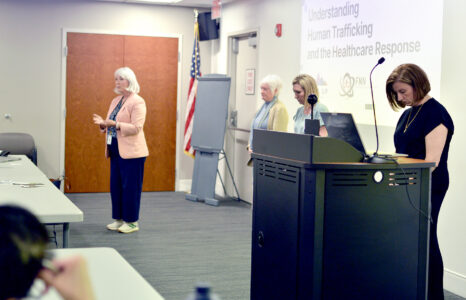
STEUBENVILLE -- A seminar hosted by Trinity Health System invited community health care workers to learn about human trafficking and how they can intervene to bring about a positive outcome.
Entitled Human Trafficking 101 with an Appalachian and Healthcare Focus, Monday's seminar dove into the realities of human trafficking -- particularly as it's seen in Appalachian Ohio -- and how health care workers should proceed if a suspected case of human trafficking falls into their purview.
Taking place at Trinity Medical Center West, the seminar was presented in partnership with Eyes Up Appalachia, an anti-human trafficking initiative serving 32 Appalachian Ohio counties, and Forensic Nursing Network, a nonprofit providing mentorship and education for nurses in the field of forensics.
The seminar comes as Trinity Health System's sponsoring organization, CommonSpirit Health, continues development of a task force to address human trafficking cases, according to Wendy Ralston, who is the the task force's developer, as well as Trinity's director of behavioral health and sexual assault nurse examiner.
Ralston said the task force will be composed of a multi-disciplinary team, including nursing staff, spiritual care, physicians and social workers, as well as outside resources including domestic violence shelters and pediatric centers. The task force will raise awareness of how health care workers should react to an active case, help them identify red flags and teach the proper approach and language to use.
Liz Schriner, Trinity's market director of mission, commended Ralston's work toward connecting the community with education aimed at solving the social issues that follow from clinical issues. She said the task force may, at some point, feed into establishing a county-wide coalition for the same purpose.
"Human trafficking is so prevalent, and no one entity can (solve) it all," Schriner said. "Wendy's idea of taking the conversation broadly and seeing who would like to partner up for other initiatives is great."
As for human trafficking's prevalence in the region, Ralston said, the nearby convergence of major interstate highways makes the area a main hub for human trafficking, which was later defined as "compelling someone to engage in commercial sex, labor or services through the use of force, fraud or coercion in exchange for anything of value."
The founder of Eyes Up Appalachia, Christi Scott Bartman, discussed targeting myths surrounding human trafficking. Unlike in the movies, she said, human trafficking's perpetrators and victims do not have a single demographic profile, though some demographics are more common. Most often, individuals are trafficked by family members, and kidnapping is only the case in about 3 percent of situations.
Human trafficking may be done for labor purposes -- whether it be forced labor, debt bondage or child labor -- or sex trafficking, added Heather Wild, director of education for Forensic Nursing Network. Online recruitment for sex trafficking has been on the rise, Wild said, noting that online recruitment saw a 22 percent increase in 2020, according to the anti-human trafficking nonprofit Polaris.
Trafficking begins when those involved identify a person's need and seek to fill it. Individuals could want love, shelter, friendship, family, luxury, protection or freedom. The trafficker offers the person these things and works to isolate the person, convincing him or her that the trafficker is the only person who cares.
Eventually, the abuse begins, wherein the trafficker insists that the victim owes him or her, Wild said. This relationship can be made more complex through trauma bonding, or the victim's feeling of fear mixed with the gratitude for being allowed to live.
Variables that could push someone toward getting involved with a trafficker could include economic difficulty, lack of opportunity, homelessness, lack of education, intimate partner violence, sex abuse or trauma, Bartman said. If these vulnerabilities are displayed online, they may draw the attention of traffickers wanting to exploit those desires.
Bartman also described family trafficking, which is when a family member allows access to a child in exchange for something, such as money or drugs. Bartman said this type of trafficking is what is most commonly seen in Appalachian Ohio, and studies frequently show a familial relationship in trafficking cases.
"The counties with poor substance use stats are getting worse," Bartman said, "and this and human trafficking go hand in hand."
Sadly, Wild said, 88 percent of human trafficking survivors said they were treated by a health care provider, but their situation was never recognized. At the same time, only 6 percent of health care workers reported treating a human trafficking victim.
"We know they're coming into our hospitals, ... but we're just doing what we need to do and going on to the next one and sending them on their way," Wild said, adding that health care workers have a unique opportunity to intervene in these cases and recovering victims.
The first step to helping a victim is recognizing the warning signs, which may include the person not knowing his or her address, lying about their age, not speaking English, avoiding eye contact or being accompanied by another person who answers questions on the patient's behalf.
Wild said health care workers should always place treating the person's medical needs first and always be compassionate, working to gain their trust. Ensuring to get the patient alone to speak, workers should lead with patience and calm in their questioning, as overt questions could scare the patient away from openness.
For individuals older than 18, workers will sometimes just be "planting the seed" and letting the patient know the hospital is a safe place, Wild said, adding that the worker should acquire the patient's consent before calling law enforcement, taking into account possible dangers if the patient does not return to the trafficker.
Human trafficking is not covered under mandatory reporting laws in Ohio, except for if the individuals is younger than 18, Wild noted.
Bartman said special care should be used when questioning children, who often do not have the proper vocabulary to describe the situations they're in.
Ralston, herself a survivor of family trafficking, encouraged those in attendance to be kind and believe what victims say. Attendees were directed to become familiar with local resources that might help victims and, if needed, to contact the National Human Trafficking Hotline by calling (888) 373-7888 or texting "befree" to 23373.