
Ohio Valley turns out for eclipse day
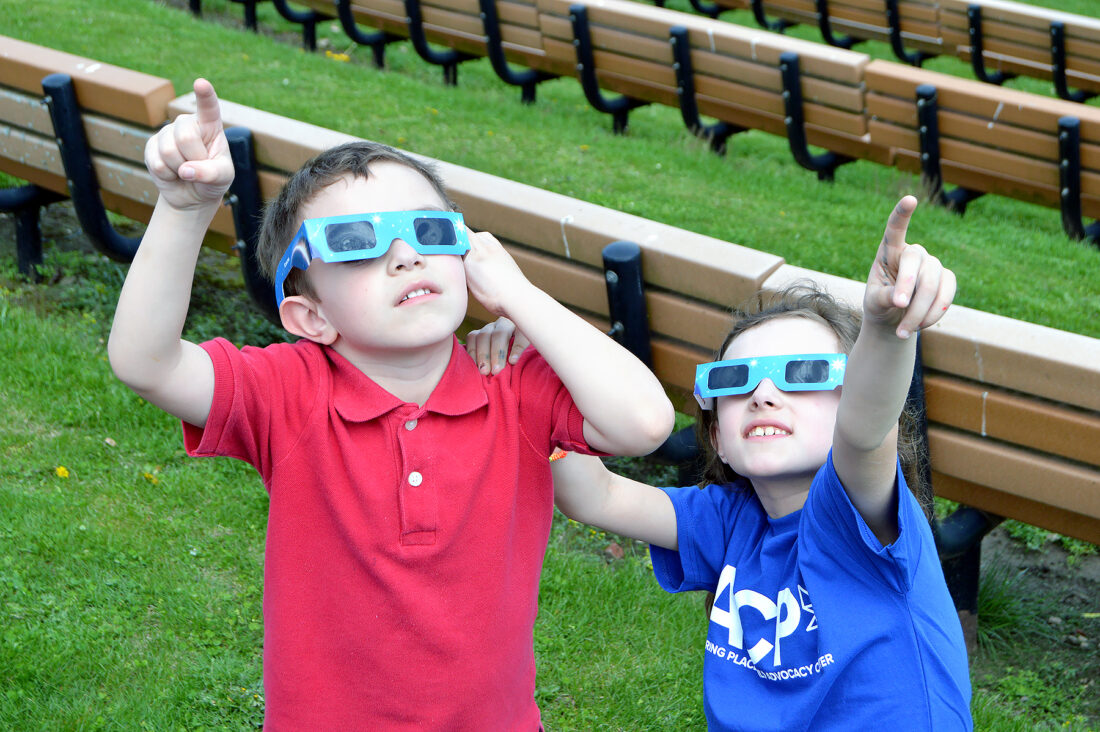
LOOK! — Giada and Joseph Maccariella pointed at the solar eclipse during their watch party with their grandparents Monday at the Louis Berkman Amphitheater. -- Christopher Dacanay

GENERATIONS — Three generations were represented Monday in an eclipse watch party in Wintersville, featuring grandmother Debbie Elias, daughter Jessica Elias and granddaughter Skyla Jo Doran. -- Contributed
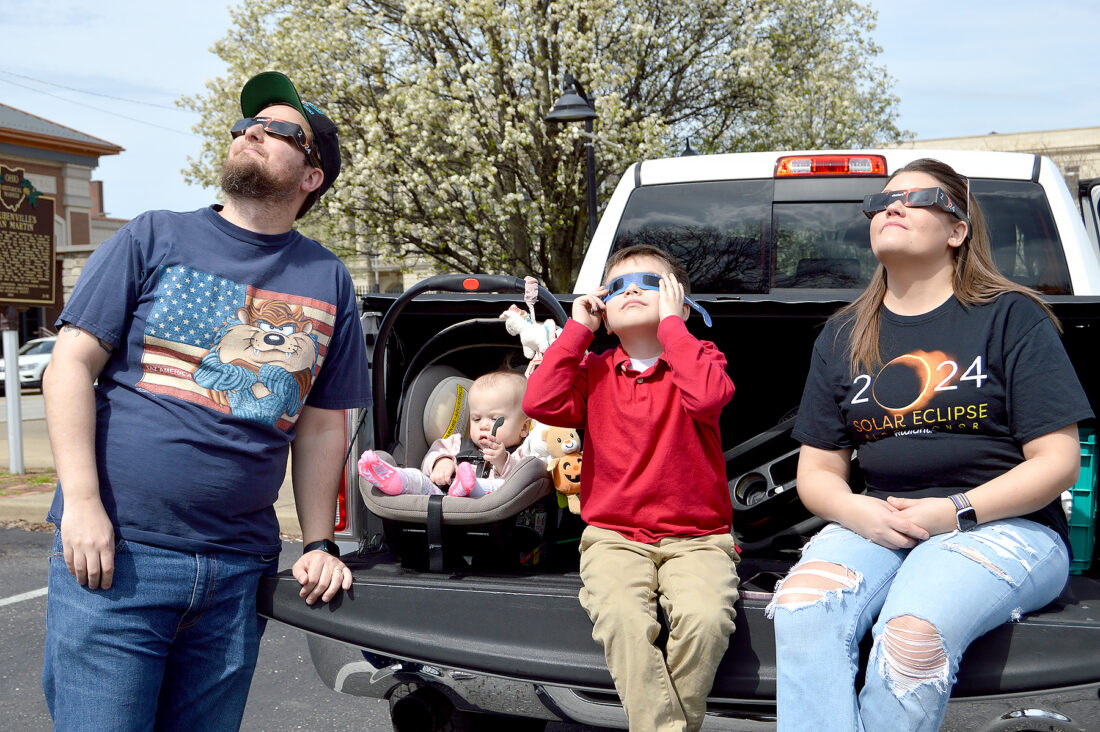
WATCH PARTY — Members of the Saxon family watched the eclipse together Monday in the parking lot of the Steubenville Visitors Center. From left are John Saxon; Vivian Saxon, 1; Edison Saxon, 6; and Emily Saxon. -- Christopher Dacanay
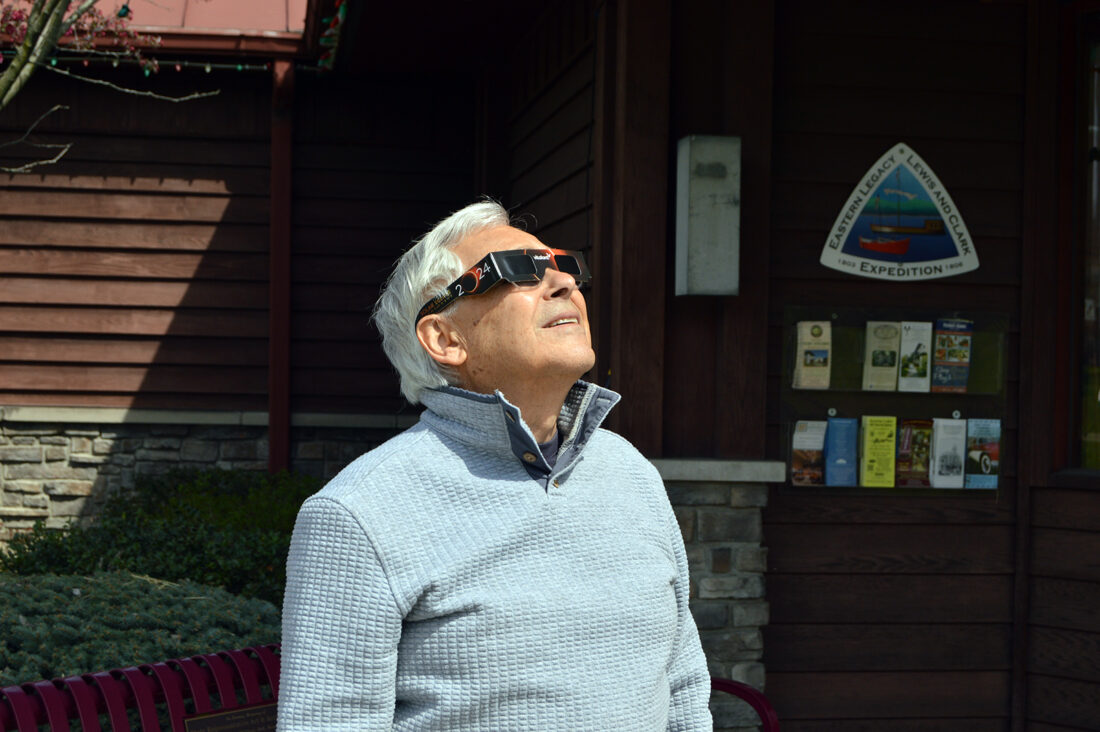
IMPRESSED — Steubenville Mayor Jerry Barilla watched Monday’s solar eclipse through eclipse viewing glasses, something he’s never done before. -- Christopher Dacanay
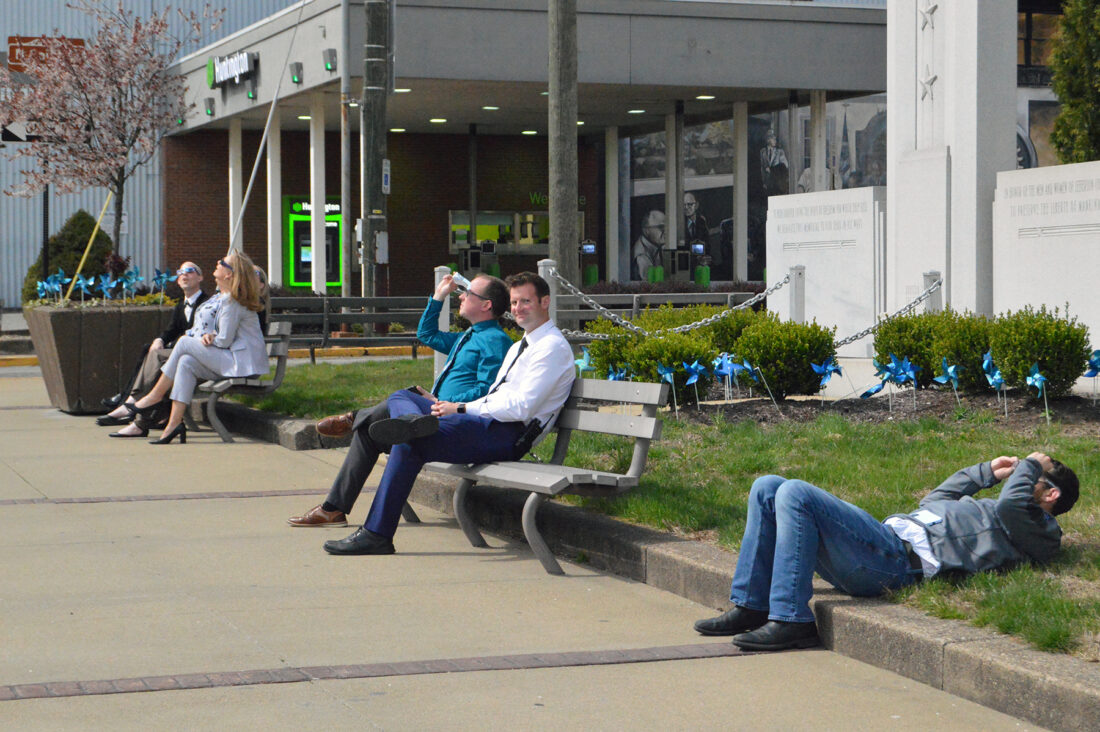
LOUNGING — Employees at the Jefferson County Courthouse watched the eclipse as it reached its peak Monday. -- Christopher Dacanay
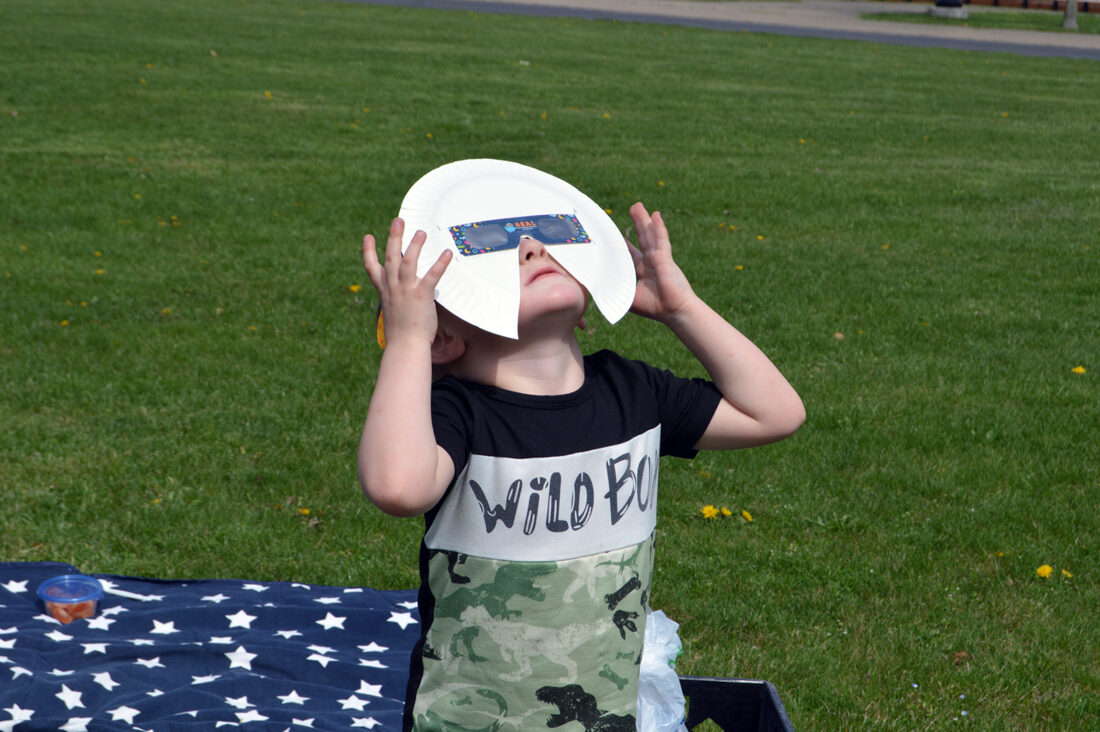
SAFETY GLASSES — Declan Gross looked at Monday’s solar eclipse through glasses, modified for safety by his grandmother, Eileen Reilly. -- Christopher Dacanay
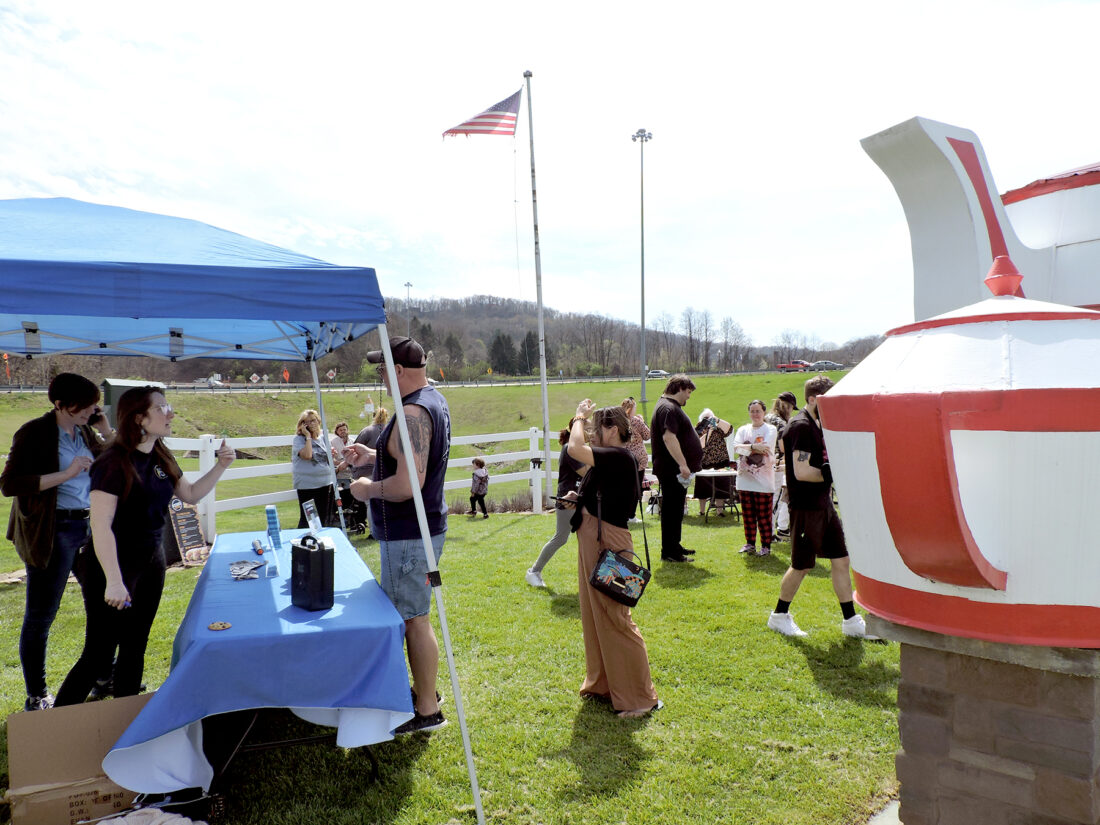
ON WATCH — Area residents gathered in West Virginia’s northernmost city Monday afternoon for a solar eclipse watch party at the World’s Largest Teapot. The event, organized by the Top of West Virginia Convention and Visitors Bureau, included the distribution of 50 pairs of solar eclipse glasses to safely view the astronomical event, music, and free activities for the kids by representatives of the Lynn Murray Memorial Library. Locally, there was approximately 98 percent coverage of the sun by the moon as part of the eclipse. -- Craig Howell
LOOK! — Giada and Joseph Maccariella pointed at the solar eclipse during their watch party with their grandparents Monday at the Louis Berkman Amphitheater. -- Christopher Dacanay
GENERATIONS — Three generations were represented Monday in an eclipse watch party in Wintersville, featuring grandmother Debbie Elias, daughter Jessica Elias and granddaughter Skyla Jo Doran. -- Contributed
WATCH PARTY — Members of the Saxon family watched the eclipse together Monday in the parking lot of the Steubenville Visitors Center. From left are John Saxon; Vivian Saxon, 1; Edison Saxon, 6; and Emily Saxon. -- Christopher Dacanay
IMPRESSED — Steubenville Mayor Jerry Barilla watched Monday’s solar eclipse through eclipse viewing glasses, something he’s never done before. -- Christopher Dacanay
LOUNGING — Employees at the Jefferson County Courthouse watched the eclipse as it reached its peak Monday. -- Christopher Dacanay
SAFETY GLASSES — Declan Gross looked at Monday’s solar eclipse through glasses, modified for safety by his grandmother, Eileen Reilly. -- Christopher Dacanay
ON WATCH — Area residents gathered in West Virginia’s northernmost city Monday afternoon for a solar eclipse watch party at the World’s Largest Teapot. The event, organized by the Top of West Virginia Convention and Visitors Bureau, included the distribution of 50 pairs of solar eclipse glasses to safely view the astronomical event, music, and free activities for the kids by representatives of the Lynn Murray Memorial Library. Locally, there was approximately 98 percent coverage of the sun by the moon as part of the eclipse. -- Craig Howell
Trending
STEUBENVILLE -- Around 3 p.m. Monday, as a strange darkness enveloped Steubenville and surrounding communities, individuals emerged from businesses and homes to view the rare solar eclipse that has for months enraptured the nation.
A solar eclipse is a phenomenon wherein the moon, in its orbit around the Earth, temporarily passes in front of the sun and blocks its light. This particular eclipse saw the moon's shadow pass over North America, traversing through parts of 15 U.S. states over a little more than an hour.
Parts of the U.S., including much of Northern and Eastern Ohio, temporarily witnessed 100 percent blockage of the sun by the moon for a period of about four minutes, during which it was safe to look at the phenomenon with the naked eye. Eclipse-themed events dotted the path of totality, which became a hotspot for travelers.
Although residents of the Tri-State Area did not see totality -- the city witnessed about 98 percent coverage -- individuals in the area could still don protective glasses and see the sun reduced to a small sliver, obscured by the passing moon. The highest peak in the sun's blockage for Steubenville occurred at 3:16 p.m.
The partial eclipse period in Steubenville lasted from 1:59 p.m. to 4:29 p.m., according to the National Solar Observatory. During that time, a near-twilight was cast over the city, as individuals craned their necks to see the spectacle.
Watching the event while seated near the Steubenville Visitor Center was Nicole Shoemaker, who was off work Monday. Shoemaker, who recalled watching the last total solar eclipse in the U.S. in 2017, said she could feel the air get colder as this eclipse's peak approached.
"It's pretty cool to just see a sliver of the sun," Shoemaker said as the eclipse waned.
Also posted near the center were Barry and Iris Bardone of Bloomingdale, who brought with them their grandchildren Giada, 8, and Joseph, 5, Maccariella of Rayland. The Bardones had retrieved the two kids early from Wells Academy to watch the eclipse, and the kids played energetically around the Louis Berkman Amphitheater as the eclipse approached.
"This is going to be real exciting," Barry Bardone had said before the peak.
Barry Bardone recalled witnessing a previous eclipse some 40 or 50 years ago. He has always been interested in astronomy and used to take pictures of the moon through a telescope.
Giada Maccariella said she was "excited" for the eclipse, adding that she had been learning extensively about the phenomenon at school and doing fun, eclipse-themed worksheets.
To Giada Maccariella, Barry Bardone said, "You'll remember this day."
Nearby, Declan Gross, 4, flew a kite under the supervision of his grandmother, Eileen Reilly. The two had a picnic blanket set up, from which they intended to view the eclipse.
Gross, a student at Hills Elementary School where students got to leave early, wore highly tinted eclipse glasses that Reilly had fixed to a paper plate to make sure no extra sunlight seeped in and threatened Gross' vision. Reilly herself demonstrated an old-school eclipse-viewing device made from a cereal box cut with two holes, one for looking into and another for taking in sunlight -- as the sun is eclipsed, the second hole's light begins to decrease, mimicking the sun.
John and Emily Saxon of Weirton had picked up their son, Edison, 6, from Wells Academy early and driven to the visitor center parking lot to view the eclipse together, along with their daughter Vivian, a 1-year-old as of March.
Edison Saxon, who learned about the eclipse in school, said the next total solar eclipse will take place in 20 years -- in fact, it will occur on Aug. 23, 2044, and only pass over parts of Montana, North Dakota and South Dakota.
To that fact, John Saxon added, "I hope I'm alive."
The family watched the eclipse using glasses obtained for free from Emily Saxon's job. Regarding being able to see such a historic event, Emily Saxon said, "I think it's really cool."
John Saxon added that it's "something you'll always remember."
Eclipse viewing glasses had seemingly became a "hot commodity" leading up to the event itself, John Saxon said.
Indeed, glasses were in high demand even locally, as seen by how the Public Library of Steubenville and Jefferson County distributed all 5,000 of its pairs, obtained from the Space Science Institute's Solar Eclipse Activities for Libraries program, during the past month.
With so many glasses floating around in the public's possession, PLSJ advised Monday that it will be collecting used solar eclipse glasses "to recycle for future eclipses around the world," according to a release."
In the same, the library announced: "Library patrons will have until April 30 to return used glasses to any library branch. The library will ship used solar glasses to a nonprofit organization that will distribute them to underserved communities and schools internationally for use in future solar eclipses."
Also at the visitor center was Steubenville Mayor Jerry Barilla, who was viewing an eclipse through glasses for the first time. With the next eclipse occurring in 2044, Barrila said, "This is my last chance at this."
With Barilla was Dan Filbert, who noted that he'd previously used a welders' mask to view an eclipse.
Across the street, employees at the Jefferson County Courthouse stood outside, some lounging on benches or even in the grass, to see the eclipse hit its peak.
Farther up Market Street, Shawnna Smogonovich used eclipse glasses she obtained for free from Metro by T-Mobile. She said the phenomenon was "a glimpse of what God can create."
Meanwhile, in Wintersville, three generations were represented in a watch party, featuring grandmother Debbie Elias, daughter Jessica Elias and granddaughter Skyla Jo Doran.
A Pugliese West Elementary School student, Doran said she was excited to see in action what she had learned in school, adding, "It was super cool when it got darker out."