
Indian Creek, ODNR partnership saving salamanders
Trending
WINTERSVILLE -- An environment-themed learning fair at Indian Creek High School Thursday showcased the school's partnership with the Ohio Department of Natural Resources, which will give students a role in preserving an endangered salamander species, the hellbender.
Indian Creek's Healthy Creek, Healthy Hellbender Aquatic Learning Experiences event featured educational stations regarding environmental and conservation topics, created and presented on by students. The event was paired with Indian Creek's annual career fair, this year netting 29 different entities, including universities, businesses and military branches.
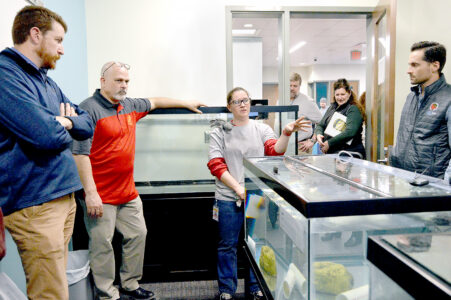
However, the star of the show was Chief, the school's 3-year-old eastern hellbender salamander. Housed in a tank in the school's atrium, Chief would occasionally poke its head out from between stones as visitors to the fair looked on and students provided information about hellbenders, an endangered species in Ohio.
Chief is the "educational ambassador" is the forerunner for the Ohio Hellbender Partnership program, which ICHS has been involved in for about a year, according to Crystal Fluharty, teacher for the school's natural resource management CTE program.
Aimed at the rearing and releasing of hellbenders into the wild to bolster their natural numbers, the partnership combines efforts from the ODNR, Ohio State University, Columbus and Toledo zoos, Penta Career Center, the Wilds, county soil and water conservation districts, U.S. Fish and Wildlife Service, U.S. Department of Agriculture, University of Perdue and Rural Action.
The school's participation in the hellbender partnership will be driven by students' curiosity and desire to make a difference in preserving wildlife, Fluharty said, adding that the CTE program emphasizes the importance of looking at other fields like economics and agriculture in conjunction with wildlife preservation.
Fluharty said ICHS received the ODNR's annual Aquatic Wildlife Education Grant to create a permanent home for Chief, who is cared for by students and teachers. Now, through the hellbender partnership, ICHS will soon raise its own young hellbenders in a new rearing room, enabled by the ODNR's grant and equipment donations from Pet Supplies Plus.
Twenty 1-year-old hellbenders, collected as eggs from northern Jefferson County's Yellow Creek and hatched at the Toledo Zoo, will be given to ICHS. CTE students will then raise them to maturity over about three years, at which point the hellbenders will be released back into the wild. Afterward, students will present their findings from the past years' observations at a wildlife symposium in the Wilds safari park in Cumberland.
Specially sterilized to prevent contamination of the young hellbenders, the rearing room includes five 40-gallon tanks equipped with surveillance cameras for students, and possibly the public, to watch their progress. The hellbenders are anticipated to arrive in April.
"This is a tremendous opportunity for us to take part in this partnership," said Assistant Principal Keith Swearingen, who added that the rearing room's capacity may grow in the future as the program develops.
ICHS is the first high school to raise hellbenders, noted Kendra Wecker, chief of the ODNR's Division of Wildlife, during a presentation before fair attendees.
Wecker said she appreciates the school's dedication to wildlife rearing and reintroduction. She added that hellbenders need that help in particular, having experienced an 82 percent decline in population from 1980 to 2000, spurred by changes to their aquatic habitats.
"We (the partnered organizations) are here to help support you in the hellbender project," Wecker said, addressing the school.
Through the partnership, which was created in 2010, nearly 1,900 hellbenders have received a head start through rearing help in a laboratory setting before being released into the wild, Wecker said. Furthermore, evidence of nesting suggests that hellbenders are reproducing.
"Last year, a zoo-reared hellbender … was discovered guarding his nest," Wecker said. "This 10-year-old animal was collected as an egg in 2013 and released as a 3-year-old in 2016. So, not only are human-reared individuals thriving in the wild, but they're also producing the next generation. And just imagine what you all can accomplish with your 20 hellbenders you're going to get from Yellow Creek."
Themed games and activities for all ages were available during the fair, which also featured a performance from the Indian Creek High School Choir and a preview of the school's upcoming production of "Grease."