
Engineering award presented for new Ohio River bridge
Trending
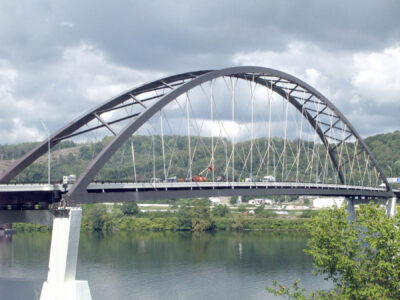
WELLSBURG -- The American Council of Engineering Companies has presented its Diamond Award to the new Ohio River span linking Wellsburg and Brilliant.
The honor was shared by the West Virginia Department of Transportation and COWI, the New York design consultant behind the bridge, which was built by Flatiron Construction.
Accepting it at the council's annual Engineering Excellence Awards Gala in New York on April 13 were Jimmy Wriston, West Virginia's secretary of transportation; and Deputy Secretary Alanna Keller.
"West Virginia has arrived. We're on a roll. Alanna and I couldn't be more proud to have accepted this award," said Wriston, who had joined Gov. Jim Justice for the bridge's grand opening on Sept. 21.
He noted COWI and Flatiron made the decision to build the 830-foot main span of the 1.800-foot bridge on the shore of the river, in a construction yard near the Brooke County Pioneer Trail and Wellsburg's south end.
From there, it was floated down the river on April 21, 2021, and the 4,100-ton segment was lifted, using hydraulic jacks, onto piers standing about 80 feet above.
The maneuver was witnessed by many people on both sides of the river, including spectators at the Wellsburg Wharf and Brilliant area residents who gathered near its future abutment at Third and Cleaver streets.
But even more area residents turned out on Sept. 21 to cross the completed span by foot and observe two ribbon cutting ceremonies involving state and local officials.
Wriston estimated about 2,500 people attended the event, which included a classic car show organized by the Wellsburg Chamber of Commerce, fireworks, confetti and performances by the Brooke High School and Buckeye North High School marching bands.
"The structure was decades and decades in the making. When Gov. Justice cut the ribbon, it was like an explosion of celebration," said Wriston.
The cost of the $131 million project was divided 65-35 by the West Virginia and Ohio departments of transportation, respectively, with federal dollars awarded to the two states also contributing to its expense.
The project was named a priority by the Brooke-Hancock-Jefferson Metropolitan Planning Commission, which commissioned a 2000 study showing the need for a new span, citing the advancing ages of the Fort Steuben and Market Street bridges.
A second BHJ study in 2003 recommended its location, suggesting it would encourage new economic development while offering an interstate emergency route in the event of future rockslides along state Routes 2 and 7 and conforming to the elevation needed to allow barges to pass safely under the span.
To accommodate the location, crews also built a half-mile long retaining wall to support the hillside below a section of Route 2 leading to it and allowing the highway to be expanded toward the river.