
Demolishing abandoned properties ‘not that easy’
Trending
MINGO JUNCTION -- Frustrating development possibilities and drawing the ire of citizens, the presence of dilapidated, uninhabited buildings in the village of Mingo Junction has been a longstanding problem.
A look through the windows of some long-unused buildings, particularly downtown, often reveals a disheartening interior, with the roofs of some commercial properties having caved inward.
Mayor Judy Ruckman said a number of these buildings are dangerous, while some have become targets for vagrants.
Getting "really aggressive" on dilapidated properties was one of Ruckman's campaign promises while running for mayor in 2023. To start, she has collected a list of "dangerous or unused" buildings in the village -- residential and commercial -- that need to be taken care of one way or another.
But getting problem buildings torn down and out of the way of development isn't as simple as paying a bulldozer to plow through.
"It's not that easy," Ruckman said. "You can't just say, 'We'll tear them down.' You have to go through the whole process."
Demolitions are made possible through the Jefferson County Land Reutilization Corp., commonly known as the Jefferson County Land Bank. Formed in May 2014, the land bank is a nonprofit organization and county-wide resource, aimed at stemming blight within communities and returning abandoned properties to productive use.
Since being formed, the land bank has demolished 269 abandoned structures throughout the county, with 27 in Mingo Junction, according to Tabatha Glover, a member of the land bank's administrative staff. Of those 269 structures, the land bank has sold most of those lots to end users after demolition, putting those properties back on tax rolls and hypothetically raising surrounding property valuations.
Staffed through the Jefferson County treasurer's, auditor's and prosecutor's offices, the land bank conducts demolitions if funding is available. Previous demolition efforts were funded through the Neighborhood Initiative Program, which ceased in 2019, and the Ohio Department of Development's Building Demolition and Site Revitalization Program, which launched in 2021 and allocated $150 million for commercial and residential building demolition and site revitalization for surrounding properties.
Through that program, Jefferson County was awarded $964,728 for fiscal year 2022-2023, Glover said. Each of Ohio's 88 counties was awarded $500,000 to fund demolitions at 100 percent, while the remaining $106 million was awarded on a first-come, first-served basis, with a 25 percent match required to cover project costs.
"Under the current grant program, a 25 percent match is required for any demolitions over the county's allocated amount of $500,000," Glover said. "The land bank does request that the municipalities contribute 25 percent toward a commercial structure demolition. These projects are consistently more expensive. This also allows the land bank to collaborate with municipalities for the larger projects."
The Building Demolition and Site Revitalization Program was renewed in 2023 under Gov. Mike DeWine's state budget, Glover said, and the land bank is in the process of applying for fiscal year 2024-2025 funding.
Municipalities can submit properties to the land bank's waitlist for demolition, a list that Glover said can take up to a year depending on if the land bank must file for a foreclosure on the property.
Properties must first be confirmed as vacant and dilapidated before municipalities fill out a standard submission form, which the land bank will use to investigate if it can assist on a project, Glover said. Thus, part of Ruckman's task in Mingo Junction has been taking photos of the structures in question and attempting to contact their owners -- which can be difficult at times because owners have moved or died.
Properties must also be delinquent in taxes in order for the land bank to acquire them by tax foreclosure, demolish the structures and sell the parcels. If not delinquent in taxes, the land bank can obtain a property by willful donation from the owner, Glover said.
Another step is looking for elements like asbestos, which must be properly abated before razing can begin. That step was completed around October for 645 Commercial St. in Mingo Junction, known as the Argo building.
Slated to come down in the summer, plans for the building hit a snag in the land bank pipeline earlier this year due to its being included in the Ohio Historic Inventory and contributing to the Commercial Street Historic District, which is listed on the National Register of Historic Places.
Ruckman said on March 12 that she and Glover had successfully obtained a waiver from the State Historical Preservation Office, stating that the building can be demolished provided that an historical marker is placed, noting the building's historical significance. Now, the land bank is planning to submit its grant application to the ODD, and after the application's approval, demolition will commence.
Apart from utilizing the land bank, Ruckman said other measures should be put in place to hold property owners accountable.
One such method would be the enforcement of the village codified ordinances' section 143.07 -- itself reiterating Ohio Revised Code 3929.86(C) -- that permits the village to hold a portion of an individual's insurance check if his or her house burns down and is deemed a total loss. That portion, written out to the village, is held as collateral until the property is sufficiently cleared from debris, said Fire/EMS Chief Brandon Montgomery.
"As long as they get the property cleaned up and the house torn down, they'll get (the full amount)," Montgomery said.
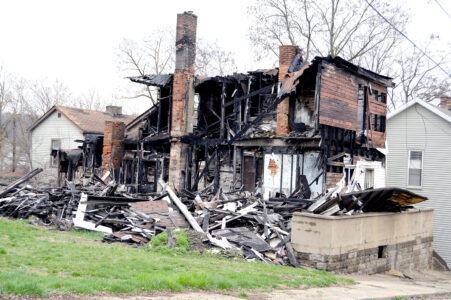
It's an individual's responsibility to clear a burned home and not the municipality's, Montgomery said, and that's how the village has become stuck with one such home on Lincoln Avenue, which Ruckman has submitted to the land bank for demolition.
Although she can't point at a singular person, Ruckman said "negligence" from village government is to blame for the mounting derelict properties.
"A lot of years of just turning your head" has left the village with properties whose owners have moved or died, and the remaining family members either don't know or don't care about the properties.