
Mingo Junction officials hear report about senior service levy
Trending
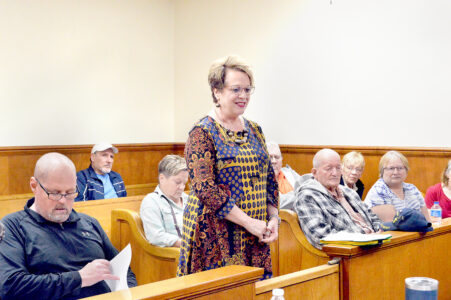
MINGO JUNCTION -- The manager of Prime Time Office on Aging listed the center's services before the Mingo Junction Village Council Tuesday, encouraging those present to vote in support of a senior service levy that would benefit the center.
Trudy Wilson, who is in her third year as Prime Time's manager, provided statistics on the center's services, with a focus on how they affect Mingo Junction residents. This follows council's Feb. 13 meeting, during which individuals made critical comments about Prime Time and whether it gives proper attention to Mingo Junction seniors.
Accompanied at Tuesday's meeting by Prime Time members wearing "Vote Yes" shirts, Wilson also sought to motivate voters to pass the Prime Time Senior Service Levy, which will appear on Jefferson County voters' ballots in the March 19 primary election. If passed, the 1.2-mill replacement levy would be based on current property valuations, generating about $2.2 million for Prime Time to continue and expand its senior services, Wilson said.
With a campus located at 300 Lovers Lane in Steubenville, Prime Time services Jefferson County seniors aged 60 and older, offering them free services ranging from meal delivery, transportation and non-court-based legal referrals. About 118 clients from the Mingo Junction ZIP code, 43938, receive multiple services through Prime Time, Wilson said, citing statistics pulled from Prime Time's current fiscal year.
According to those statistics, Prime Time has 69 total clients for its meal delivery service who live in Mingo Junction. A total of 7,624 meals, approved by a registered dietician for nutritional value, have been delivered to those seniors since July over Prime Time's two delivery routes -- downtown and on the hill.
The meals themselves, Wilson said, are cooked in the Prime Time campus' kitchen, which recently underwent a $200,000 expansion and produces upwards of 1,000 meals each day. Wilson said there are currently four waiting lists for individuals to get on the meal delivery service route.
Prime Time is a $2.6 million operation that currently receives about $1.9 million in funding through the longstanding Jefferson County Senior Service Levy, as well as about $300,000 through the the Area Agency on Aging, which in turn is funded by the Ohio Department of Aging.
Prime Time was founded as a senior outreach organization by Trinity Health System, Wilson said, but it is also a county organization and state organization, being a nonprofit. In sprue of its origin, Prime Time is "as far separated form the (Trinity) while still being part of the hospital as you can be," Wilson said, adding that her has autonomy in how she runs Prime Time and Trinity hospital does not receive funding through the levy.
"We must have these levy funds to continue to support the 240,881 meals that we provided last fiscal year (2022-2023) in Jefferson County," Wilson said, noting that the number of meals was up 11 percent from the prior year.
The population across Jefferson County's approximately 400 square miles is aging and the need for services is increasing, Wilson said. Prime Time is attempting to reach as far as it can but is limited in its services by factors such as the number of vehicles.
"(With) the levy coming up, the reason it's so, so important and we're asking everybody to vote for it is because, without that levy, we could not sustain providing all these hundreds of thousands of services to seniors in Jefferson County," Wilson said. "It's not just Mingo, it's not just Toronto, it's not just Steubenville. It's as far as we can reach physically, right now with what we have, out into the outskirts of Jefferson County."
The levy is a replacement and not a renewal in order to use current property valuations, as opposed to the current levy that utilizes valuations from five years ago, Wilson said. For a house valued at $100,000, $42 would go to Prime Time, and since meals cost $3 each to produce, that means a taxpayer would help feed 14 seniors throughout the year, Wilson said.
Wilson spoke further on the meal delivery program, based out of the kitchen on Lovers Lane. In addition to delivering meals directly to seniors' homes, the program has congregate sites, where meals are delivered in batches to groups of people who eat together in the presence of a Prime Time employee, and grab and go sites, where seniors can pick up their meals like a drive-through.
Wilson said she discussed with Mingo Junction Mayor Judy Ruckman about possibly bringing a grab-andgo site to the village. The site, she said, would likely be at the city building in the parking lot.
Councilwoman Pat Cramblett asked Wilson why a Mingo Junction meal delivery site couldn't be located at the existing Mingo Junction Senior Center.
To that, Wilson said a congregate site did exist at the center before her tenure with Prime Time. However, individuals with the center at the time allegedly mismanaged the meals and sold a portion for money, resulting in an audit against Prime Time and the subsequent closing of the site.
Asked by Cramblett what it would take to bring a congregate site back, Wilson said it would take "very strict paperwork and oversight," as well as inspections so as not to cause a repeat incident. Alternatively, Wilson said grab and go sites -- popularized during the COVID-19 pandemic -- might be "the way to go."
Wilson fielded other questions and comments from those present, including from village resident John Andreano, who suggested that no longer having Prime Time meals at the Mingo Junction Senior Center has dissuaded them from attending, meaning they miss out on essential socialization and activity. Rather, delivering meals to seniors' homes encourages them to stay at home.
Advising against a grab-and-go site due to many seniors being supposedly unable to drive themselves, Councilwoman Patty Mannarino said to Wilson: "I'm suggesting that, to benefit our community and our seniors, that you get down there and inspect, do what you need to do, and let's get this moving for our seniors."
"I will do my best to make that happen," Wilson said, having noted earlier that she would continue conversations with Ruckman about the possible development.
After the meeting, Wilson said she remains hopeful that the levy will pass as it has before, but she does not want to forecast what the situation would look like if the levy failed, and Prime Time lost access to the vast majority of its funding.
"I would hate to see all the thousands of people that we serve lose the services that we provide -- the meals, the transportation, the legal referrals -- because the levy didn't pass."