
Family farm focused on real food
Trending
TORONTO -- Amid the hustle and bustle of city life, it's tempting to daydream about how things might be on a farm -- a tranquil setting, filled with honest work and good food straight from the soil.
For those who wish to make that daydream a reality, there is the Healing Land, a Jefferson County-based nonprofit that was incorporated in 2021. The Healing Land's goal is to educate individuals about homesteading and regenerative farming techniques through mentorship, workshops and conferences.
The Healing Land's current endeavor is a monthly talk series on "Real Food and Real Community," which will run through April. The next talk will be at 7 p.m. Thursday in the third-floor ballroom of Leonardo's Coffeehouse on Fourth Street in Steubenville. Meg Krivoniak of Wild Sycamore Farm will speak on "Nourished Kitchen: Scratch Cooking with Local Ingredients."
Kicking off the series in January was a talk by one of the Healing Land's founders, Dr. Brian Burke, who spoke on "Real Food as Medicine." A family medicine doctor for Trinity Health System, Burke advocated for the consumption of locally grown, non-industrialized foods for one's health benefit, supported by experiences from his practice.
Among other topics, Burke proposed the benefits of raw, unpasteurized milk from pasture-fed cows, saying that pasteurization -- a sterilization practice standard in the milk industry -- destroys many of the essential minerals present in milk taken straight from the cow.
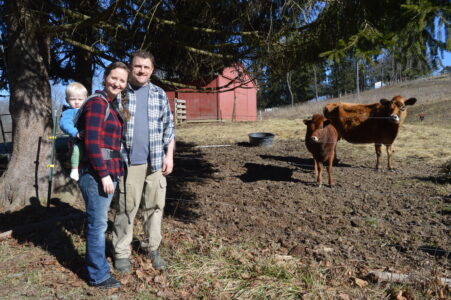
Burke manages a 5-acre farm along county Road 56 in Toronto with his wife, Johanna Burke, and six children, five of them boys. With shared responsibilities for each family member -- some with more than others, given the youngest is a 1-year-old -- the Burkes tend to their dozen laying chickens, two hogs and dairy cow, which has one calf and another on the way.
One might think, by the look of their rolling, peaceful property, that the Burkes have been in the business of farming for their whole lives. However, the family's history of farming is a bit more complicated.
Originally from Eastern Pennsylvania, Johanna Burke moved with her family to Eastern Ohio at 10 years old, giving her two radically different childhoods, she recalled. Homeschooled and living on a 5-acre property, she was introduced to gardening and tending chickens. The environment taught her responsibility and gave her the freedom to pursue her interests.
"I knew that when I had kids, that's what I wanted for them," Johanna Burke said.
Brian Burke, on the other hand, was a "public school kid" living in Seattle without a hint of farming experience. The two met during their time studying at Franciscan University of Steubenville, and when Johanna Burke told her future husband that she wanted to raise a family on a farm, he was open to the idea.
Brian Burke said, "We wanted to be a connected family that was focused on supporting each other and growing in holiness but also doing that in the country, giving our kids the opportunity and space to play, run and work."
That vision would have to wait, as Brian Burke began serving in the Navy to help complete his education. Despite limited property potential, the Burkes made do with their situation, picking up and practicing skills including canning foods, repairing items, creating cleaning products and gardening, albeit to a small extent.
Following Brian Burke's time in the Navy, the family was ready to hit the ground running with their vision. They found and purchased their Toronto property in late 2019 -- furnished with most of a perimeter fence and an empty shell of a barn -- and they began to bring on animals, starting with chickens and growing from there.
For mentorship, the Burkes looked to local farming sages Shawn and Beth Dougherty, who have been farming since the 1980s, the last 20 years in Eastern Ohio.
Brian Burke also met a number of nearby farmers of varying degrees through his practice, but it seemed like most of them didn't know each other. So, the Burkes collected a list of local Catholic farmers and created a directory.
Those in the group began to meet regularly for farm walks, or visits to each other's farms, and provided each other with mentorship, support and community. It was from this group that the Burkes, the Doughertys and two others decided to expand the group's reach regionally through the Healing Land. The nonprofit has since drawn hundreds of attendees in from across the U.S. to learn about farming techniques in Jefferson County, Brian Burke said.
The Burkes themselves have hosted butchering classes for the Healing Land, with another one planned for March 1 and 2 at the Burke's property.
It's important to the Burkes to know where their food is coming from and how the animals are treated. Real food is a big deal for the family, with Brian Burke swearing by the health benefits he's seen in his patients and Johanna Burke herself through changes in diet centered on good nutrition.
Burke specializes in restorative reproductive medicine, helping women naturally overcome fertility issues. Nutrition supplements, along with targeted hormone support, are a crucial part of helping women restore their natural fertility cycles, Brian Burke said.
"The most cost-effective way to obtain nutrient-dense food is to raise it yourself," he said.
Everyone in the family has a job on the farm, Brian Burke said, adding that the responsibilities teach the children important skills. Some of the Burke children help with the once-a-day milking of the dairy cow, from which the family gets its fresh, raw milk that Brian Burke said "Hits the spot every time."
Despite all of the work going into food cultivation, Brian Burke said the products are for the family, and are not for sale.
"You can't put a price tag on it that's worth what it really should be," he said. "It's a labor of love."
The Burkes are examples that nearly anyone can pick up farming or homesteading to some degree, no matter how much experience he or she has. The key to success, Brian Burke said, is to constantly "read and watch," looking to various resources -- the Healing Land, for example -- and taking small steps on new projects.
Also invaluable for that success formula is community, a surrounding group of individuals with their own expertise who can show the way and offer help. Johanna Burke noted that no person is totally self-sufficient because there will always be something he or she can't do.
To that, Brian Burke remarked that the goal is not individual self-sufficiency but "self-sufficiency as a community."