
Red Cross calling on all donors
Nation has largest blood shortage in 20 years
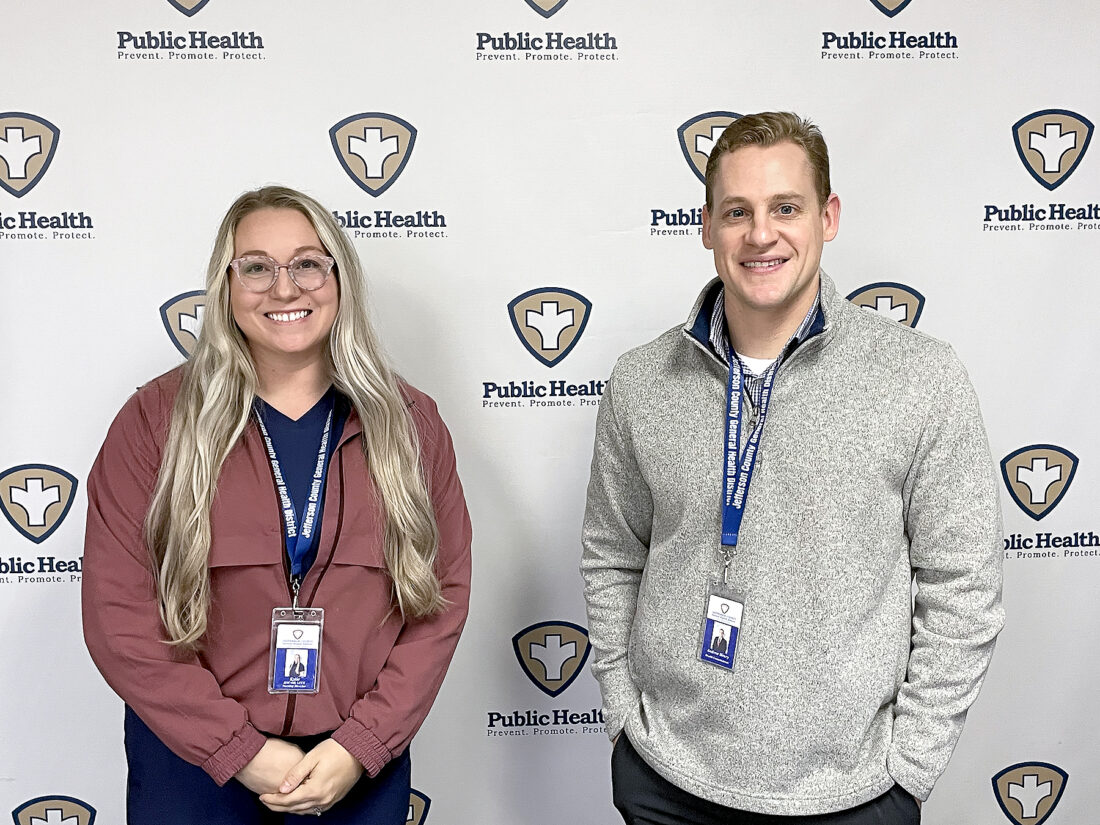
HEALTH OFFICIALS ASK PUBLIC TO GIVE BLOOD — Officials with the Jefferson County Health Department, including Kylie Smogonovich, director of nursing, and Andrew Henry, health director, announced to the community the current need to donate blood. Despite an upcoming Media Days Blood Drive on Jan. 22-23, those at the Red Cross are asking if donors can contribute sooner, if possible. The need stems from a decrease in blood donations, illnesses, winter weather, the holidays and changes in society since the COVID pandemic. Officials say they want to ensure area hospitals will not have to turn patients away because there is not enough in its blood supply. -- Julie Stenger
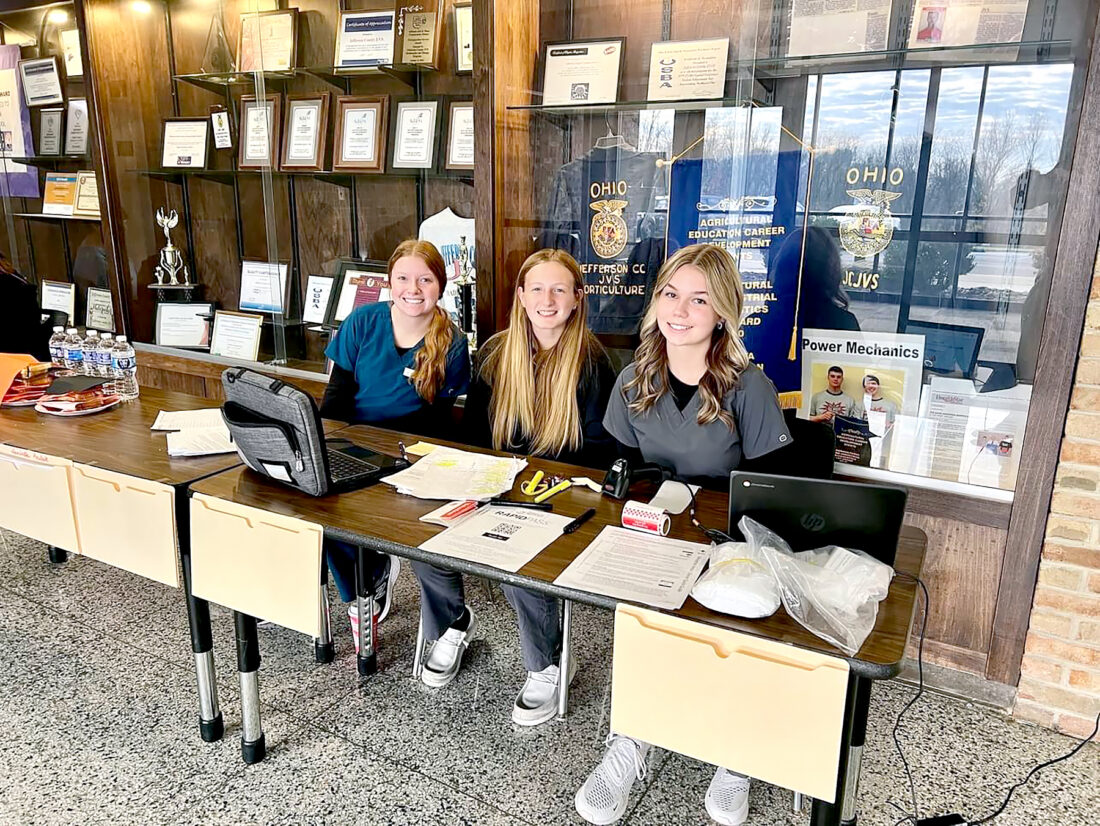
Students enrolled in the health technologies program at the Jefferson County Joint Vocational School have been organizing community blood drives for the past few years. Juniors and seniors volunteer to donate blood and assist the blood donors who visit the school as either walk-ins or having an appointment. At left, student volunteers and donors included, from left, Lillian Gibbons, Vanessa Davis and Caitlyn Hager. -- Contributed
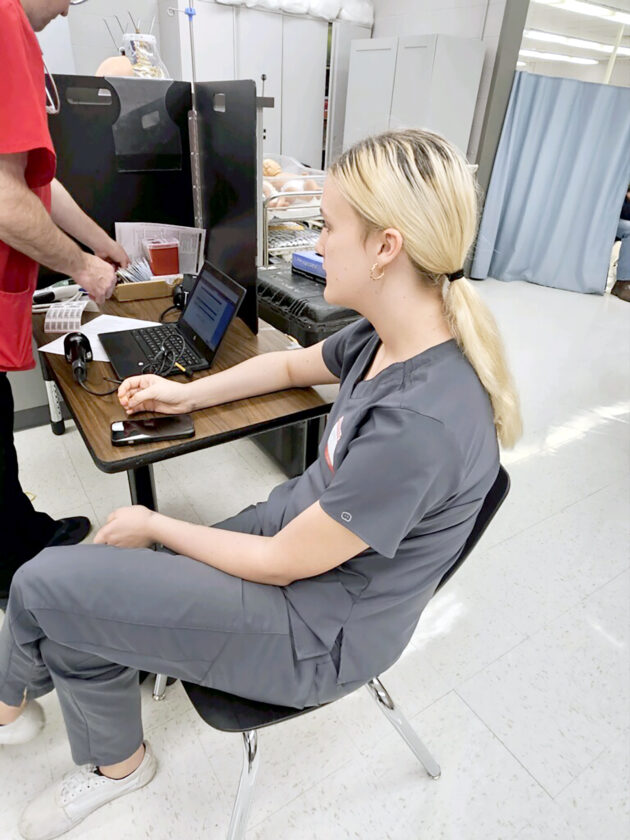
Lexie Reed prepared to donate blood, as American Red Cross officials performed prescreening tests to ensure she was alright to give the gift of life to another. -- Contributed
HEALTH OFFICIALS ASK PUBLIC TO GIVE BLOOD — Officials with the Jefferson County Health Department, including Kylie Smogonovich, director of nursing, and Andrew Henry, health director, announced to the community the current need to donate blood. Despite an upcoming Media Days Blood Drive on Jan. 22-23, those at the Red Cross are asking if donors can contribute sooner, if possible. The need stems from a decrease in blood donations, illnesses, winter weather, the holidays and changes in society since the COVID pandemic. Officials say they want to ensure area hospitals will not have to turn patients away because there is not enough in its blood supply. -- Julie Stenger
Students enrolled in the health technologies program at the Jefferson County Joint Vocational School have been organizing community blood drives for the past few years. Juniors and seniors volunteer to donate blood and assist the blood donors who visit the school as either walk-ins or having an appointment. At left, student volunteers and donors included, from left, Lillian Gibbons, Vanessa Davis and Caitlyn Hager. -- Contributed
Lexie Reed prepared to donate blood, as American Red Cross officials performed prescreening tests to ensure she was alright to give the gift of life to another. -- Contributed
Trending
STEUBENVILLE -- You have heard the pleas before. And truth be told, you have probably either skimmed or entirely disregarded those articles referencing the need for blood donations.
Why? Because they aren't exciting. Because the subject might not pertain to you. Because for many people, the topic is irrelevant.
Until it isn't.
The fact is, donating blood is perhaps the most selfless and meaningful gestures that one can give.
It is a need that will never go away. And one of the few things money is unable to buy.
When emergencies occur, having the most educated physicians and the top medical equipment on site means nothing if there isn't any blood in the hospital's inventory.
And as it currently stands, some hospitals do not.
Officials at the American Red Cross have announced the nation's blood supply has fallen to critically low levels. In fact, they are the lowest levels in 20 years. For the first time in decades, the nonprofit organization is facing a crisis and needs your help.
To put the numbers in perspective, approximately 8,000 donations are needed every week in January just to meet the current need of hospitals.
According to Dr. Eric Gehrie, medical director for the Red Cross, these low figures can likely be attributed to surges in common respiratory illnesses such as COVID and the flu. Factor that with fewer companies holding blood drives at their workplace now that people are working remotely out of their home, and that leads to an "out of sight, out of mind" mentality.
"There is more need for blood at hospitals than we are able to provide at current donation levels, and this is an issue that is really ... a long-term problem," Gehrie stated.
Gehrie explained further challenges lie ahead, as severe winter weather and additional seasonal illnesses could compound the "dire blood supply situation."
"'Emergency' means that hospitals are requesting blood from the American Red Cross ... and we don't have enough blood to meet their patients' needs," he added.
Gehrie said the Red Cross has approximately 300,000 fewer donors than it did in 2019, prior to the COVID-19 pandemic.
"The shortage is an emergency because it has the potential to disrupt care," he commented. "In more extreme situations, shortages may result in a cancellation of surgeries, including heart surgeries when hospitals and doctors don't believe they have enough blood to safely operate."
Since the pandemic, we are now living in a more challenging era for collecting blood due to changes in society.
Gehrie said donations are at their lowest level in 20 years and have become especially strained in the new year. Blood collection centers typically see blood inventories shrink during the month of January, as the holidays leave little time to donate, and respiratory viruses keep some donors home to recover.
"This is why donors of all types -- especially those with type O blood and those giving platelets, are urged to donate now," Gehrie concluded.
Sharon Kesselring, executive director of the American Red Cross of the Ohio River Valley, added to Gehrie's comment, saying, "In recent weeks, we've had to limit our distributions of some of the most transfused blood types to hospitals. We're having to start limiting distribution of type O blood products and we need donors now and in the weeks ahead to help rebuild the blood supply."
Blood shortages have been an ongoing issue for this nation. Pleas for this type of assistance have been requested multiple times in the past. However, this shocking statistic has contributed to America's current problem -- during the past 20 years, the number of people who are donating blood to the Red Cross has declined by about 40 percent.
"We need to reverse this trend," Kesselring said. "Blood cannot be stockpiled. It has a shelf life. So, we have to be very conscious of that and make sure we distribute it at the appropriate time with the appropriate shelf life taken into consideration."
While the 38th-annual Media Days Blood Drive is scheduled to take place from 11:30 a.m. to 5 p.m. Jan. 22-23 at the Wheeling Island Hotel, Casino and Racetrack, this unprecedented blood shortage has left officials asking if donors can make an appointment at another local drive even sooner.
"That way we'll be able to get back out of this crevasse that we're in right now as far as the lack of enough blood donors and we'll be able to make sure that the blood is there for when you need it or someone you love needs it," Kesselring said.
"There is no other source of maintaining blood flow other than one human giving blood to another human," said Kesselring, who said she finds blood donation "to be an intimate experience no matter who the recipient could be."
Once again, she's leading the event with one goal in mind -- to collect 160 units of blood in two days time.
Kesselring set this goal knowing it could be difficult, as January is often their slowest collection month.
"Winter does especially cause us a lot of concern about our inventories and it has to do with the bad weather that cancels so many blood drives across the nation," she commented. She noted it takes less than an hour to give except for those who are considered to be power red donors and give two units during one appointment. This may make the donation time a little lengthier, she added.
"Then you won't have to give blood for another two times your regular time," Kesselring said. "Instead of 56 days, it will be 112 days until you have to give blood again."
Kesselring explained the issue of decreased donation numbers has now "become a point of pain" in the new year and the Red Cross has entered an emergency appeal with no end date in sight.
In addition to the Media Days Blood Drive, there are numerous local drives for those who are able to make a blood donation through February.
To make an appointment at any of these sites, visit the home page of the Red Cross website at redcross.org. Enter your ZIP code in the box next to "make an appointment" and scroll down to locate the drive in your area you wish to attend.
Should a drive indicate there are no appointments remaining, walk-ins are usually welcome. Phone the contact number at the event you wish to attend to make sure they will be accepting walk-ins who do not have an appointment.
Upcoming drives include: Crossroads North River Campus, 207 North River Ave, Toronto, 11 a.m. to 4 p.m. Friday; St. Nicholas Orthodox Church, 604 Colliers Way, Weirton, 10:30 a.m. to 3 p.m., Jan. 25; Lighthouse Evangelical Presbyterian Church, 336 W. Main St., Richmond, 10 a.m. to 4 p.m., Jan. 29; Holiday Inn, 350 Three Springs Drive, Weirton, 11 a.m. to 4 p.m., Jan. 30; Jefferson County JVS, 1509 county Road 22A, Bloomingdale, 8 a.m. to 1:30 p.m., Jan. 31; Toronto High School, 1305 Dennis Way, Toronto, 8 a.m. to 1:30 p.m., Feb. 1; Eastern Gateway Founders Hall, 4000 Sunset Blvd., noon to 4:30 p.m., Feb. 7; Crossroads Christian Church, 110 Springdale Ave., Wintersville, 10 a.m. to 3:30 p.m., Feb. 12; Steubenville High School, 420 N. Fourth St., 8 a.m. to 1:30 p.m., Feb. 13; Apollo Pro Cleaning and Restoration, 1626 Cadiz Road, Wintersville, 11 a.m. to 4 p.m., Feb. 20; and Word of Life Fellowship, 565 Lovers Lane, 12:30 p.m. to 6 p.m., Feb. 28.
Kate Fry, chief executive officer of America's blood centers, announced, "Blood inventories are not at levels we'd like to see."
There are currently 7,000 fewer blood units than what is needed; therefore, hospitals have to rely on their own blood banks to fill the gap.
Fry explained it typically takes 24 to 36 hours to test and process a new blood donation to ensure it is ready for use in a hospital. This is why donation centers prefer to have enough blood on hand for at least three days of what a hospital might need for emergency care and scheduled operations.
"Anything less is cutting it close for doctors and patients," Fry said.
Fry introduced the fact that 62 percent of the population is eligible to donate blood. Yet, only 3 percent do. And donations from people under the age of 50 are particularly low, she added.
"Corporate blood drives provided up to 30 percent of donations for America's Blood Center collection sites before the COVID-19 pandemic, but those job-based blood drives have slowed because so many companies allow remote work," Fry said.
Blood drives at high schools and colleges -- sites which attract teen and young adult donors, have generated 20 to 30 percent of donations, according to Fry.
These school drives slowed when the pandemic kept students home, but they are beginning to rebound, she stated.
School districts throughout the area are among those still actively participating in hosting blood drives multiple times each year.
One example is the Jefferson County Joint Vocational School.
Tammy Sismondo, health technologies program instructor, explained the school's program and the American Red Cross join forces to make each event a success. Students register and assist donors, while Red Cross medical personnel oversees the collections.
Sismondo said the school tries to hold a few drives each year. One such drive was held this past Halloween, with the volunteer response being larger than previous events, she commented.
"There was a large number of sign-ups from the public and the students," Sismondo stated.
Among them were first-time and repeat donors, with one having given nearly three dozen times.
"We try to hold a drive at least two or three times each year," she continued. The drives are organized by the students while she oversees the process. Most of the donors are students within the school, she said, adding there are a few outside donors who will attend.
"Our drives have been very successful and once in a while we have had to turn some students away," because of time restraints, Sismondo noted. "In our class we teach leadership, sacrifice of self and helping others." The class focuses on having a strong commitment toward these lessons.
The students take away valuable lessons from having headed the drives and donating themselves. During the summer months, many of the school's students will find an alternative location at which to give blood, as they realize the importance of donating for the sake of three lives they will help through one donation.
"These students take on the responsibility of organizing the drives and meeting the appropriate standards of the Red Cross," Sismondo said of those in her class.
Amy Rice is the secretary at the Crossroads North River Campus in Toronto. She announced the church will be holding a blood drive from 11 a.m. to 4 p.m. Friday.
Rice explained the church has been holding drives for the past couple of years and each event is well attended. She noted there are usually no remaining appointment times but said walk-ins are welcome. Those who attend without an appointment will have to check with officials to determine whether there is enough time to complete the donation process.
Rice said those wanting to make an appointment can go online to the Red Cross website and fill in the appropriate form by searching blood drives through one's ZIP code and clicking the link to its church. If anyone needs help completing the application, she said for them to call the church and she would be happy to complete the process for them.
"There's always a need for blood," Rice said. "Since COVID, fewer people have been coming in to donate. We are hoping to pick back up again, so we are very happy about that."
Rice said she knows of members within the church who have had cancer and have required surgeries. Therefore, she is aware of the vital importance for donating blood and what it can mean in saving one's life.
Andrew Henry, health commissioner for the Jefferson County Health Department, explained people sometimes perceive blood as being used primarily in emergency situations.
He said there are many additional instances in which blood is vital to have on hand. Examples included those who are going through cancer and individuals who have chronic illnesses.
"We want to inform the community about the importance of donating and to be an advocate for the Red Cross," Henry stated. He said those at the health department are happy to help any individual who may need assistance in locating or signing up for an appointment at an area blood drive.
Henry said anybody in the community who needs help setting up an appointment can contact the health department and officials will either walk you through the process of completing the appointment or complete the application themselves on your behalf.
Kylie Smogonovich, the health department's director of nursing, stated the nursing staff attended the blood drive held at Steubenville High School in November. Each member of the staff realizes the importance of giving blood, especially during this period in which it is so crucial.
She noted donors can opt to give through a normal donation or use the power red method.
This is when two units of red blood cells are collected.
"You can donate more red cells from a Power Red donation," Smogonovich said. These are usually given to newborns and trauma patients, she added. "Power Red donations are also used in emergency transfusions during birth, people with sickle cell anemia and anyone who is suffering blood loss."
Smogonovich explained a Power Red donation gives a concentrated dose of red cells. This type of donation uses an automated process which separates red blood cells from other blood components. It then returns the plasma and platelets back safely.
She said donors who opt for the Power Red donation should be regular donors and not those donating for the first time.
Henry and Smogonovich agree there are many factors which can contribute to the decline in blood donations throughout the years. The economy can play a role as well as there being fewer residents in the local population.
Anyone who has concerns about their eligibility can speak with Red Cross officials, Henry noted.
Smogonovich added the agency will ensure one is safe to donate through a variety of measures including a screening which involves a finger prick and conducting an online questionnaire survey.
The health department has added to its website information regarding January being National Blood Donor Month and some facts on blood donations.
Anyone interested in donating must be in good health and meet weight and height requirements.
Donors must be 17 years of age (or 16 with parental consent) and weigh at least 110 pounds.
Note that anyone can be excluded if they are sick, taking antibiotics, have a high fever, or because of another medical factor.