
Nonprofit promotes real food and good community
Trending
STEUBENVILLE -- As societies have urbanized, their members have lost some skills once thought to be crucial. In particular, average city-dwellers might be totally unfamiliar with the nuances and know-how integral to the practice of farming.
According to the American Farm Bureau Federation, farming and ranch families comprise less than 2 percent of the U.S. population. Farming survives among its practitioners, but there are those who have made it their mission to spread those skills to an increasing number of rookies, hungry to live off the land and be a part of a farming or homesteading community.
Incorporated in late 2021, the Healing Land is a Jefferson County-based nonprofit that does just that -- educating and mentoring individuals about homesteading and regenerative agriculture through hands-on workshops, conferences and speaking events.
The nonprofit was founded and is directed by six individuals, each with their own experiences and expertise: Shawn and Beth Dougherty, Luke Dougherty, Dr. Brian and Johanna Burke and Terry McKeegan.
Shawn and Beth Dougherty, international speakers and authors of the homesteading handbook "The Independent Farmstead," have been farming since the 1980s, living near Toronto for almost three decades.
The father of five with his wife, Jessica, Luke Dougherty is a sheep shearer, carpenter and farrier, with experience running a Wyoming dude ranch.
The Burkes manage a 5-acre homestead -- complete with a garden and farm animals -- with their five children. A Navy veteran, Brian is a family physician who specializes in restorative reproductive medicine for Trinity Health System.
Finally, McKeegan is a prospective homesteader who lives in Steubenville, where he is restoring an historic home. An attorney with experience in international law and public policy, McKeegan handles the Healing Land's event planning and logistics, having experience planning art shows and festivals -- two projects he's contributed to are the Appaloosa Music Festival in Front Royal, Va., and a Christian art exhibition that took place in Moscow, Beijing and New York.
McKeegan said the Healing Land grew out of an informal group of Catholic farming families that looked to Shawn and Beth Dougherty as seasoned mentors. The Burkes crafted the Healing Land to be a more formal version of that group, desiring to bring conferences and workshops on farming and homesteading to others.
"There's a great interest now among a lot of people in returning to the land and learning how to do a lot of these practical things that people used to know how to do, like raising and butchering animals," McKeegan said.
To teach these skills, McKeegan said, the Healing Land hosts annual homesteading conferences in the summer, offering as many as 30 workshops on many different skills -- candle and soap making, timber framing and more. Limited to 300 attendees, the first conference took place in 2021, sold out after only two weeks and drew learners from nearly 20 different states.
Other efforts include on-farm workshops, where instructional events are held at surrounding farms. Also, the Healing Land hosts a winter talk series, which McKeegan said averaged 100 attendees per talk last year.
This year's four-part series will begin in January and end in April, with individual talks running from 7 p.m. to 8:30 p.m. on four separate dates in Leonardo's Coffeehouse. The theme this year centers on "connecting people with good food and good community," McKeegan said.
Brian Burke will give the first talk, "Real Food as Medicine," on Thursday, followed by Meg Krivoniak of Wild Sycamore Farm's talk on Feb. 15, entitled, "Nourished Kitchen: Scratch Cooking with Local Ingredients." March 21 will see Marc Barnes, Steubenville Grocery Box co-owner, speak on "How to Support Your Local Producers," and Shawn and Beth Dougherty will share "How to Build Real Community" on April 18.
"That act of buying locally and organically generates community," McKeegan said. "(And) it's not just a matter of supporting local producers. It's actually quite important to know where your food comes from. You can't rely on the big commercial operations to provide healthy food for people anymore.
"The ideal situation is ... growing as much of your own food as possible. Then you have a sense of security when you're doing it yourself," McKeegan said, noting that large-scale farming operations are becoming increasingly associated with allergen issues and the use of pesticides -- added chemicals are antithetical to the Healing Land's mission.
The community aspect also is critical, McKeegan said. Many individuals have expressed interest in moving to Eastern Ohio during the last few years, hoping to be a part of the existing homesteading community. The influx of people has been aided by the relatively low price of land, which McKeegan said is at a premium now because so many people have moved in, and big investment companies have begun to buy up land.
McKeegan said dozens of individuals have moved to the region because of the Healing Land's conferences and community. However, he stressed that encouraging people to move to Eastern Ohio has never been the Healing Land's goal. Rather, he said, "The message is 'If you're in a good place, stay where you're at and build your community there.'"
The region has seen a boom in producers and health food, McKeegan said, and a lot can be contributed to the Dougherty's example. They've consulted with Amish individuals who have lost some skills for farming in favor of home-building.
"It's really incredible that (Steubenville) has been built up for people to sell their stuff and buy more locally. Most of that didn't exist five years ago, and it seems to be growing more and more each day. More things are opening up downtown with connections to local producers," McKeegan added.
McKeegan is involved with the committee for the Saturday Market on Fourth, which is in the green space across the street from Leonardo's. He hopes to help that ramp up when the market's season resumes and will be working with the Steubenville Grocery Box.
Raised in central Pennsylvania, McKeegan didn't grow up exposed to homesteading. Desiring to become more self-sufficient and learn more practical skills, he connected with the farming group and attended some social events and tours, which he said were great ways to learn about farming processes and get connected with experienced farmers.
Currently, McKeegan's "second full-time job" is restoring his 1880 Italianate house, which he purchased through a tax sale in 2021 after it had been neglected for 20 years. The home has come a long way and was featured in a Christmas historic home tour. As renovations wrap up, McKeegan plans to move into more homesteading practices, already having a tilled garden plotted out.
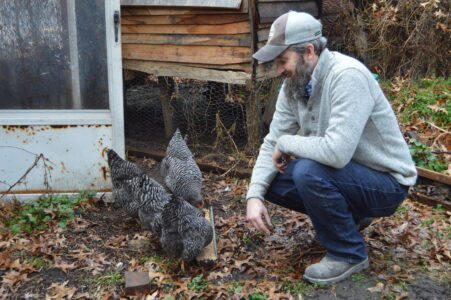
Despite living downtown, animals are still a possibility, McKeegan noted, adding that he's had the pleasure of goat-sitting for a fellow downtown resident. He himself has a handful of barred Plymouth rock chickens living in a backyard coop.
McKeegan said he appreciates the farming community's willingness to help each other, being willing to share equipment and expertise.
"It becomes a lot easier when you have a lot of people who are doing the same thing," he said.