
Descendants of Steubenville World War I airman sought
Trending
STEUBENVILLE -- For Veterans Day, volunteers behind the Jefferson County Historical Association's museum on Franklin Avenue invited area residents to learn more about the many local veterans who have served in conflicts dating back to the Civil War, including one whose final chapter may not have been written.
Linda Hilty, a member of the group's board of directors, said they were contacted recently by a national group hoping to confirm the remains of Kenyon Roper, a Steubenville native whose plane is believed to have been shot down over France during World War I.
Taking its name from a nickname given to many soldiers during World War I, the Doughboy Foundation states its mission is to locate and identify the final resting places of U.S. troops who had been declared missing in action during the international conflict.
The group notes the remains of as many as 1,697 fallen soldiers have been buried in American cemeteries abroad under headstones inscribed with "Here Lies in Honored Glory an American Soldier Known but to God."
That includes Kenyon Roper, a captain with the Army Air Service, a forerunner of the Air Force.
Military officials believe Roper was aboard a Salmson 2-A-2, a French biplane used for reconnaissance missions, when it was shot down by German aircraft over France.
Hilty said Roper applied his skills as a photographer in collecting, from the air, images of enemy territory for use as military intelligence.
The Doughboy Foundation has found record that in 1918, Roper flew 29 missions during a six-week period, including one in which he and 1st Lt. Paul "Huggy" Hughey, his frequent pilot, shot down an enemy aircraft to rescue another Salmson.
In letters to his family, Roper wrote they had shot down three others while behind enemy lines, and it was common for such encounters to go undocumented.
Roper was with Hughey on Sept. 14, 1918, when their plane departed for another recon mission, never to return.
Military officials later found near the community of Tronville in Northeastern France, a grave with a marker inscribed with German words meaning "Here lay two American airmen."
Exhuming the remains, they found one badly burned, unrecognizable corpse and another wearing underwear on which was printed the initials "K.R."
Later they reported encountering a boy with a handkerchief, likely discarded by German souvenir hunters, on which was printed Roper's name.
The Doughboy Foundation reports Roper's parents were not convinced, having been told initially their son had been captured by the Germans and taken to one of their field hospitals.
George Roper Sr. argued that his son's name had been stitched inside his clothing, and while visiting the crash site, that aircraft parts found there did not belong to a Salmson. There also appeared to be discrepancies between the remains and Kenyon's dental records.
The military transferred the two corpses to St. Mihiel American Cemetery, where they identified Hughey's remains as such while marking the grave for the other as an "Unknown Aviator."
Hilty said the Doughboy Foundation seeks a descendant of Kenyon Roper in hopes of facilitating a DNA match that would allow government officials to confirm or refute his burial site.
She added the group also is interested in photos and a diary at the museum that had belonged to Kenyon.
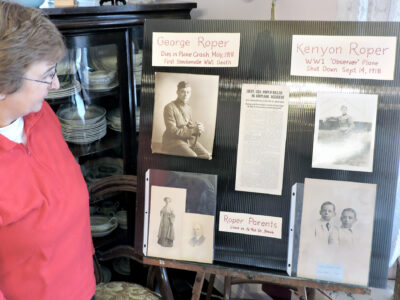
Glued into brittle albums, his many black-and-white photos offer a look at life in the military and off-duty.
Hilty noted the well-worn journal includes entries through much of his service, from December 1917, when he was preparing for deployment to France, to his final written comments on Sept. 13,1918.
Hilty noted George and Jean Kinsey Roper had experienced tragedy as recently as May 25 of that year when their first son, George Jr., was killed in an airplane accident over France.
Dennis Milko, another member of the Jefferson County Historical Association, noted George Jr. had enlisted in Great Britain's Royal Flying Corps, receiving his training in Canada before the U.S. entered the war.
He and Hilty noted that in the days before World War II, it was known as the Great War, and the museum has medallions that were presented to local veterans reflecting that.
The museum also has a clipping from an unidentified newspaper that reported the Ropers received a cablegram from London saying George Jr. had been participating in a practice flight when his plane crashed.
Kenyon, who had obtained a 10-day leave of absence to visit his brother, witnessed the fatal accident.
The Doughboy Foundation said George Jr.'s plane was said to have been very low to the ground when it was hit by a strong wind, causing it to flip over, spin into the ground and burst into flames.
The news article described George Jr. as "one of Steubenville's most popular young men" with a "legion" of friends.
The Doughboy Foundation notes the brothers were students at Massachusetts Institute of Technology when they enlisted.
Both were graduates also of Steubenville High School, and the family lived in a house on a lot now occupied by the parking lot for St. Peter Catholic Church on North Fourth Street, noted Hilty.
Milko said their father had owned an underwear factory downtown.
The association is encouraging descendants of the Ropers interested in helping the Doughboy Foundation to call (740) 283-1133.